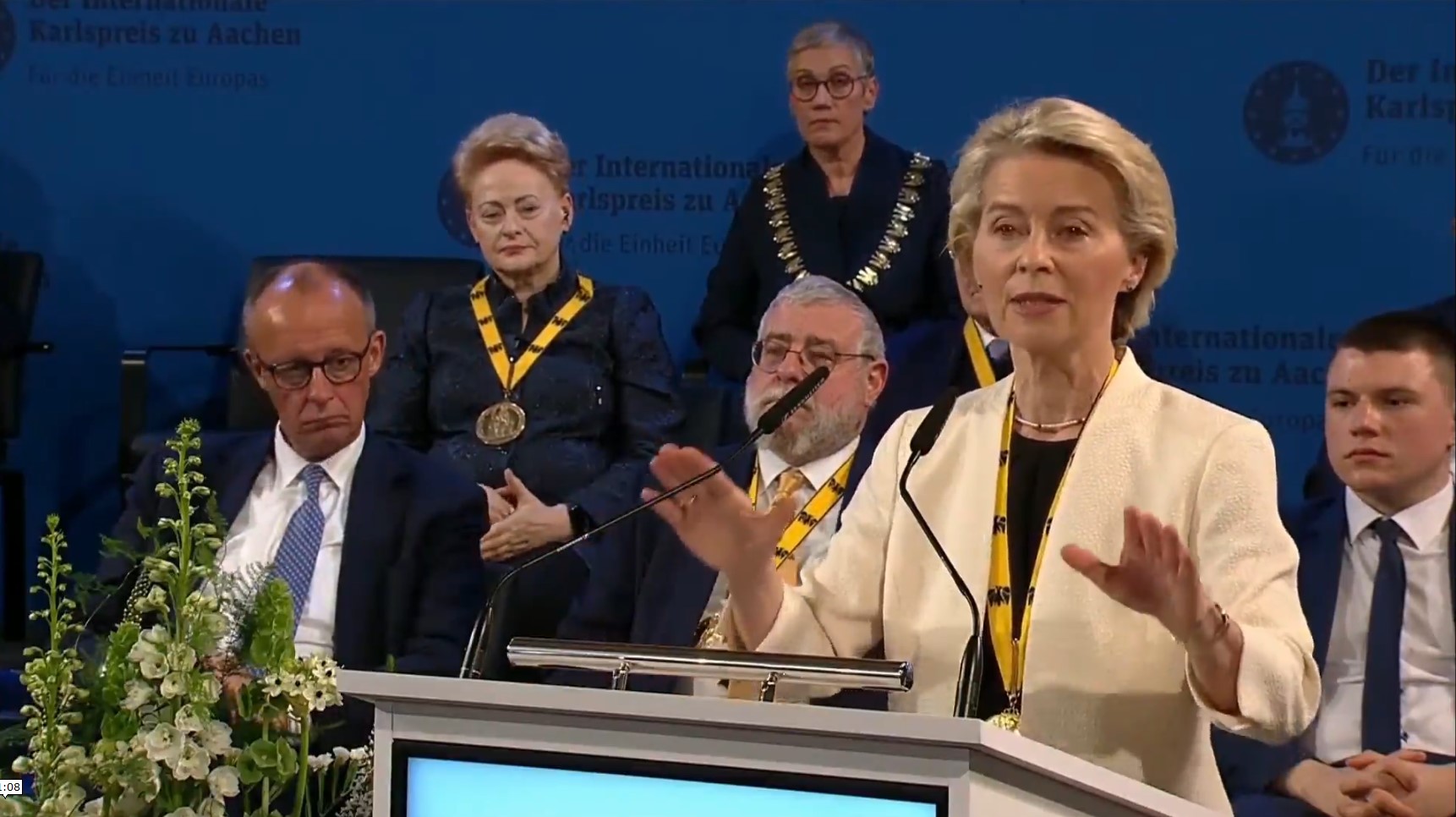
رئيسة المفوضية الأوروبية أورسولا فون دير لاين تلقي خطاباً مؤثراً عند تسلمها جائزة شارلمان الدولية في آخن.
播放器加载中....
欧盟委员会主席冯德莱恩荣获亚琛国际查理曼奖发表震撼人心的演说
President of the European Commission Ursula von der Leyen delivers a powerful speech upon receiving the International Charlemagne Prize of Aachen
播放器加载中....
La présidente de la Commission européenne, Ursula von der Leyen, prononce un discours poignant lors de la remise du Prix international Charlemagne d’Aix-la-Chapelle
播放器加载中....
Председатель Европейской комиссии Урсула фон дер Ляйен произнесла вдохновляющую речь при вручении Международной премии Карла Великого в Ахене
播放器加载中....
La presidenta de la Comisión Europea, Ursula von der Leyen, pronunció un discurso conmovedor al recibir el Premio Internacional Carlomagno de Aquisgrán
Celebrity Media Editor’s Note: In early April 2025, a fierce military clash broke out between India and Pakistan near the Line of Control in Kashmir, resulting in casualties and a deteriorating regional security situation. The conflict quickly drew significant concern from members of the United Nations Security Council and the international community. U.S. President Donald Trump intervened urgently and facilitated a temporary ceasefire agreement between the two parties, momentarily easing the risk of war. UN Secretary-General António Guterres also called on both sides at the earliest moment to exercise restraint and return to dialogue, emphasizing the importance of resolving disputes through peaceful means.
At this critical juncture, veteran international journalist Ahmed Fathi, who has long been active at the United Nations News Centre, conducted an exclusive interview at UN Headquarters with the Permanent Representative of Pakistan to the UN. The in-depth discussion covered the origins of the conflict, the diplomatic maneuvering, and the role of multilateral mechanisms. The interview was subsequently compiled and written into a special report by Mr. Ahmed Fathi, which we are honored to republish in full.
To ensure accessibility and fairness of information, the Celebrity Media Network AI Technology Division has translated the interview video into all six official UN languages—Arabic, Chinese, English, French, Russian, and Spanish—and released it globally. This not only reflects our media’s commitment to balanced discourse but also provides the international community with diverse perspectives to better understand the situation in South Asia.
As Mr. Fathi stated at the close of the interview, “I hope to bring you India’s perspective next.” He further remarked, “The path forward requires hearing both sides. We will continue to present each party’s stance and vision in a complete and truthful manner, so that the possibilities for peace may grow through deeper understanding.”
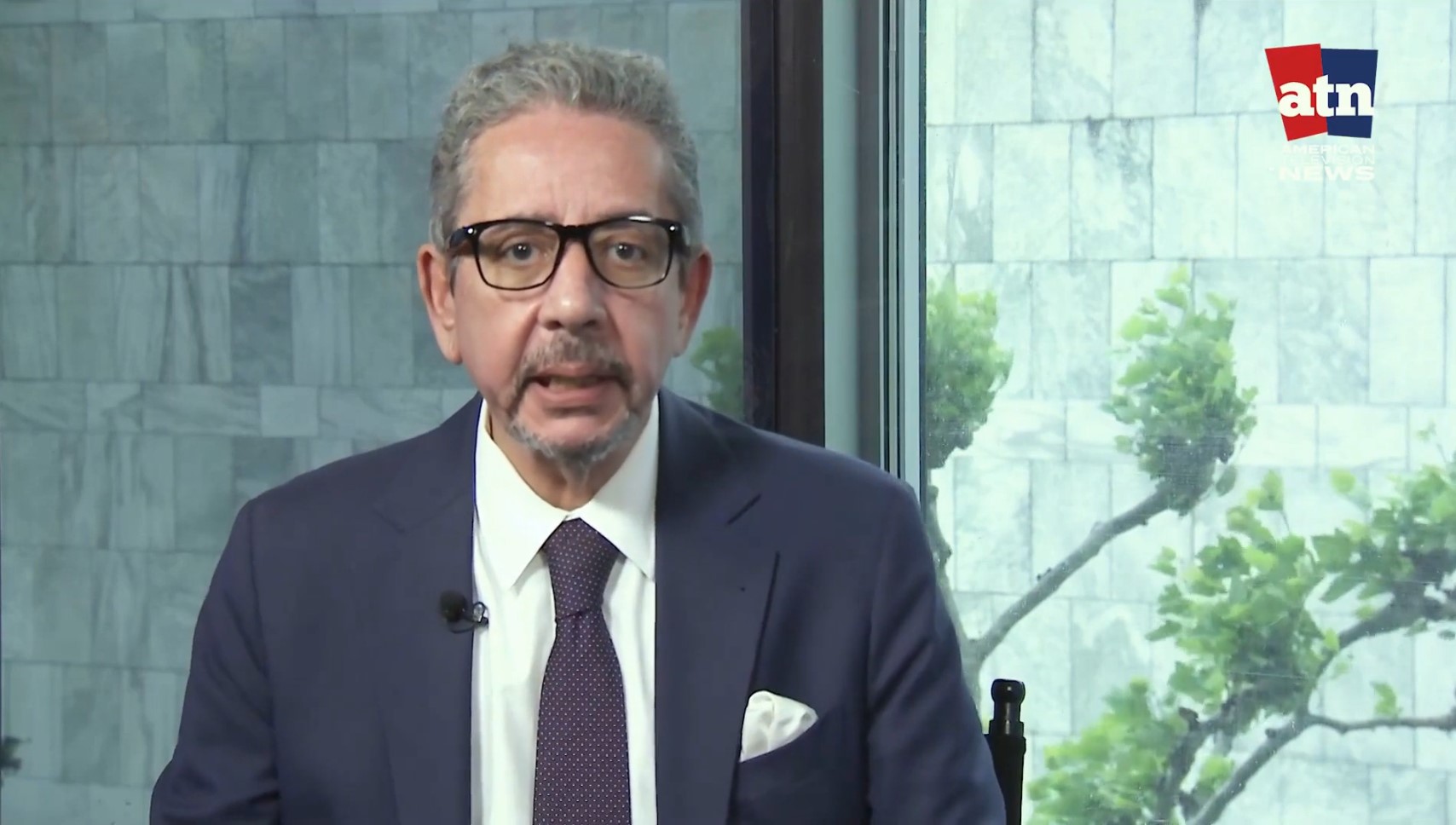
Ahmed Fathi, President of ATN American Television News and an Egyptian-American journalist, has long traversed the five continents. From conflict zones in the Middle East to the European Parliament, from impoverished communities in
South America to innovation hubs in East Asia, his reporting has never stopped at the surface of “facts” but constantly explores the deeper “meaning” behind them.
Ahmed Fathi:Exclusive-No Dialogue, No Peace: Inside Pakistan’s Diplomatic Stand at the UN
Exclusive Interview with Permanent Representative of Pakistan to the United Nations, Ambassador Asim Iftikhar Ahmad over the India-Pakistan Crisis
UNITED NATIONS, New York — As regional tensions surged following the April 22 terrorist attack in Indian-administered Kashmir, Pakistan’s top diplomat to the United Nations offered a detailed defense of Islamabad’s position, calling for an impartial investigation, adherence to international law, and a return to structured dialogue with India—potentially with third-party facilitation.In an exclusive interview, Ambassador Asim Iftikhar Ahmad, Permanent Representative of Pakistan to the United Nations, rejected Indian allegations that Pakistan-based groups were behind the attack and criticized what he described as a premature military response by New Delhi.“This was a terrorist incident, and Pakistan condemned it along with the international community,” Ambassador Ahmad said. “But accountability cannot be achieved without evidence, investigation, and legal process. Allegations alone are not a basis for action.”
Escalation and Retaliation
On May 6, India launched airstrikes across the Line of Control, describing them as counterterrorism operations. Pakistan responded with its own military action. Ambassador Ahmad asserted that Pakistan’s actions were taken under the right of self-defense, as enshrined in Article 51 of the UN Charter.“Their actions violated Pakistan’s sovereignty,” Ahmad said. “Our response was proportional and lawful under international norms. There is no provision in international law for unilateral armed strikes based on assumption.”
Ceasefire: Turning Point or Temporary Pause?
A U.S.-brokered ceasefire followed the military exchange. While acknowledging the role played by Washington and other international actors, the ambassador warned that such truces would be fragile without political will.“We welcome the ceasefire,” Ahmad said. “But it cannot simply be a pause. Remarks by Indian leadership suggesting it’s temporary are unhelpful. We need to move toward a sustainable peace process.”
Humanitarian Concerns and Civilian Harm
Ahmad also expressed grave concern over the impact of military escalation on civilians near the Line of Control.“Over 30 civilians were killed, and dozens injured in the first wave of strikes,” he stated. “Pakistan’s response targeted only military sites, but India’s actions endangered civilian lives and even disrupted international commercial air traffic.”He emphasized that Pakistan has always sought to minimize harm to civilians and called on both sides to reestablish humanitarian protocols to avoid future escalations.
Treaties Under Strain: Indus Waters and Simla
The ambassador addressed India’s suspension of the Indus Waters Treaty and Pakistan’s reassessment of the Simla Agreement, both long-standing mechanisms for managing bilateral disputes.“India’s move to place the Indus Treaty in abeyance is a violation of international law and the Vienna Convention on treaties,” Ahmad said. “There is no legal provision for such unilateral suspension.”
While clarifying that Pakistan has not suspended the Simla Agreement, he noted that Islamabad is reviewing its options as bilateral mechanisms have failed to deliver stability.
Call for Multilateral Engagement
Ahmad indicated a growing openness from Pakistan toward multilateral or third-party involvement in resolving long-standing disputes, including Kashmir.
“Bilateral dialogue is effectively frozen,” he said. “India suspended it over a decade ago. Yet it insists on resolving everything bilaterally—while refusing to engage. That contradiction has blocked progress.”Pakistan, he said, remains open to facilitation by the United Nations, the United States, or other international actors.“If bilateral paths are closed and mediation is rejected, what is left? Pakistan welcomes international facilitation. The door is open on our side,” he emphasized.
Kashmir and the Road Ahead
Ahmad identified Kashmir as the central unresolved issue preventing lasting peace between the two nations.“This is an international dispute under Security Council resolutions,” he said. “It must be resolved in line with international law, and more importantly, the will of the Kashmiri people.”He called on the global community to recognize that sustainable peace in South Asia depends on addressing root causes—not merely managing symptoms.“The current ceasefire is a starting point,” he concluded. “But unless we engage in honest, structured dialogue, we will continue to return to the brink every few years.”
Awaiting India’s Response
The interview concluded with a renewed appeal for balanced dialogue. “I hope to bring you the Indian perspective next,” Fathi said. “The path forward requires hearing both sides, and we remain committed to presenting them in full.”
UN Secretary-General António Guterres has strongly condemned the “appalling killing” of two Israeli embassy officials in the United States capital, stressing that “nothing can justify such a horrific act,” his Spokesperson said in a statement on Thursday.
The diplomats were gunned down on Wednesday night as they left an event at the Capital Jewish Museum in central Washington DC, where the American Jewish Committee was hosting a reception.
They were identified as Yaron Lischinsky, 30, and Sarah Milgrim, 26, who were about to be engaged, according to officials and family members. A suspect was taken into custody.
Justice and sympathy
“The Secretary-General reiterates his consistent condemnation of attacks against diplomatic officials,” the statement said.
He called for the perpetrator to be brought to justice and extended his sympathies to the families and loved ones of the victims and to the Government of Israel.
The lone suspect, identified as Elias Rodriguez from Chicago, was apprehended shortly after the murders.
He shouted pro-Palestinian slogans while in custody, according to media reports.
A ‘heinous antisemitic act’
The head of a UN platform that promotes intercultural dialogue and understanding also voiced his strong condemnation.
“This heinous antisemitic act is unacceptable and unjustifiable. My thoughts go to their families, their colleagues, and the State of Israel,” said Miguel Ángel Moratinos, High Representative for the United Nations Alliance of Civilizations (UNAOC).
Virginia Gamba, Acting UN Special Adviser on the Prevention of Genocide, called for an end to antisemitism saying “there is no place in the world where such a horrific antisemitic hate crime as the murders of Mr. Yaron Lischinsky and Miss Sarah Milgrim can be justified.”
Senior politicians from across the world have also expressed their condemnation.
The killings occurred against the backdrop of the war in Gaza, which began on 7 October 2023 following Hamas-led attacks on Israel which left roughly 1,200 people dead while another 250 were taken hostage. More than 53,000 Palestinians have been killed in Gaza, according to the health authorities.
Israeli foreign minister Gideon Sa’ar described the attack as “the direct consequence of the virulent and toxic antisemitic rhetoric against Israel and Jewish communities around the world that has been going on since October 7.”
‘An unbearable loss’
Mr. Lischinsky was a research assistant in the political department at the Israeli Embassy in Washington while Ms. Milgrim organized trips to Israel, according to media reports.
They were killed after attending the American Jewish Committee's annual Young Diplomats reception which this year focused on response to humanitarian crises throughout the Middle East and North Africa.
The Spokesperson of the Israeli Embassy in Washington, Tal Naim, described their deaths as “an unbearable loss.”
She tweeted a photo of the couple below a message which said that “instead of walking you down the aisle, we are walking with you to your graves.”
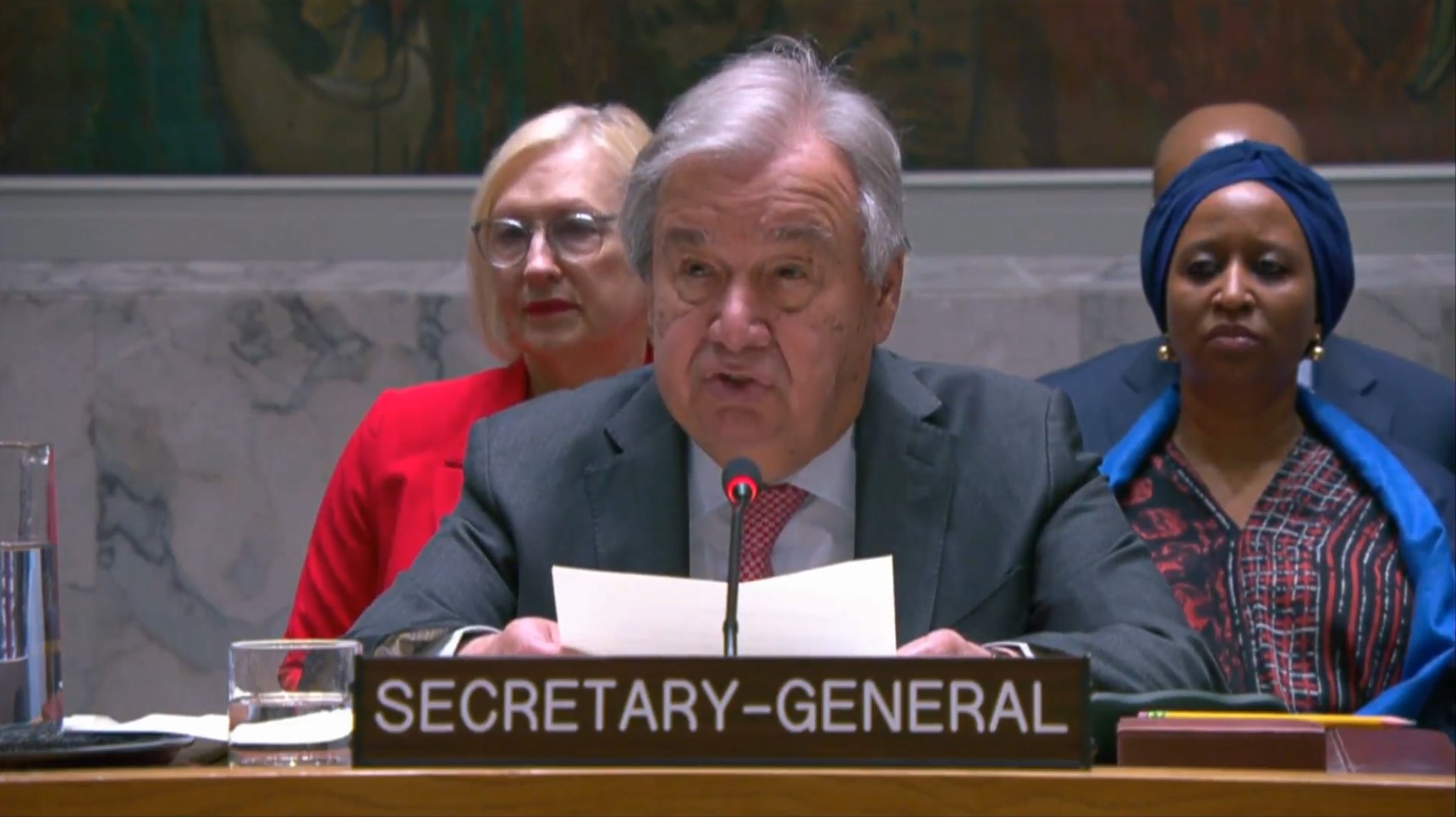
قال الأمين العام للأمم المتحدة أنطونيو غوتيريش: "بدون الأمن البحري، لا يمكن أن يكون هناك أمن عالمي."
اللغة السادسة – العربية – تُكتب من اليمين إلى اليسار。
播放器加载中....
联合国秘书长安东尼奥·古特雷斯表示:“没有海上安全,就没有全球安全。
播放器加载中....
UN Chief Antonio Guterres said:“Without maritime security, there can be no global security”
播放器加载中....
Le Secrétaire général de l’ONU, Antonio Guterres, a déclaré : « Sans sécurité maritime, il ne peut y avoir de sécurité mondiale. »
播放器加载中....
Генеральный секретарь ООН Антониу Гутерриш заявил: «Без морской безопасности не может быть глобальной безопасности.»
播放器加载中....
El Secretario General de la ONU, Antonio Guterres, dijo: “Sin seguridad marítima, no puede haber seguridad global.”







 © Wiki/Ajay Suresh The Capital Jewish Museum is a historical society and museum in Washington, D.C.