- Details
-
Category: English Media
-
Published: Wednesday, 07 August 2024 20:46
-
Written by Eager

Nuclear armed and allied governments that are parties to the NPT should replace their reliance on nuclear deterrence with common security, according to Pursuing Peace, Security and Nuclear Disarmament through our Common Humanity, a joint Inter-faith and Values Appeal to the 2024 Nuclear Non-Proliferation Treaty Prep Com. The Appeal, which was presented on July 23 to the governments meeting at the UN in Geneva, was endorsed by more than 80 faith-based organizations and an additional 190 faith and values based leaders and individuals.
States Parties to the Nuclear Nonproliferation Treaty (NPT) met at the United Nations in Geneva from July 22-August 2 to discuss nuclear-risk-reduction, non-proliferation and disarmament. The conference took place in a time when the world is embroiled in devastating armed conflicts, an erosion of multilateralism and the rule of law, increased risks and specific threats to use nuclear weapons, and a renewed nuclear arms race.
“Nuclear deterrence violates key principles and values underlying all the major religions and faiths, including justice, fairness, reciprocity, guardianship/stewardship, protection of creation (the world), common humanity, social responsibility, human dignity and respect,” says Bruce Knotts (Unitarian, USA), Co-convenor of the World Federalist Movement working group on faith and values based perspectives which has coordinated the appeal. “These principles and values are similar to the basic tenets of international law, and if utilized better, could help governments to collectively navigate toward a peaceful and sustainable future.”
The Appeal makes five concrete recommendations arising from these principles to the governments meeting at the NPT conference in Geneva, including to:
- Prevent nuclear war and protect creation (the world) by affirming that the threat or use of nuclear weapons is inadmissible and illegal, and to implement this by adopting no-first-use policies and taking all nuclear weapons off high-readiness to use (high alert);
- Embrace reciprocity and the ‘Golden Rule’ (treat others the way you would want them to treat you) by replacing nuclear deterrence with a common security framework, i.e. one that does not threaten or diminish the security of others but ensures security for all.
- Affirm our common humanity through enhanced use of global governance mechanisms such as the International Court of Justice and the United Nations to resolve international conflicts, build national security and achieve nuclear disarmament.
- Acknowledge our social responsibility by ending investments in nuclear weapons (over $100 billion per year) and re-purposing these investments to address basic human needs.
- Implementing our responsibilities as guardians of the earth for future generations by committing to achieve the global elimination of nuclear weapons no later than the 75th anniversary of the NPT.
“We are heartened that the appeal has been endorsed by faith and values based individuals and organizations from all continents (except Antarctica) and from a wide variety of traditions including Bahá’i, Buddhist, Christian, Hindu, Humanist, Islam, Jain, Jewish, Pagan, Quaker, Sikh, Unitarian, Zoroastrian and more,” says Ayleen Roy (Hindu, Austria) a representative of the WFM working group who presented the appeal to a plenary session of the NPT conference on July 23.

Ayleen Roy, Member of the Transnational Working Group on Values, faith-based perspectives and global governance, presenting the appeal to the States Parties of the NPT at the United Nations in Geneva
“We hope that the governments will appreciate the positive and forward-looking recommendations we are presenting, and will take action on them.”
END
Quotes by some of the other endorsers:
“Nuclear weapons are one of two existential threats facing humanity; the other is climate change. People of faith and goodwill must unite in the face of this devastating and growing threat to all people and our world.”
Dr. Stephen M. Colecchi (Christian, USA)
Retired Director, International Office of Justice and Peace, U.S. Conference of Catholic Bishops
“Treaty action must be complemented by the higher values of our faith traditions to treat all the members of our human family with justice, forgiveness and love on this fragile planet.”
Arthur Lyon Dahl (Bahá’í, Switzerland).
International Environment Forum
“As a life-long Peace activist, I affirm the NPT for the sake of my grand nieces and nephews and for the future of all our CHILDREN”
Sister Mary Beth Moore (Catholic, USA)
Member of Pax Christi Long Island
“The criminal nature of nuclear weapons is clearly established under the law, both the law of nations and the US Law of Land Warfare among others.”
Kary Love (Humanist, USA)
Attorney at Law who has represented nuclear disarmament activists in US court actions.
“As a grandmother it is obscene to me that $90 billion is spent annually on the development of nuclear weapons, the sole purpose of which is destruction, when that sum could be used to alleviate so many of the problems currently faced by humanity and the planet we live on. The state of the world we arehanding on to future generations is something I am deeply ashamed of.”
Nancy Gregory (Quaker, New Zealand)
“In our troubled times, life-affirming principles such as expressed in this Appeal deserve wide support. They relate, in important ways, to freeing the world from the dangers of weapons of mass destruction, to improved global governance, and respecting the rights of future generations.”
Francis Hutchison (Ecumenical/ Humanist, Australia)Member, Human Survival Project & International Network of Museums for Peace
“I give voice to the outraged protest of Christian conscience, and I proclaim … that all men whatever their race or religion, have the right to be respected by individuals and by states.”
Bénédicte Kusendila, (Catholic, Belgium) citing Pierre-Marie Théas in 1942, POW and co-founder of Pax Christi.
Peace Spirituality, Pax Christi Vlaanderen
“It is impossible to imagine Jesus of Nazareth sponsoring or using Nuclear Weapons.”
Jonathan Hartfield (Anglican, New Zealand)
Convenor, Anglican Pacifist Fellowship New Zealand
“Even Animals do not deserve to be killed by nuclear weapons how much more human beings. No to Nuclear weapons.”
Hashim Yussif (Muslim, Ghana)
Progressive Democrats Association of Ghana
“I am glad my Church, and faiths worldwide, are starting to question whether war can ever be just. There can never be a just use for nuclear weapons. They should not exist.”
Mary Johnson (Catholic, USA)
“To see the level of international and inter-faith support endorsing the Interfaith Appeal to the NPT gives further confidence in humanity’s ability to achieve our aim of a world without nuclear weapons.”
Bill Kidd MSP (Humanist, Scotland)
Co-President of Parliamentarians for Nuclear Nonproliferation and Disarmament
“Pursuing peace and justice through Common Security, not nuclear weapons, is fully aligned with my values as a humanist”
John Vlasto (Humanist, UK)
Chair of the World Federalist Movement
“We have the privilege to consciously take bold and inspired actions that can touch the hearts of so many people in our global community. Take this courageous step, now!”
David Wick (Interfaith, USA).
President, Pathways To Peace
“It cannot be overemphasized that Article VI’s “good faith” must apply not only to “disarmament” but also “non-use/threat”.
Aaron Tovish (Good Faith, Philippines)
Member, NoFirstUse Global Steering Committee
“With 5 major wars and 33 other conflicts killing 300,000 people a year, and 1.5% of world population displaced we need to wake up as a species and demand peace and cooperation.”
Michael Leggett (Christian, UK)
Member of Churches Together in Redhill and District. Member, Reigate and Redhill Campaign for Nuclear Disarmament (Surrey)
“As we reach what the French philosopher Sartre called the self-suicide with the nuclear era,it is more than timely for Humanity to be consciously more prone to rush to the ban of nukes!”
Dr Larrafi (Muslim, Morocco)
Senior Lecturer at University Ibn Tofail
“The era of senseless religious wars is over. Intrinsically, all religions promote peaceful coexistence. We, the practitioners of world religions, are the problem – not the religions. We have invented all sorts of weapons to destroy humanity, including nuclear weapons, which don’t have a place in religious principles or today’s world.”
Alimi Salifou (Muslim, Nigeria)
Partnership for Future Generations in Africa / iRelief Waqf Foundation
“We urge the leaders of the eight billion humans of the world to honour our relationship with all the diverse life on this blue speck in space, that they strive for peace in wakeful community across our global home.”
Jon Grundy (Druid, UK)
Trustee of The Druid Network
“Expanded scientific evidence-based perception of the nature of reality endorses the worldviews of ancient and indigenous knowledge holders in the recognition of our interbeing. It empowers us to envision an ecological civilization, where the structure and values of our governance and economic systems are in service to all Life that model loving care and respect, resulting in the realization of a Culture of Peace.”
Dr. Elena Mustakova (Bahá’i, Bulgaria)
Chair, Unitive Global Governance Collaborative of Thought Leaders
“We, the human race, pride ourselves on being an advanced species. Yet, no other species on this planet undertakes an action to harm our living home. Collectively we have been failing each other, our future generations and other creatures we share this planet with for our narrow selfish or individual interests. We live interconnected lives. Truth and justice that lives through us all should help us become courageous to step beyond those narrow interests, even when we are not personally affected to remind us we are all the same; many parts of a whole. May we become wiser, so that we may all have a future.”
Radhiga Dey (Mystic, Australia) World Citizens Association Australia
“We live in a historic moment of escalating military confrontation and investment in nuclear weapons modernisation – which last year reached $91.4 billion. This contributes to the threatening rhetoric for world peace, while at the same time we are witnessing the fracturing of dialogue and multilateral action. Peace is about generating options for good living”.
Montse Serrano (Catholic, Spain)
Comisión General Justicia y Paz (General Commission for Justice and Peace).
“No more war, never again war!”
Dolores Hall, DMin (retired), citing Pope Paul’s comments to the UN
“We live in an age of anger and war. Military activity has significant impacts on the environment adding to the climate crisis narrative. Not only can nuclear weapons be destructive to the socio-environment, planet and human rights but military activities produce extensive amounts of greenhouse gases and carbon emissions contributing to climate change. These all affect youth, their future, their livelihoods and basic human rights. History has taught humanity tough lessons on war and nuclear weapons will leave a trail of destruction that could not only destroy the very fabric of peace but the heart of humanity and the earth. We all are interconnected, and our decisions and actions have an impact on the whole. Let us make decisions and actions that is with ethical leadership that benefits the welfare of humanity, the earth and its creatures.”
Merylene Chitharai (Hindu, South Africa)
Member, Religions for Peace International, Global Interfaith Youth Network, African Interfaith Youth Network and African Council of Religious Leaders.
“We advocate for peace, security, and nuclear disarmament in the spirit of our shared humanity. This interfaith and values-driven appeal to the 2024 Nuclear Non-Proliferation Treaty Prep Com embodies our collective determination to create a world where compassion prevails over conflict and unity conquers division. Together, we can light the way to a future free from the threat of nuclear weapons, a future where the bonds of our common humanity strengthen the foundation of global peace.”
Terhemba Akende Ubula (Christian, Nigeria)
House of Hilkiah Foundation
“Nuclear weapons are an existential threat to humanity, and we need to get rid of them before they get rid of us. The Nuclear Non-Proliferation Treaty (NPT) aims at 1) preventing new nations from acquiring nuclear weapons, and 2) setting the nuclear armed nations on the path of nuclear disarmament. The NPT has been reasonably successful at the first task, but has completely failed at the second. The Treaty for the Prohibition of Nuclear Weapons (TPNW) may provide a more hopeful path: it entered into force on 22 January 2021 and there are currently 93 signatories and 70 states parties.”
Dat Duthinh (Quaker, USA)
Member of Frederick Friends Meeting, Frederick MD
“We are commanded to beat swords into Plowshares. Let us all works towards establishing the Peaceable Kingdom.”
Pierre Fidelia (Catholic, USA)
Pax Christi Metro New York, Inc
- Details
-
Category: English Media
-
Published: Thursday, 25 July 2024 08:04
-
Written by Eager
Celebrity Media Commentator: Next year marks the 230th anniversary of Immanuel Kant's renowned essay "Perpetual Peace." Kant, the great German philosopher, proposed peace ideas in 1795 that continue to hold significant guidance today. In the face of the current severe global situation of war and nuclear threats, we need to reassess Kant's ideas and update and apply them according to the needs of the modern world.
Kant's core propositions include opposing standing armies, non-interference in other countries' internal affairs, and establishing a "league of free nations." Despite challenges in practicing some of Kant's views, his ideas on perpetual peace advanced international law, human rights, and decent conduct in wars in the 20th century.
In the past two decades, under the leadership of former Secretary-General Ban Ki-moon and current Secretary-General António Guterres, the United Nations, through their exceptional leadership and the tremendous dedication and hard work of UN officials at all levels, has become more cohesive and effective. The UN and international law have made significant achievements in preventing a third world war. However, the current global institutions need further upgrades to meet new challenges.
Firstly, we believe that the process of reforming the United Nations should be accelerated. As we mentioned recently, please click here.
Yesterday, Mr. Jeffrey Sachs sent us an email with ten principles of perpetual peace, which further underscores the necessity to expedite the UN reform process. This world needs perpetual peace, we need a future, and we need the United Nations!
Mr. Jeffrey Sachs stated, "To address the four key geopolitical realities of the modern world, we need to formulate a new set of perpetual peace principles based on Kant's ideas." We believe that these ten principles of perpetual peace are worth considering and adopting by today's national leaders and all peace-loving people worldwide. Therefore, we are specially reprinting Mr. Jeffrey Sachs' article as follows.
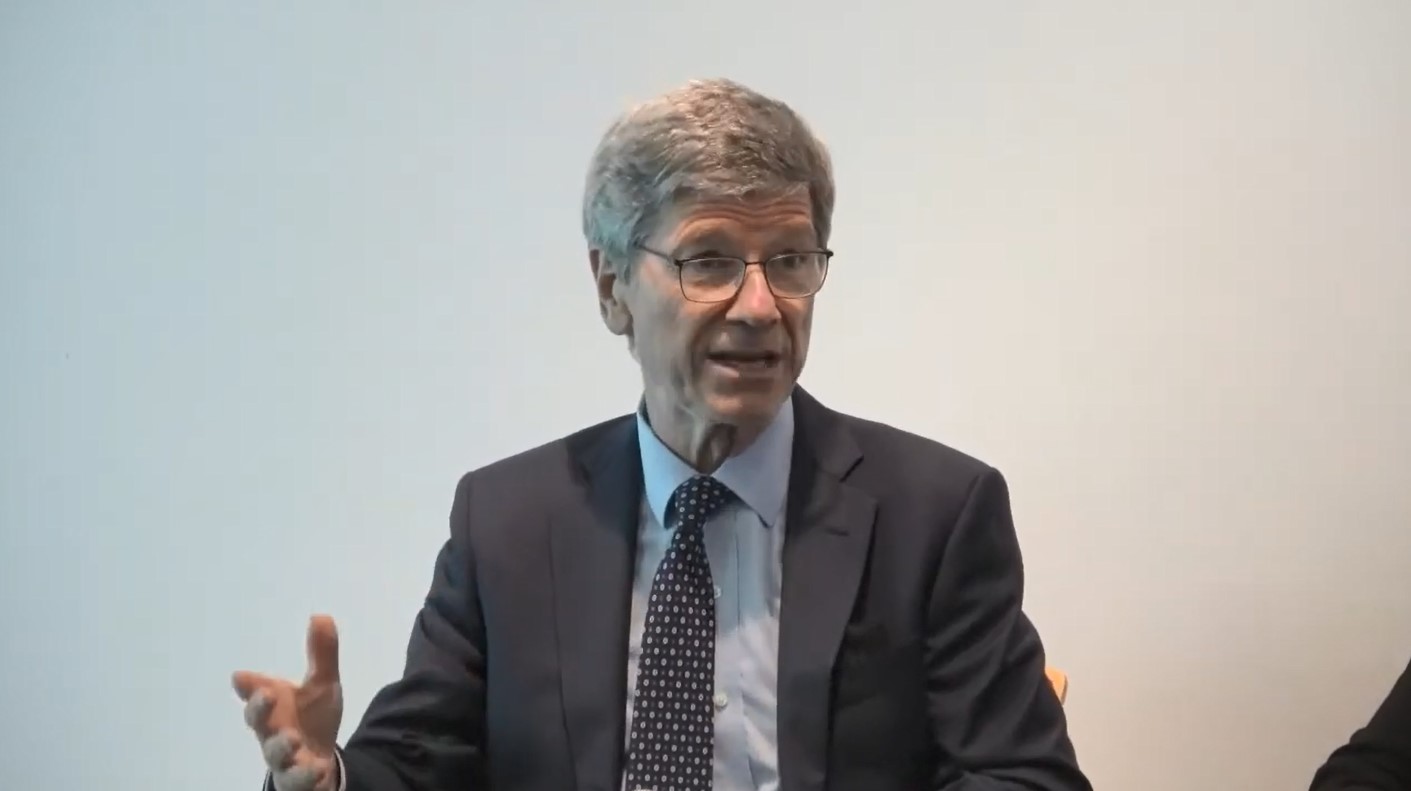
The United Nations-based structures are fragile and in need of an urgent upgrade; we should consider this one at the U.N. Summit of the Future in September.
Next year will mark the 230th anniversary of Immanuel Kant’s celebrated essay on “Perpetual Peace” (1795). The great German philosopher put forward a set of guiding principles to achieve perpetual peace among the nations of his day. As we grapple with a world at war, and indeed at dire risk of nuclear Armageddon, we should build on Kant’s approach for our own time. An updated set of principles should be considered at the United Nations Summit of the Future in September.
Kant was fully aware that his proposals would face the skepticism of “practical” politicians:
The practical politician assumes the attitude of looking down with great self-satisfaction on the political theorist as a pedant whose empty ideas in no way threaten the security of the state, inasmuch as the state must proceed on empirical principles; so the theorist is allowed to play his game without interference from the worldly-wise statesman.
Nonetheless, as historian Mark Mazower noted in his magisterial account of global governance, Kant’s was a “text that would intermittently influence generations of thinkers about world government down to our own day,” helping to lay the groundwork for the United Nations and international law on human rights, the conduct of war, and arms control.
Kant’s core proposals centered on three ideas. First, he rejected standing armies. Standing armies “incessantly menace other states by their readiness to appear at all times prepared for war.” In this, Kant anticipated by a century and a half the famous warning by U.S. President Dwight D. Eisenhower of the dangers of a military-industrial complex. Second, Kant called for non-interference in the internal affairs of other nations. In this, Kant inveighed against the kind of covert operations that the U.S. has used relentlessly to topple foreign governments. Third, Kant called for a “federation of free states,” which in our time became the United Nations, a “federation” of 193 states pledged to operate under the U.N. Charter.
Kant put great hopes on republicanism as opposed to one-person rule as a check on war-making. Kant reasoned that a single ruler would readily succumb to the temptation of war:
...a declaration of war is the easiest thing in the world to decide upon, because war does not require of the ruler, who is the proprietor and not a member of the state, the least sacrifice of the pleasures of his table, the chase, his country houses, his court functions, and the like. He may, therefore, resolve on war as on a pleasure party for the most trivial reasons, and with perfect indifference leave the justification which decency requires to the diplomatic corps who are ever ready to provide it.
By contrast, according to Kant:
...if the consent of the citizens is required in order to decide that war should be declared (and in this [republican] constitution it cannot but be the case), nothing is more natural than that they would be very cautious in commencing such a poor game, decreeing for themselves all the calamities of war.
Kant was far too optimistic about the ability of public opinion to constrain war-making. Both the Athenian and Roman republics were notoriously belligerent. Britain was the 19th century’s leading democracy, but perhaps its most belligerent power. For decades, the U.S. has engaged in non-stop wars of choice and violent overthrows of foreign governments.
There are at least three reasons why Kant got this wrong. First, even in democracies, the choice to launch wars almost always lies with a small elite group who are in fact largely insulated from public opinion. Second, and equally important, public opinion is relatively easy to manipulate through propaganda to stir the public backing for war. Third, the public can be insulated in the short term from the high costs of war by financing war through debt rather than taxation, and by relying on contractors, paid recruits, and foreign fighters rather than conscription.
Kant’s core ideas on perpetual peace helped move the world toward international law, human rights, and the decent conduct in war (such as the Geneva Conventions) in the 20th century. Yet despite the innovations in global institutions, the world remains dreadfully far from peace. According to the Doomsday Clock of the Bulletin of Atomic Scientists, we are 90 seconds to midnight, closer to nuclear war than at any time since the clock’s introduction in 1947.
The global apparatus of the U.N. and international law has arguably prevented a third world war to date. U.N. Secretary-General U Thant, for example, played a vital role in peacefully resolving the 1962 Cuban Missile Crisis. Yet the U.N.-based structures are fragile and in need of an urgent upgrade.
For this reason, I urge that we formulate and adopt a new set of principles based on four key geopolitical realities of our time.
First, we are living with the nuclear Sword of Damocles over our heads. President John F. Kennedy put it eloquently 60 years ago in his famous Peace Speech, when he declared:
I speak of peace because of the new face of war. Total war makes no sense in an age where great powers can maintain large and relatively invulnerable nuclear forces and refuse to surrender without resort to those forces. It makes no sense in an age where a single nuclear weapon contains almost 10 times the explosive force delivered by all the allied air forces in the Second World War.
Second, we have arrived at true multipolarity. For the first since the 19th century, Asia has overtaken the West in economic output. We are long past the Cold War era in which the U.S. and Soviet Union dominated, or the “unipolar moment” claimed by the U.S. after the demise of the Soviet Union in 1991. The U.S. is now one of several superpowers, including Russia, China, and India, with several regional powers as well (including Iran, Pakistan, and North Korea). The U.S. and its allies cannot unilaterally exact their will in Ukraine, the Middle East, or the Indo-Pacific region. The U.S. must learn to cooperate with the other powers.
Third, we now have an extensive and historically unprecedented set of international institutions for formulating and adopting global goals (e.g., regarding climate, sustainable development, and nuclear disarmament), adjudicating international law, and expressing the will of the global community (e.g., in the U.N. General Assembly and U.N. Security Council). Yes, these international institutions are still weak when the great powers choose to ignore them, yet they offer invaluable tools for building a true federation of nations in Kant’s sense.
Fourth, humanity’s fate is more tightly interconnected than ever. Global public goods—sustainable development, nuclear disarmament, protection of the Earth’s biodiversity, prevention of war, pandemic prevention and control—are far more central to our shared fate than at any previous time in human history. Again, we can turn to JFK’s wisdom, which rings as true today as then:
So let us not be blind to our differences, but let us also direct attention to our common interests and the means by which those differences can be resolved. And if we cannot end now our differences, at least we can help make the world safe for diversity. For in the final analysis, our most basic common link is that we all inhabit this small planet. We all breathe the same air. We all cherish our children’s futures. And we are all mortal.
What principles should we adopt in our time that could contribute to perpetual peace? I propose 10 Principles for Perpetual Peace in the 21st Century, and invite others to revise, edit, or make their own list.
The first five of my principles are the Principles of Peaceful Coexistence proposed by China 70 years ago and subsequently adopted by the Non-Aligned nations. These are:
1. Mutual respect of all nations for the territorial integrity and sovereignty of other nations;
2. Mutual non-aggression of all nations towards other nations;
3. Mutual non-interference by all nations in the internal affairs of other affairs (such as through wars of choice, regime change operations, or unilateral sanctions);
4. Equality and mutual benefits in the interactions among nations; and
5. Peaceful co-existence of all nations.
To implement these five core principles, I recommend five specific principles of action:
6. The closure of overseas military bases, of which the U.S. and U.K. have by far the largest number.
7. The end of covert regime-change operations and unilateral coercive economic measures, which are grave violations of the principle of non-interference in the internal affairs of other nations. (Political scientist Lindsey O’Rourke has carefully documented 64 U.S. covert regime-change operations during 1947-1969, and the pervasive destabilization caused by such operations.
8. Adherence by all nuclear powers (U.S., Russia, China, U.K., France, India, Pakistan, Israel, and North Korea) to Article VI of the Nuclear Non-Proliferation Treaty: “All Parties must pursue negotiations in good faith on effective measures relating to the cessation of the nuclear arms race and to nuclear disarmament, and on a treaty on general and complete disarmament under strict and effective international control.”
9. The commitment by all countries “not to strengthen their security at the expense of the security of other countries,” (as per the OSCE Charter). States will not enter into military alliances that threaten their neighbors, and commit to resolve disputes through peaceful negotiations and security arrangements backed by the United Nations Security Council.
10. The commitment by all nations to cooperate in protecting the global commons and providing global public goods, including fulfillment of the Paris climate agreement, the Sustainable Development Goals, and reform of U.N. institutions.
Today’s great power confrontations, notably the U.S. conflicts with Russia, China, Iran, and North Korea, are largely due to America’s continued pursuit of unipolarity via regime change operations, wars of choice, unilateral coercive sanctions, and the global network of U.S. military bases and alliances. The 10 principles listed above would help to move the world to peaceful multilateralism governed by the U.N. Charter and the international rule of law.
Jeffrey D. Sachs
Jeffrey D. Sachs is a Famous political commentator and economist,University Professor and Director of the Center for Sustainable Development at Columbia University, where he directed The Earth Institute from 2002 until 2016. He is also President of the UN Sustainable Development Solutions Network and a commissioner of the UN Broadband Commission for Development. He has been advisor to three United Nations Secretaries-General, and currently serves as an SDG Advocate under Secretary-General Antonio Guterres. Sachs is the author, most recently, of "A New Foreign Policy: Beyond American Exceptionalism" (2020). Other books include: "Building the New American Economy: Smart, Fair, and Sustainable" (2017) and "The Age of Sustainable Development," (2015) with Ban Ki-moon.






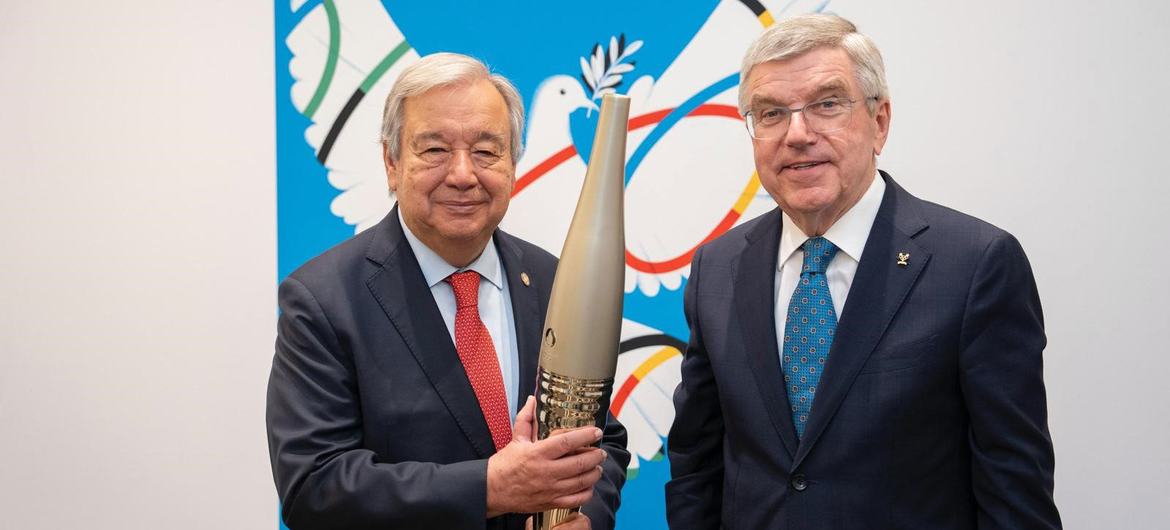 © IOC/Greg Martin UN Secretary-General António Guterres (left) and Thomas Bach, President of the International Olympic Committee (IOC), in Paris ahead of the opening of the Paris 2024 Summer Olympic Games.
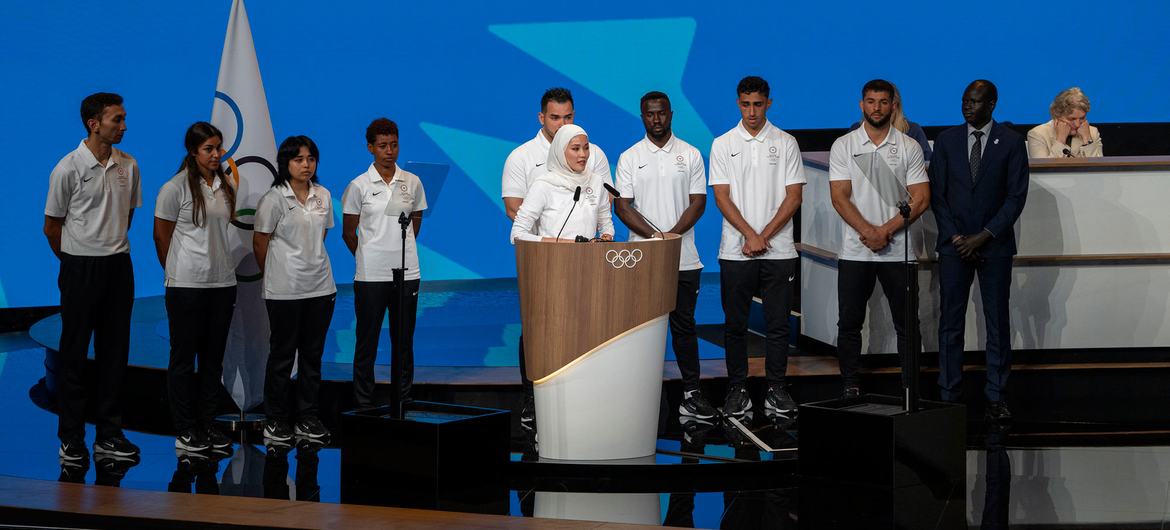 © IOC/Greg Martin The 2024 Refugee Olympic Team Paris is presented by Chef de Mission Masomah Ali Zada at the Palais des Congrès, Grand Amphithéâtre.