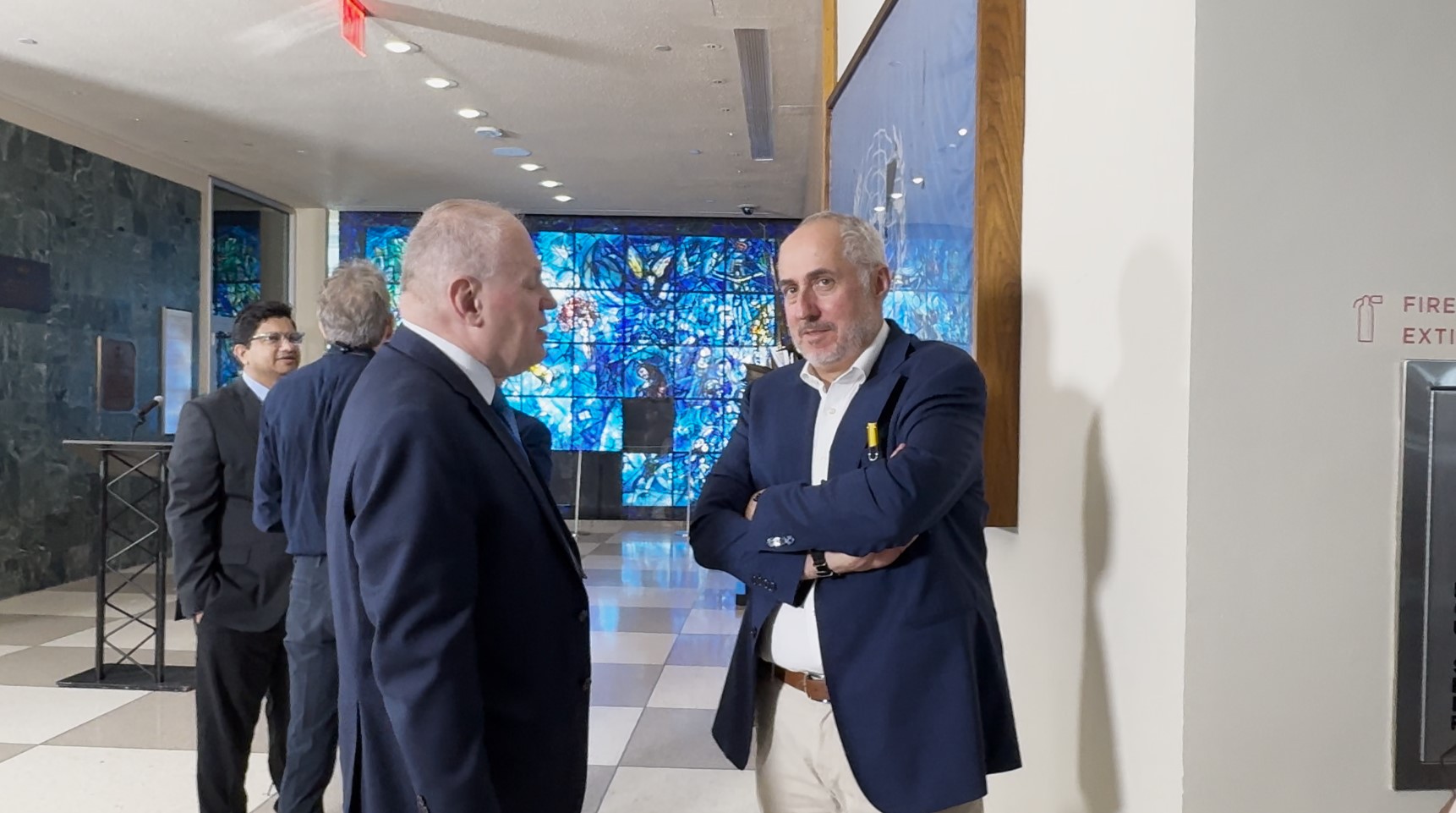
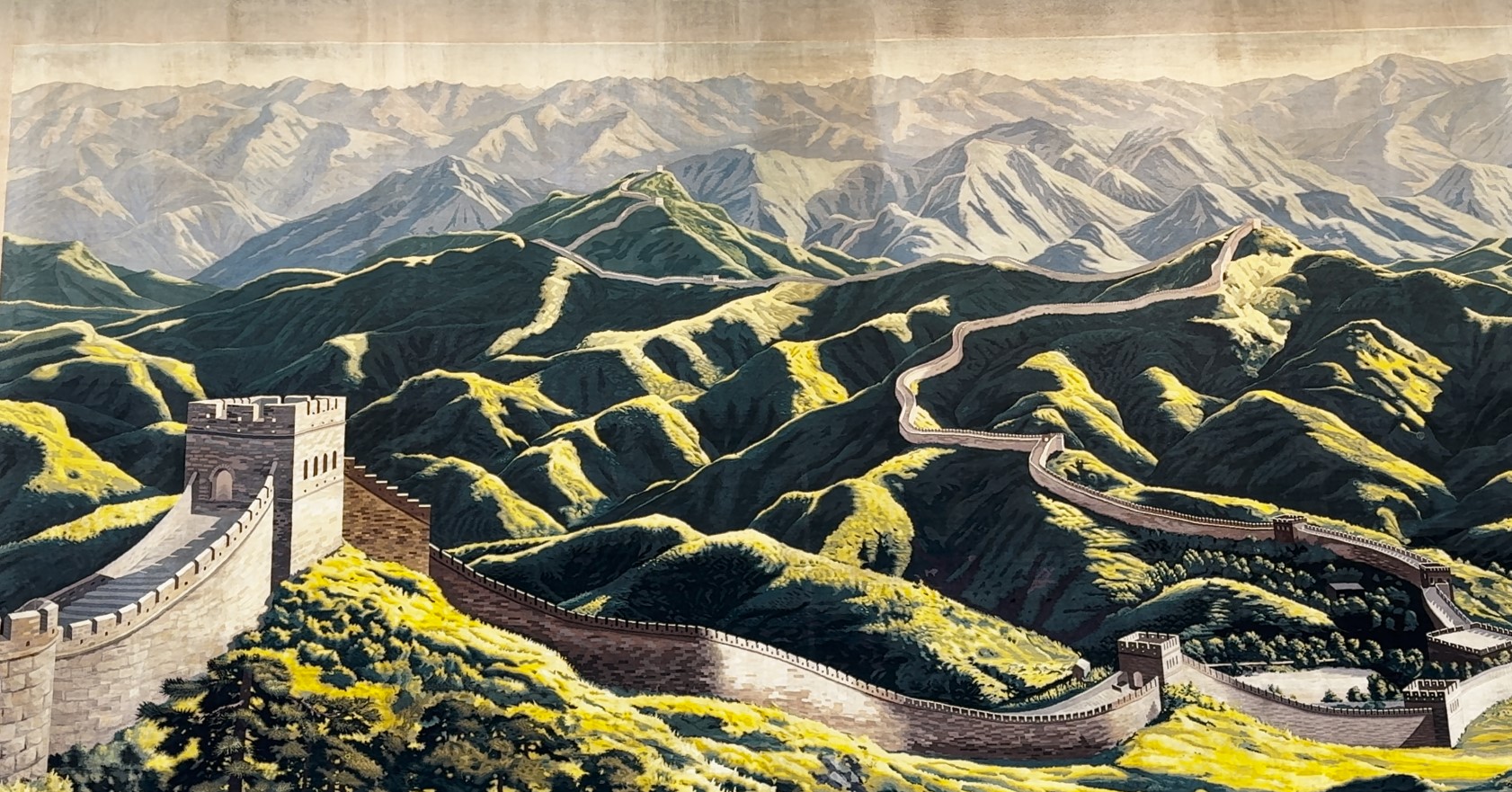
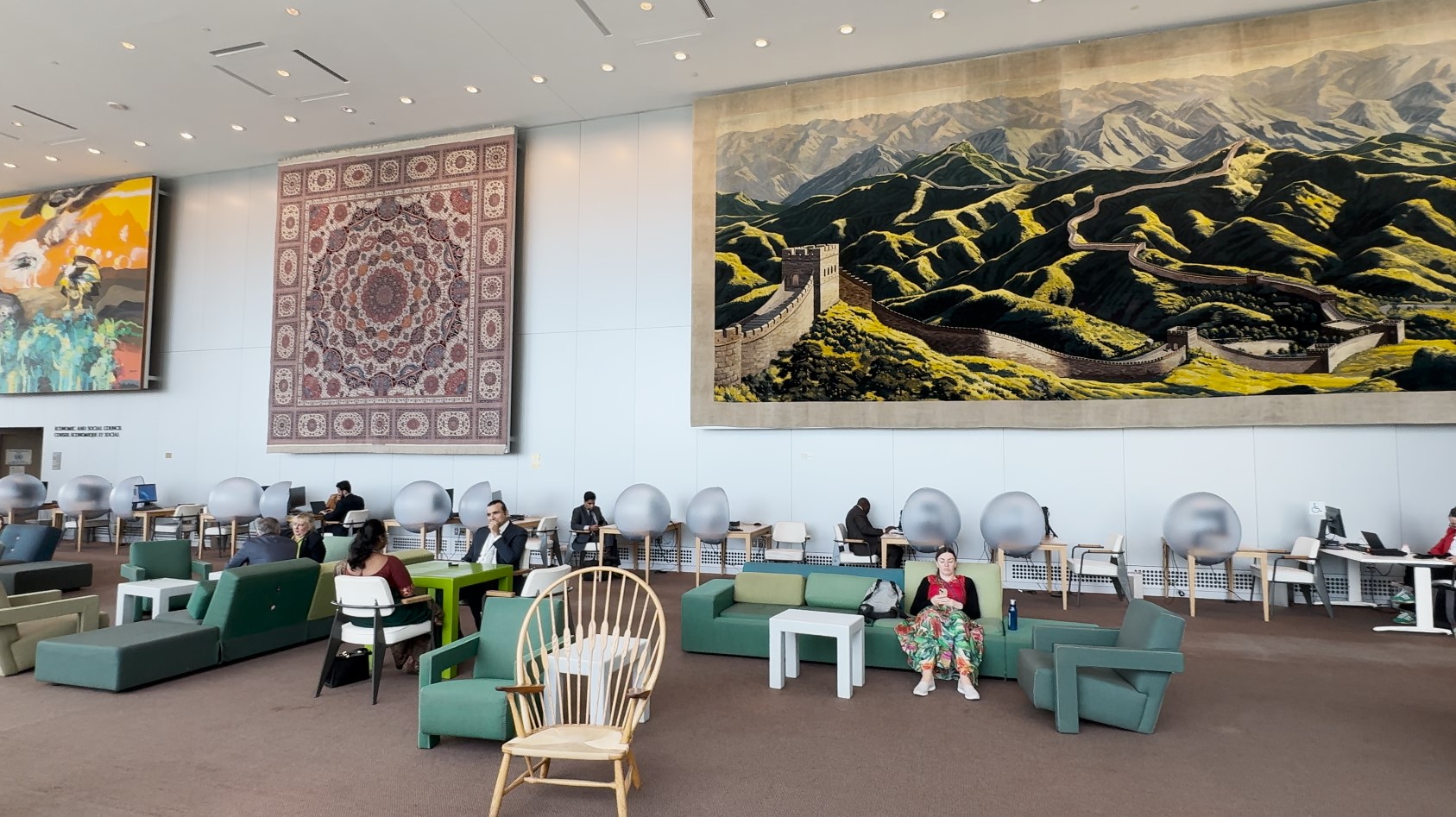
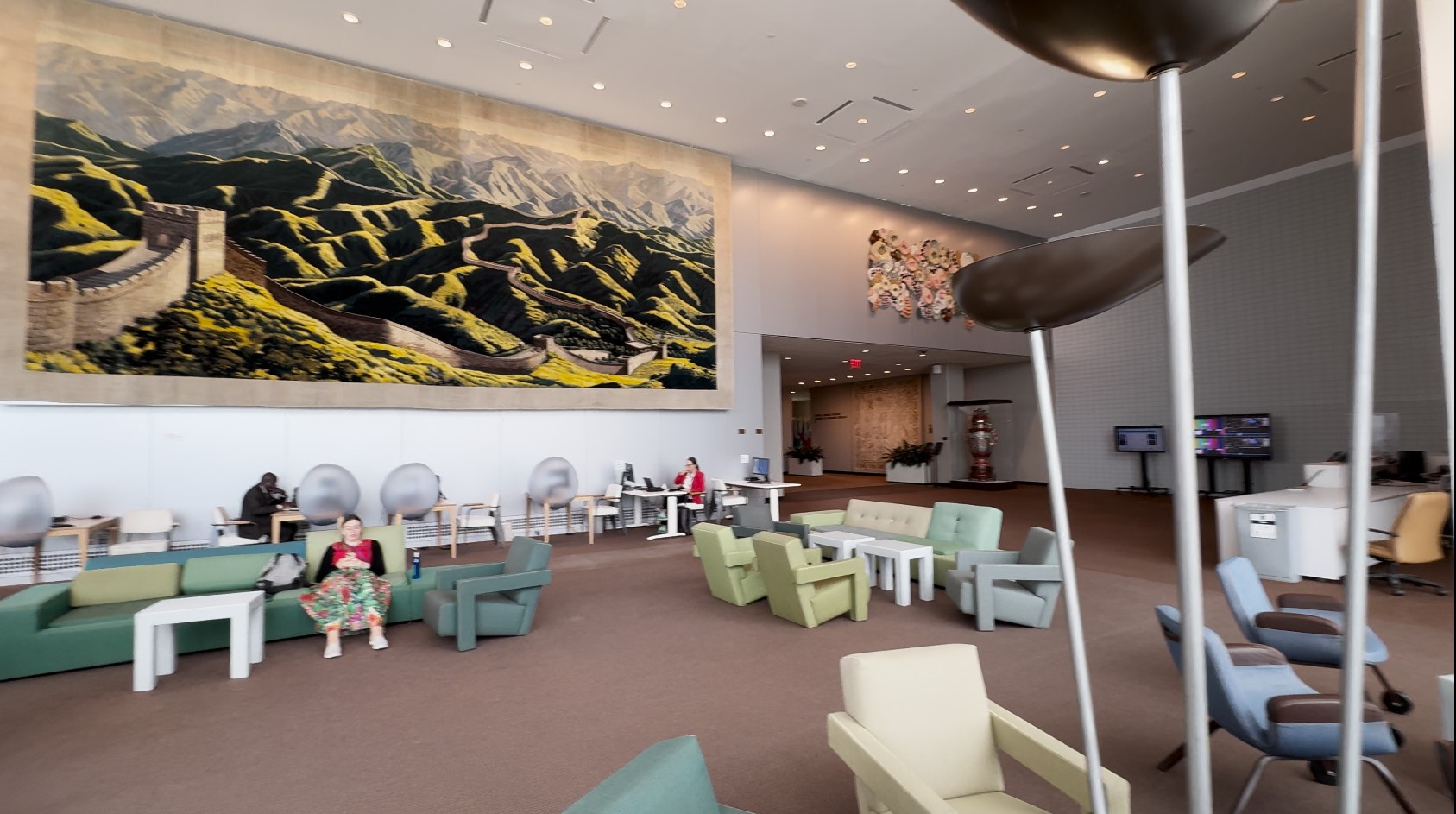
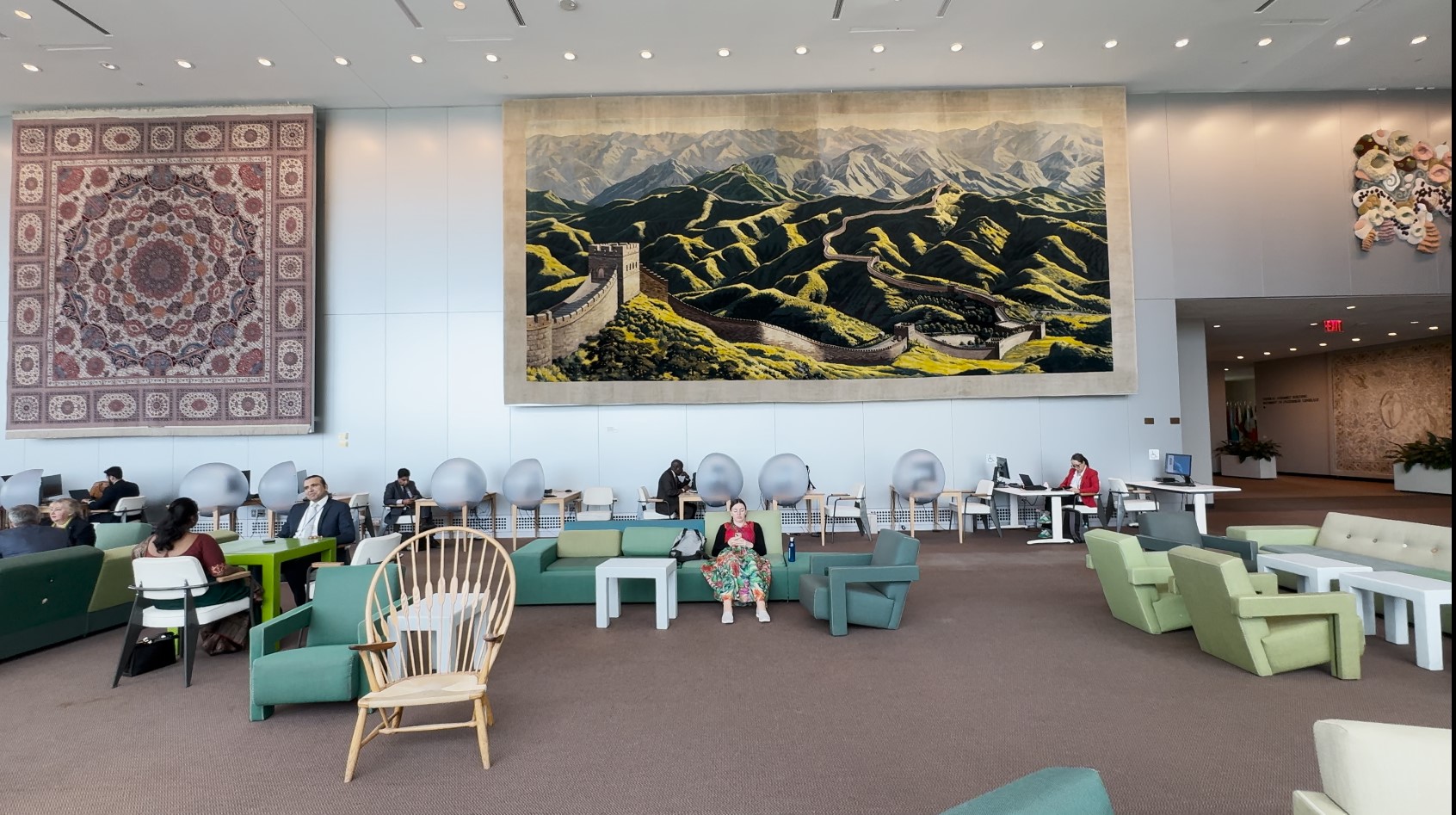
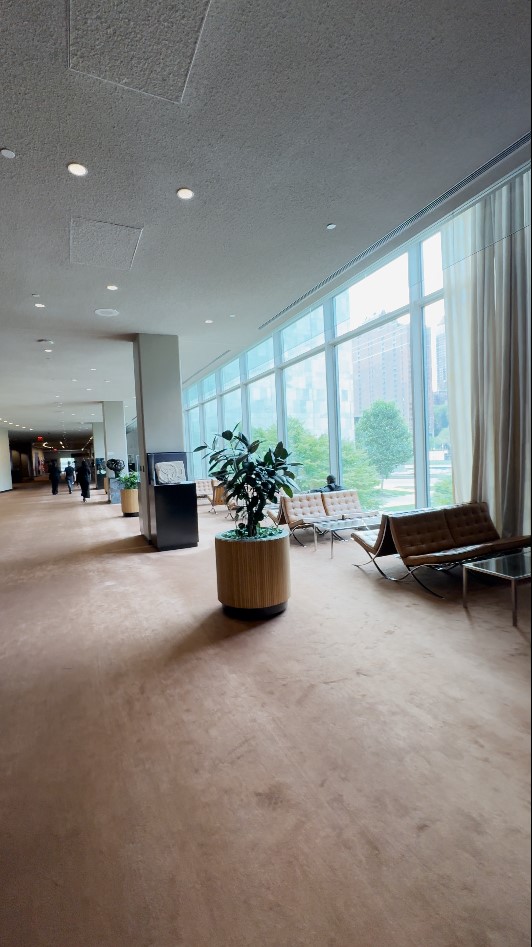
Celebrity Media Editor’s Note: Stepping into the Diplomatic Lounge on the second floor of the United Nations Headquarters in New York, the first thing people see is a massive Chinese tapestry of the Great Wall covering an entire wall. It was a gift from the Chinese government to the United Nations in 1974, with its grand composition displaying the majestic view of the winding Great Wall. The tapestry is not only a masterpiece of art but also symbolizes the resilience and guardianship of Chinese civilization, echoing the UN’s mission to safeguard world peace.
Celebrity Media
UN Second Floor Diplomatic Lounge: A “World Museum” Built by the Great Wall Tapestry and the Art Gallery
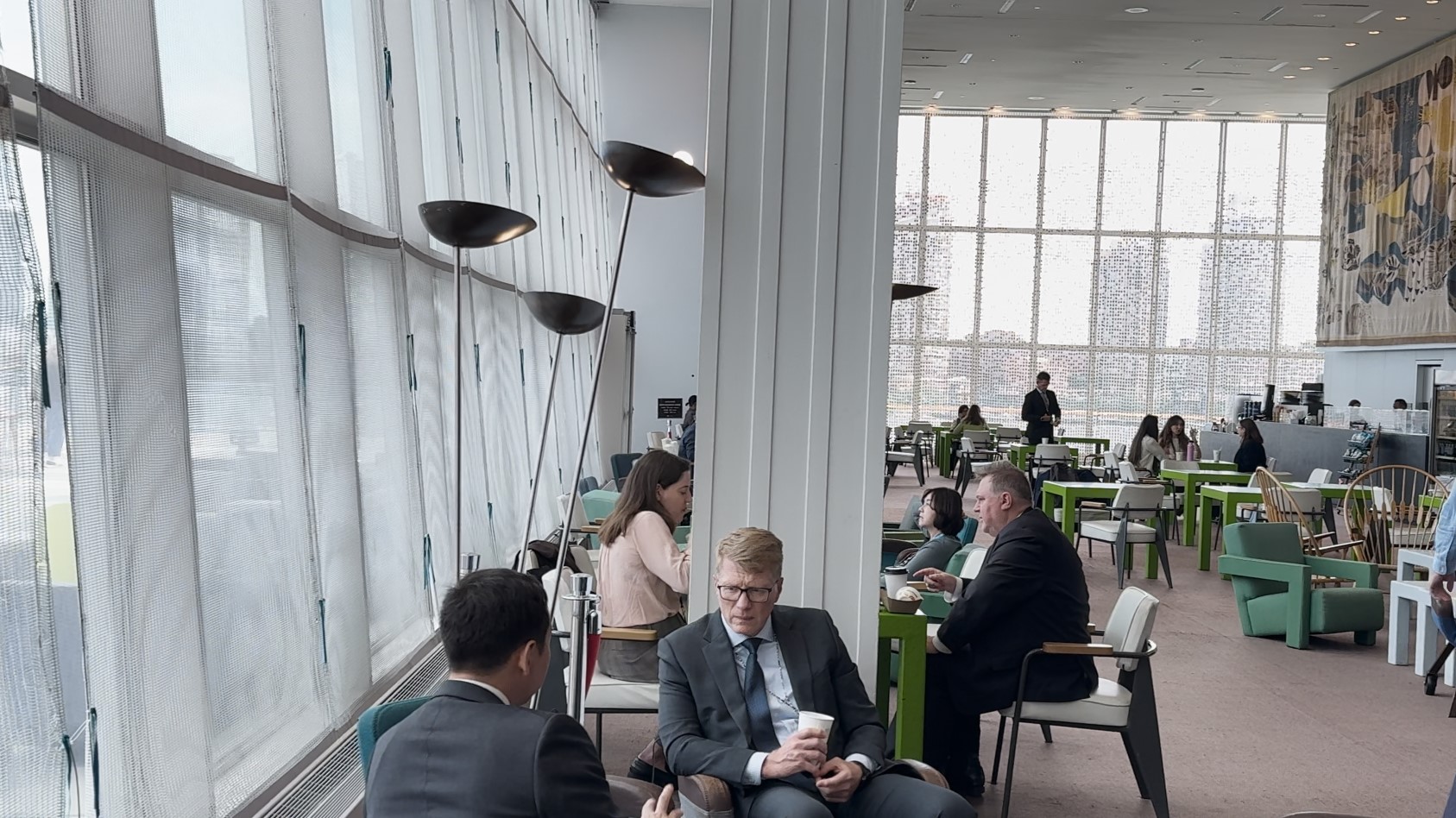
This Great Wall tapestry sets a solemn and profound tone for the lounge. Diplomats, while resting or conversing here, are often captivated by its awe-inspiring presence, sparking dialogues that bridge cultures and histories. It is not only an object of artistic appreciation but also an opportunity for civilizational exchange.
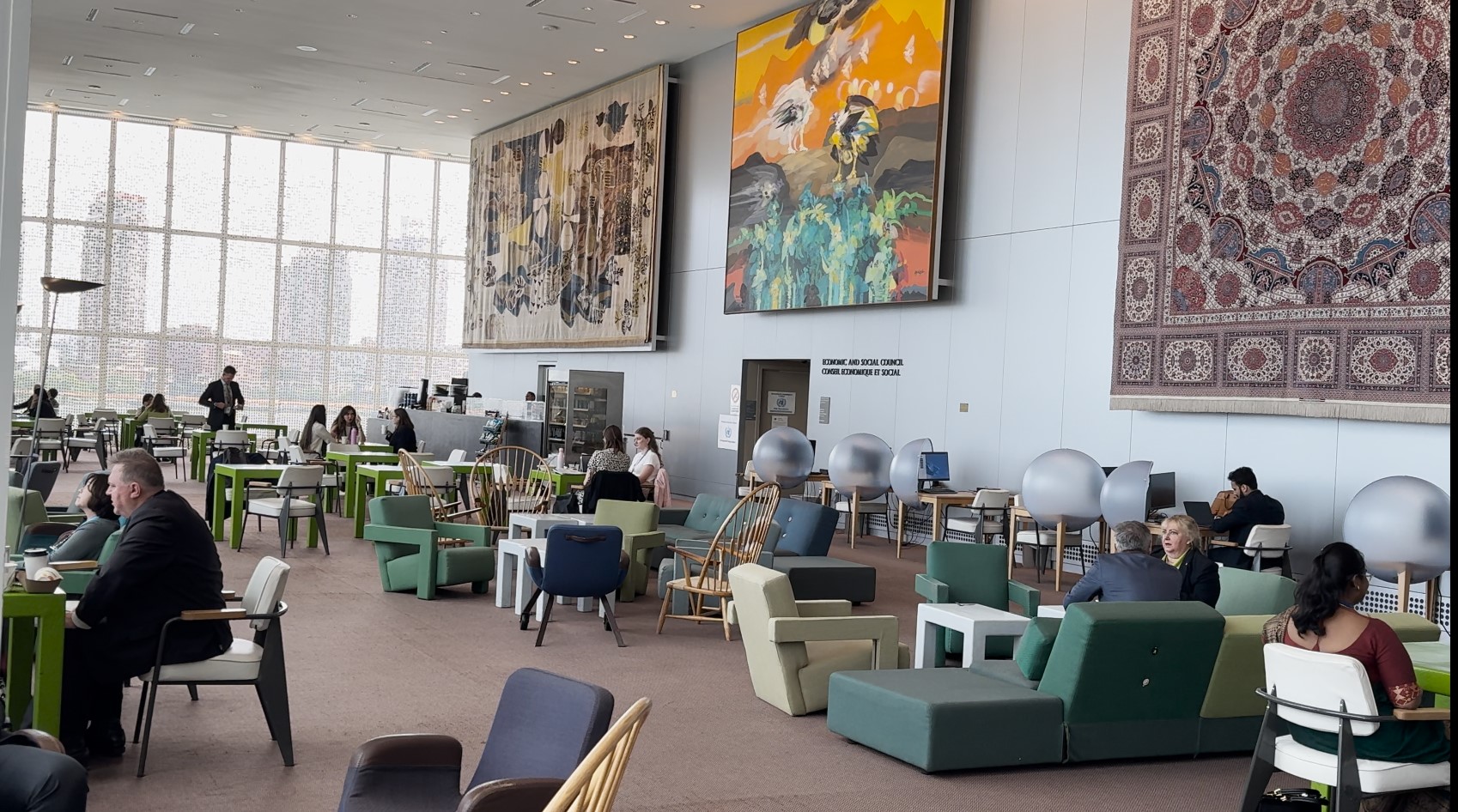
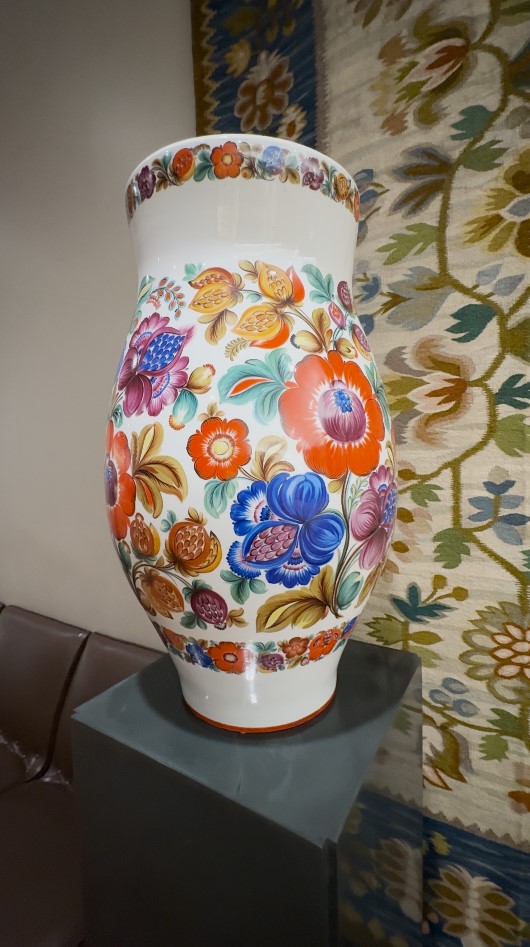
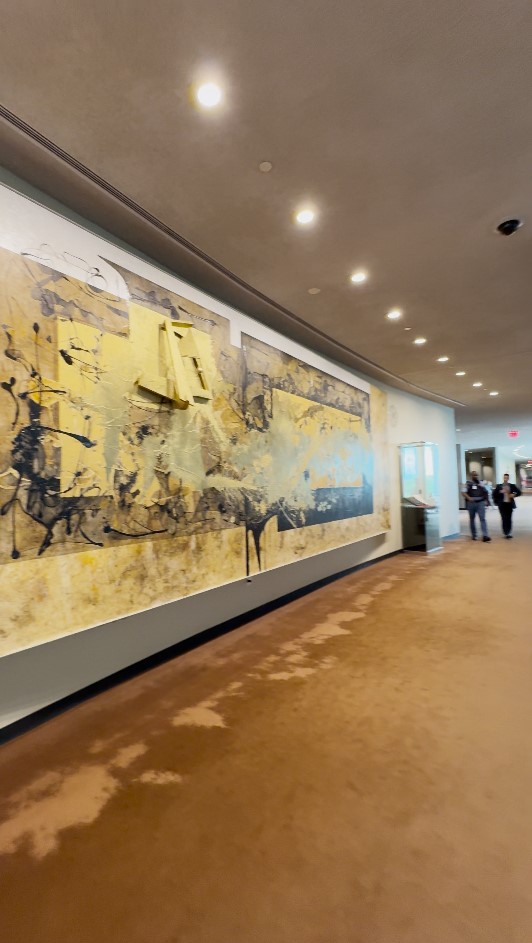
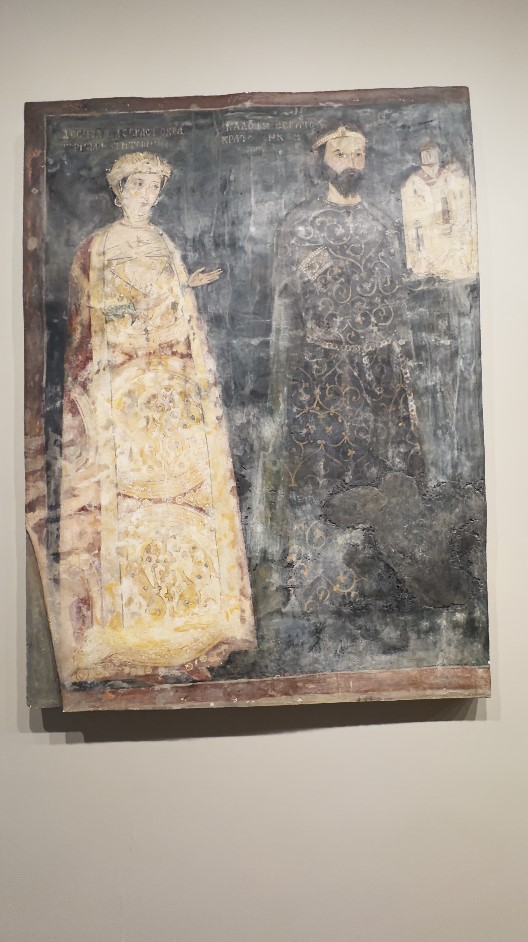
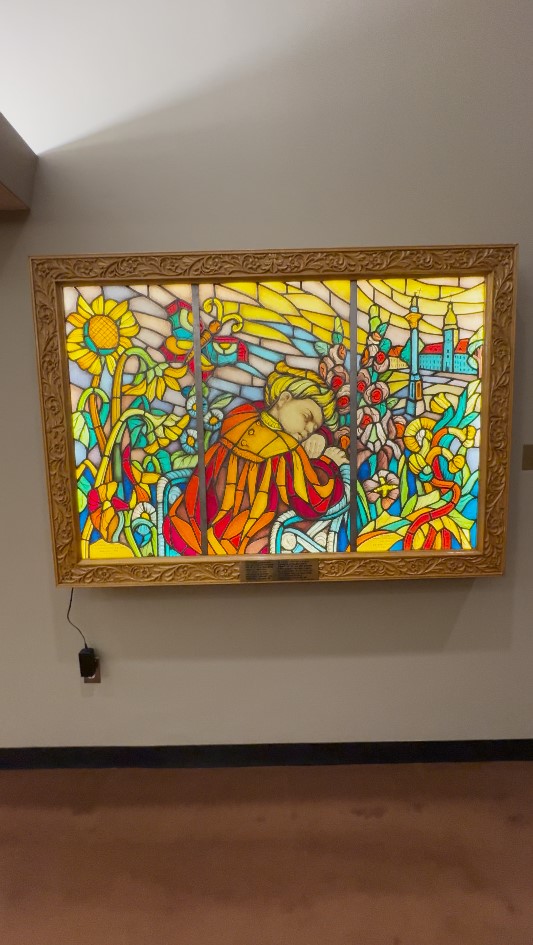
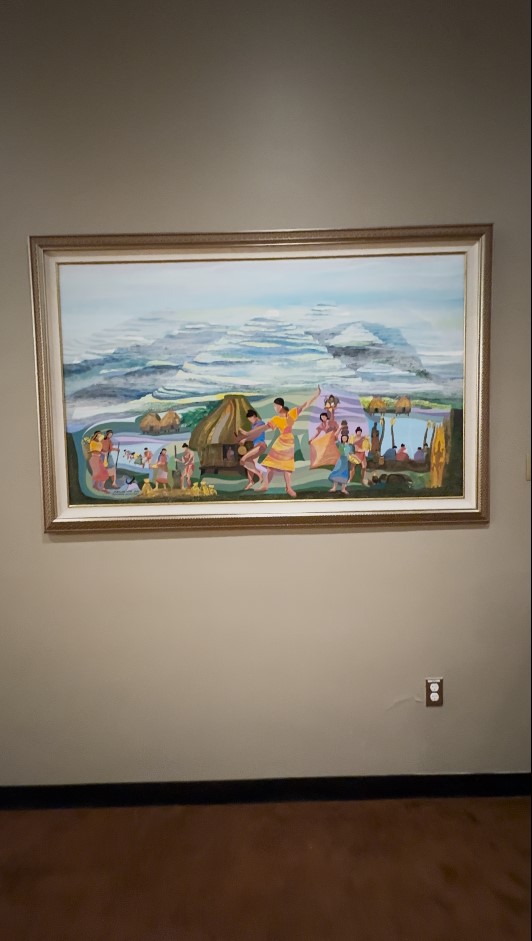
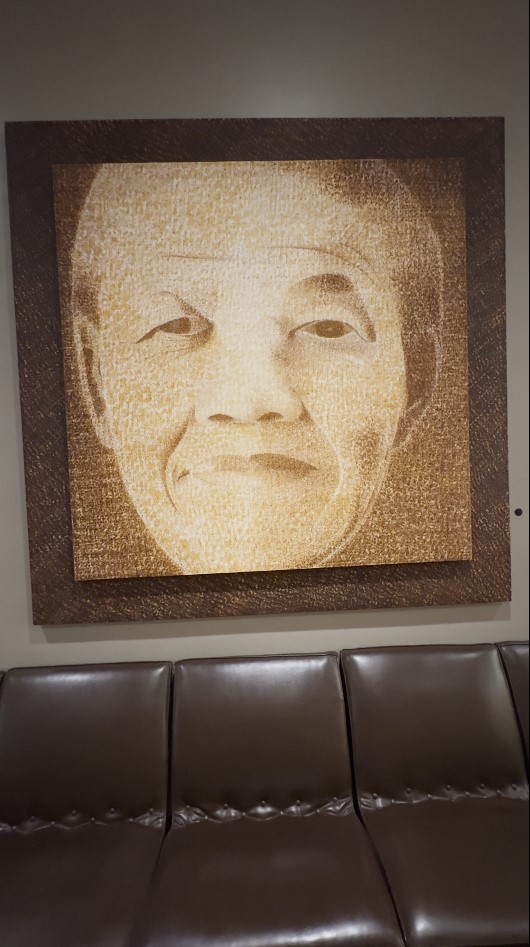
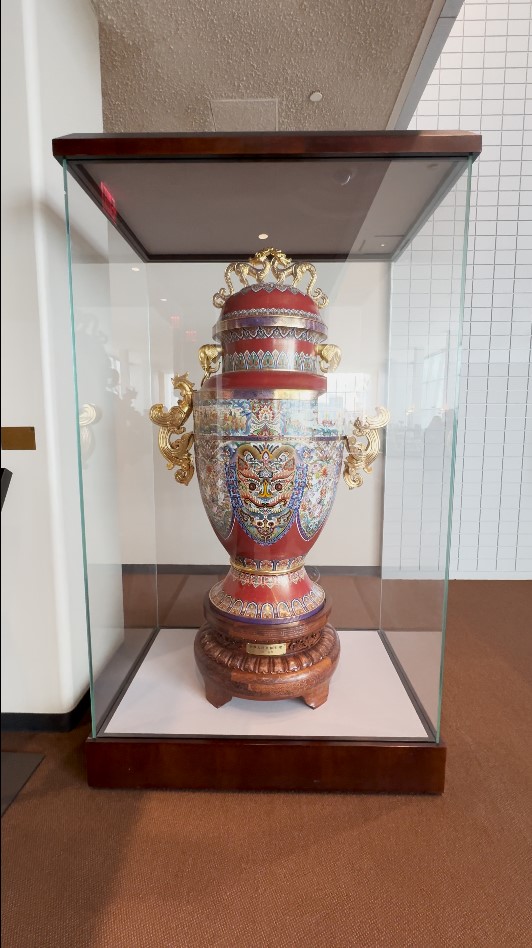
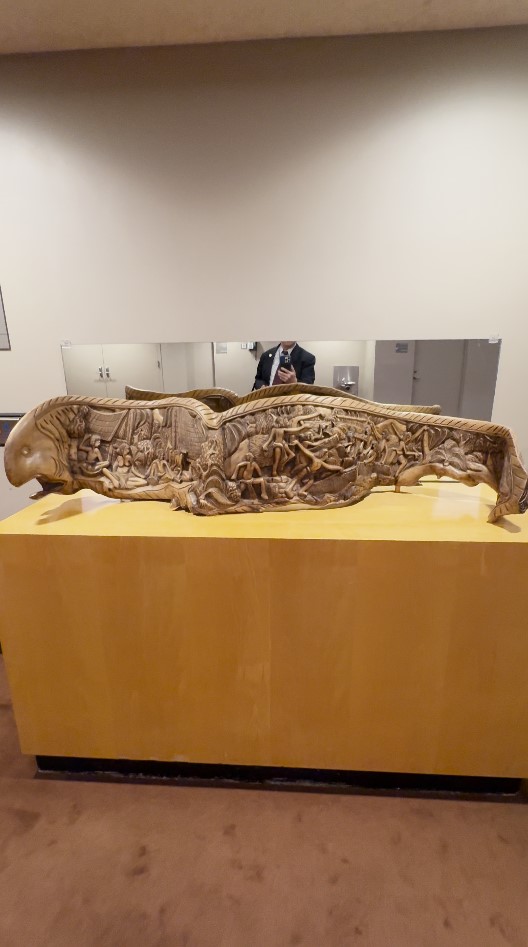
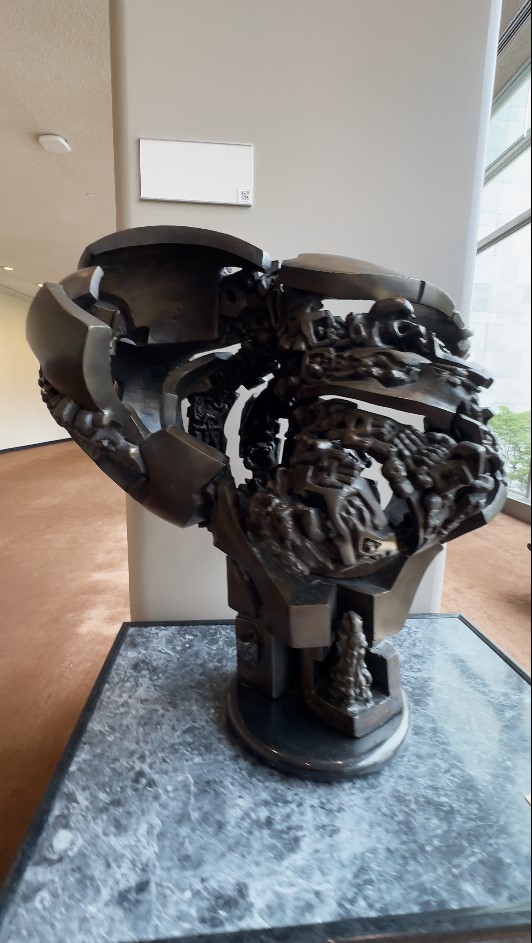
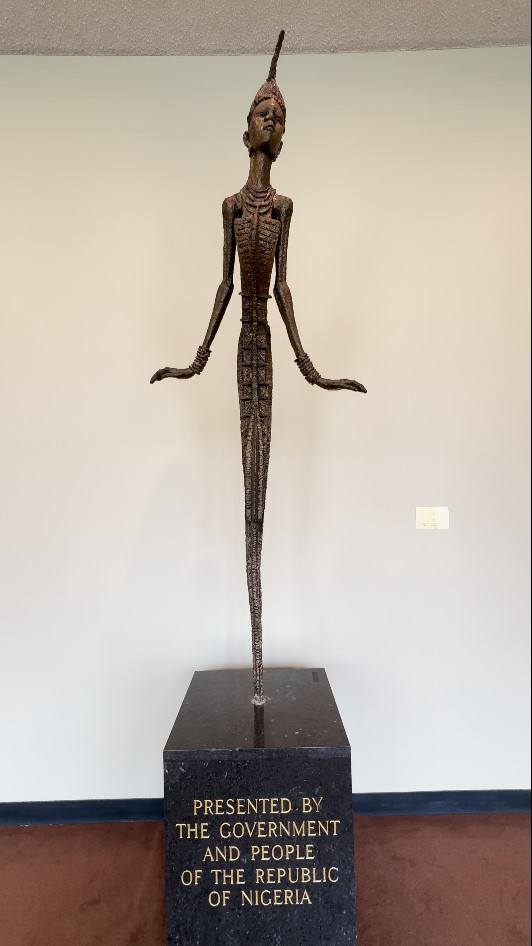
Looking around the entire second floor, from the lounge to the connected corridor, the space resembles a “living museum.” On both sides of the walls are artworks donated by countries from around the world: African wood carvings, European oil paintings, Latin American murals, Asian calligraphy and ink paintings—each carrying a unique cultural imprint. These works, together with the Great Wall tapestry, create a stage for diverse civilizations.
The corridor also displays images and historical records that capture significant UN moments: Security Council meetings during the Cold War, snapshots of peacekeeping operations… making this not just a space for work and rest, but a three-dimensional historical scroll.
It is in such an atmosphere that the image of the UN as a “home of the world” takes form. The juxtaposition of the Great Wall tapestry and diverse artworks reminds us that only through dialogue, understanding, and cooperation can the international community build a Great Wall that safeguards peace together.
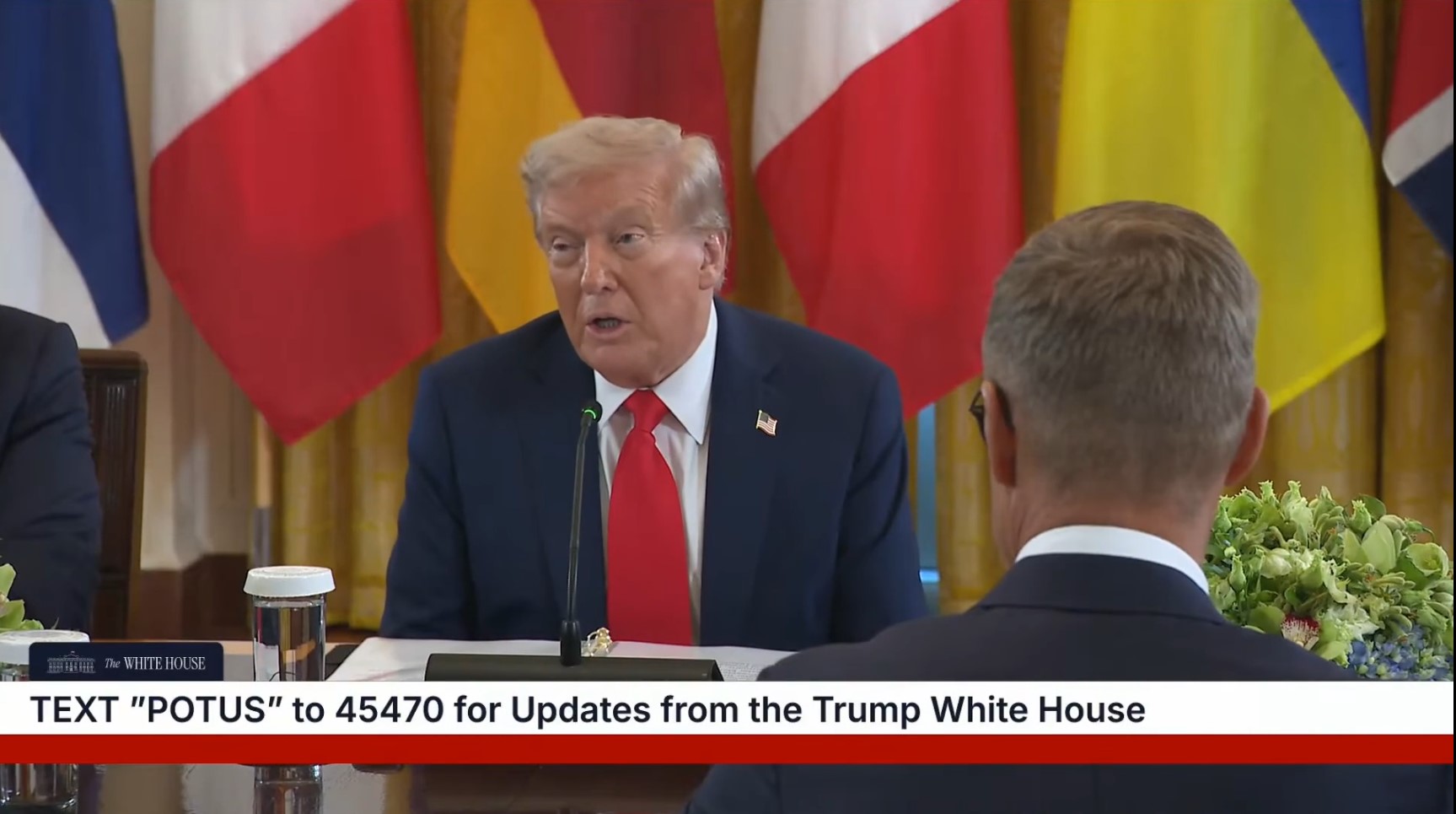
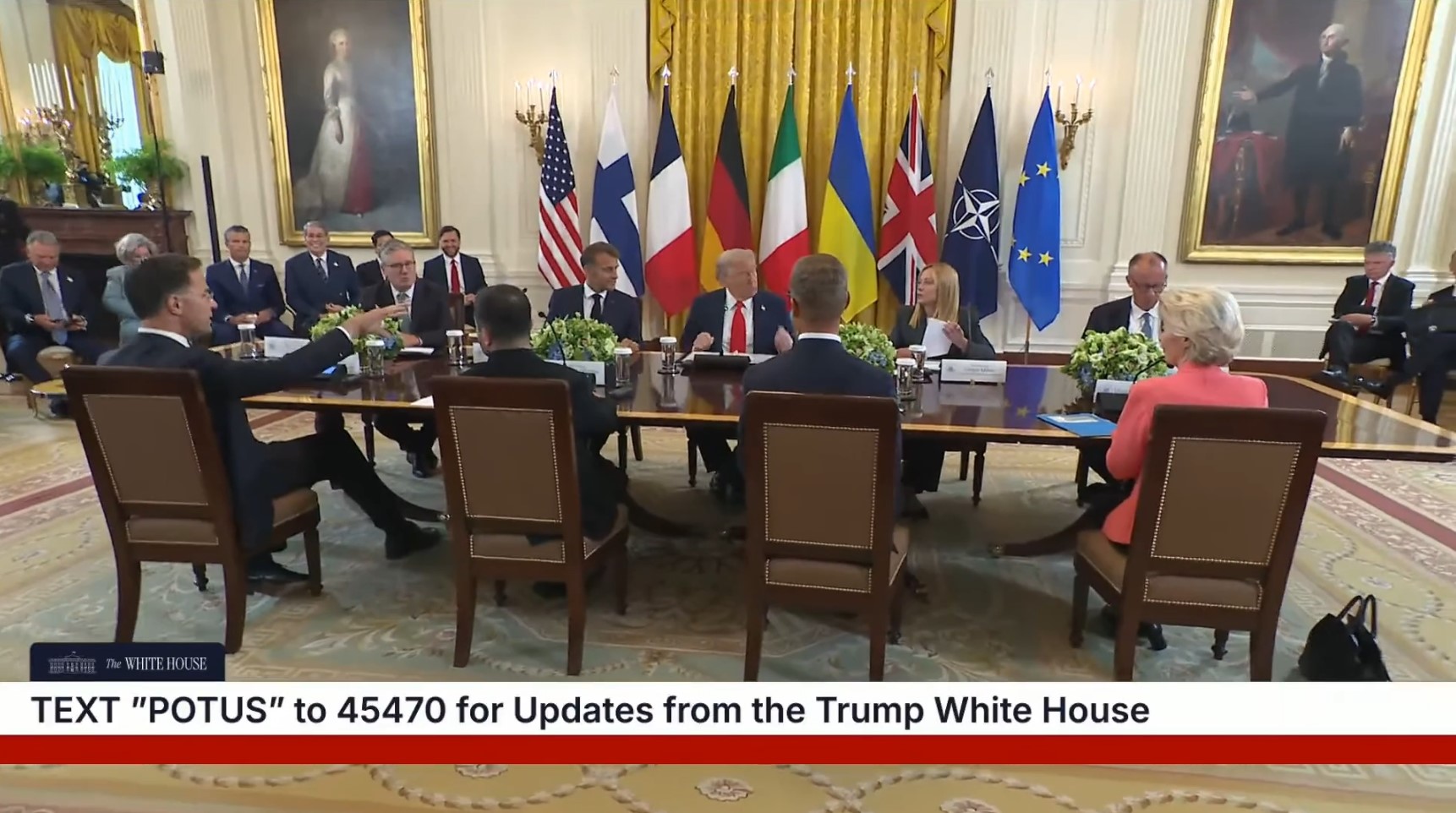
We are all working towards one goal, and that goal is simple: we want to stop the killing and calm things down.
I am honored to be able to have discussions with President Zelle Lynskey and everyone, and we have covered many areas.
I had indirect talks with President Putin. Today, we will be at this meeting. I believe we will have a good meeting, maybe even a great one. We will try to add and put it to rest. Since World War II, there have been such things.
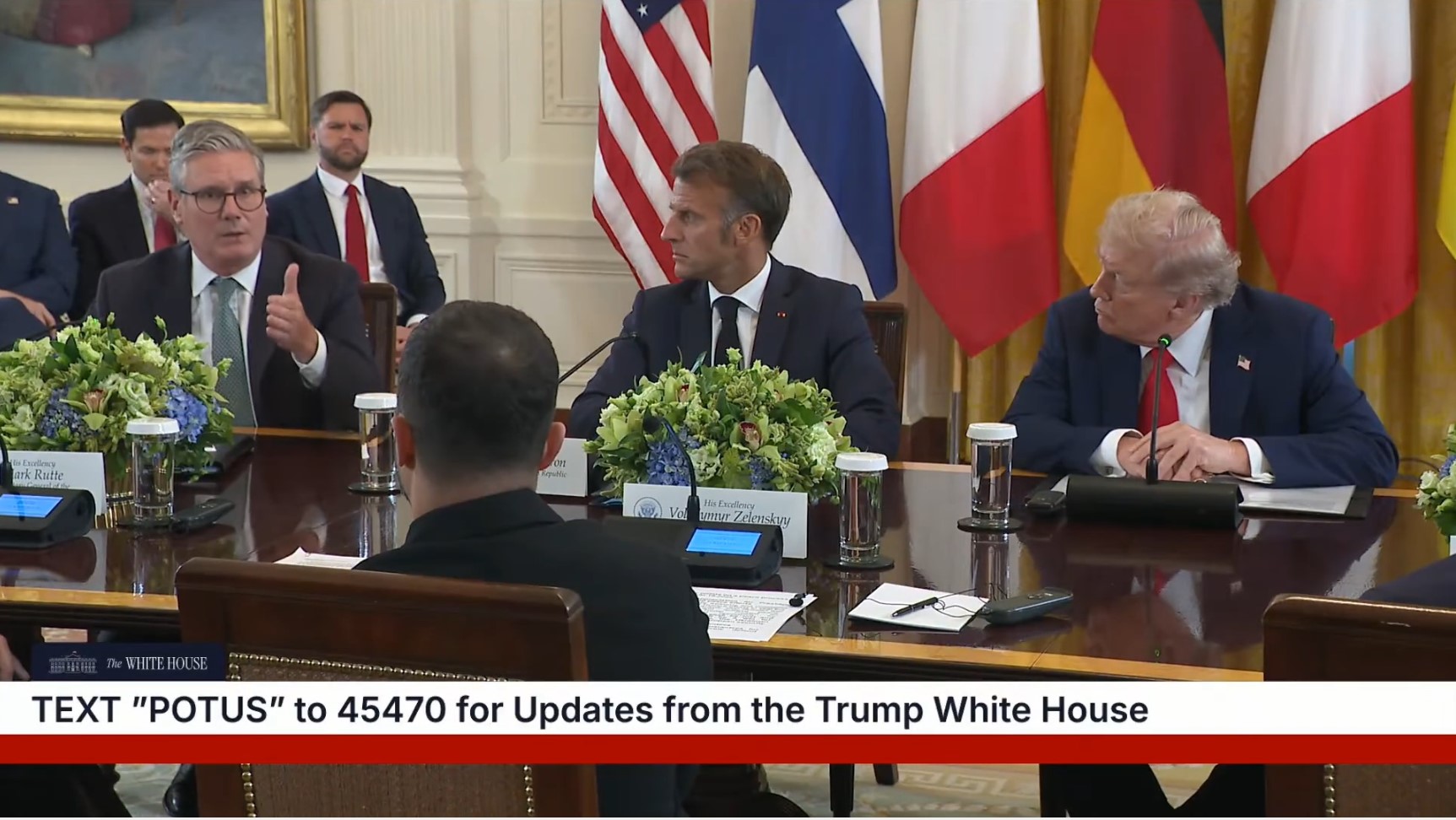
I am honored to welcome NATO Secretary General Mark, a great gentleman and a great European political leader. You have done an outstanding job. Thank you very much, Mark.
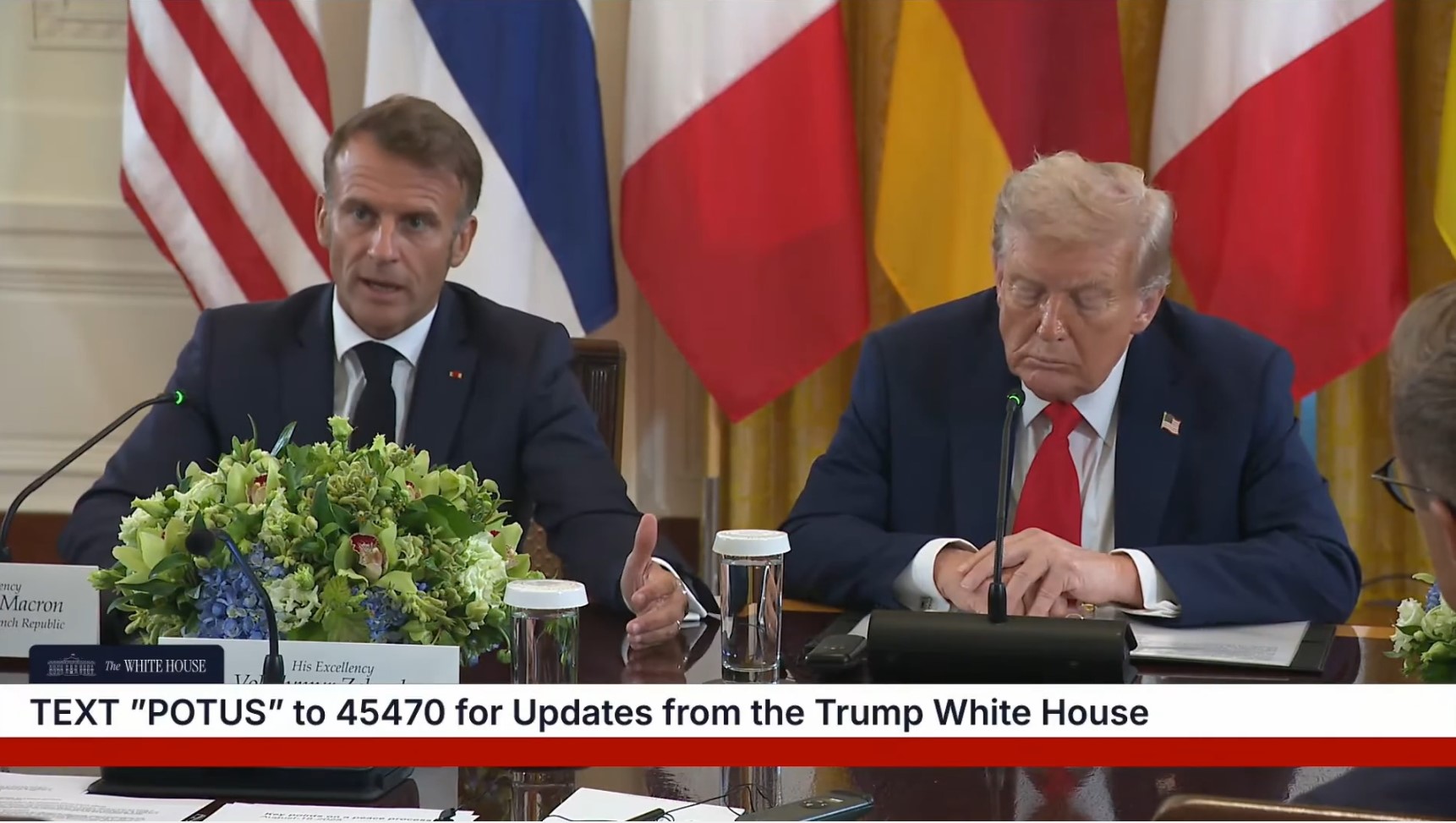
French President Emmanuel Macron and I started together. He was one of the first foreign leaders I met, I liked him from day one, and I like him even more now. This is good. This is truly unusual.
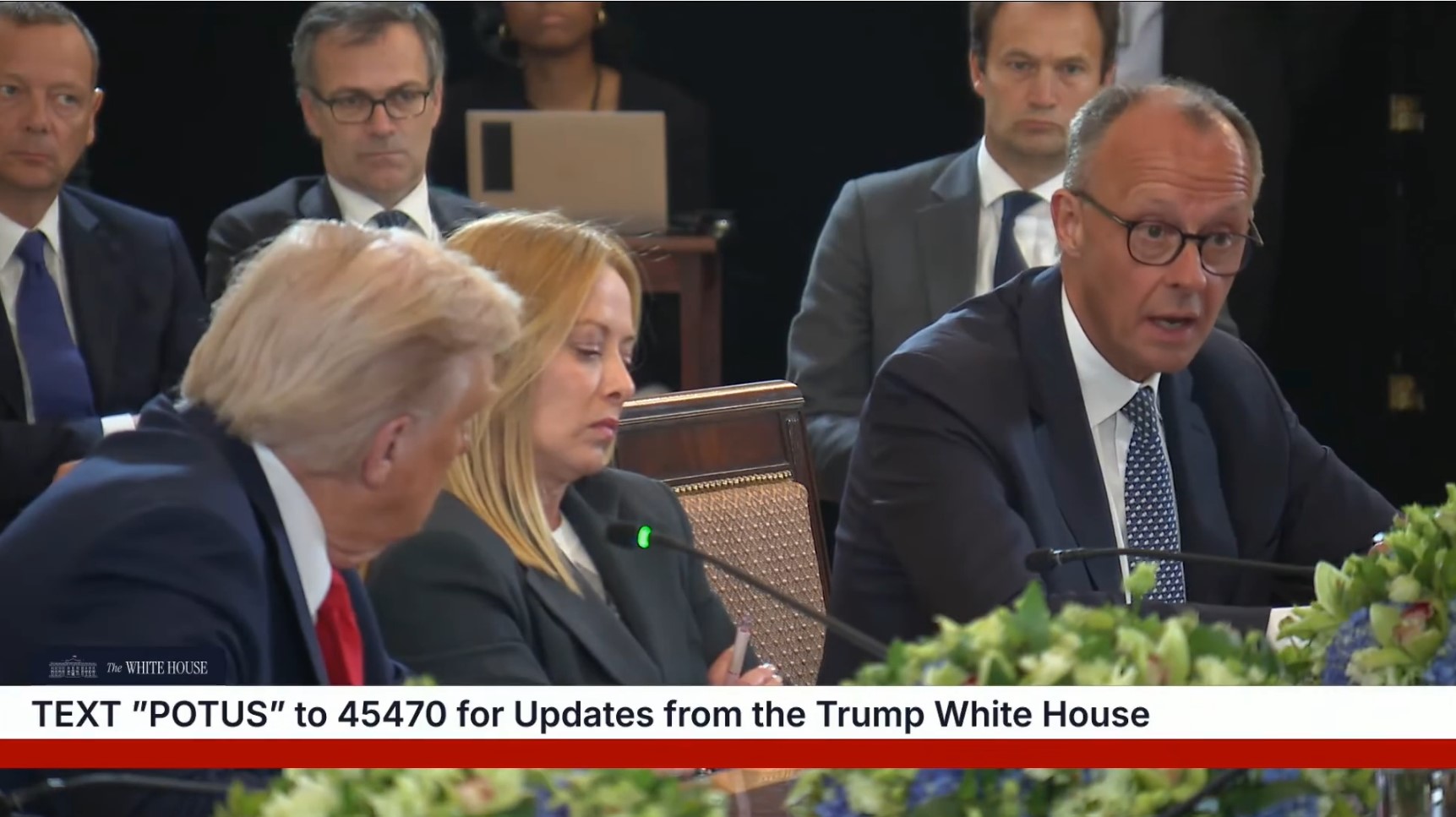
The Prime Minister surely knows who Italy is. She is indeed a great leader and an inspiring figure. Although still young, she has already served for a long time. You will be there for a long time.
Germany is a strong man and a very powerful leader, highly respected in Germany. He is my friend. I am honored, thank you. He is my friend. You look great, your skin is tanned, where did you get that tan? I’d like to get that color too.
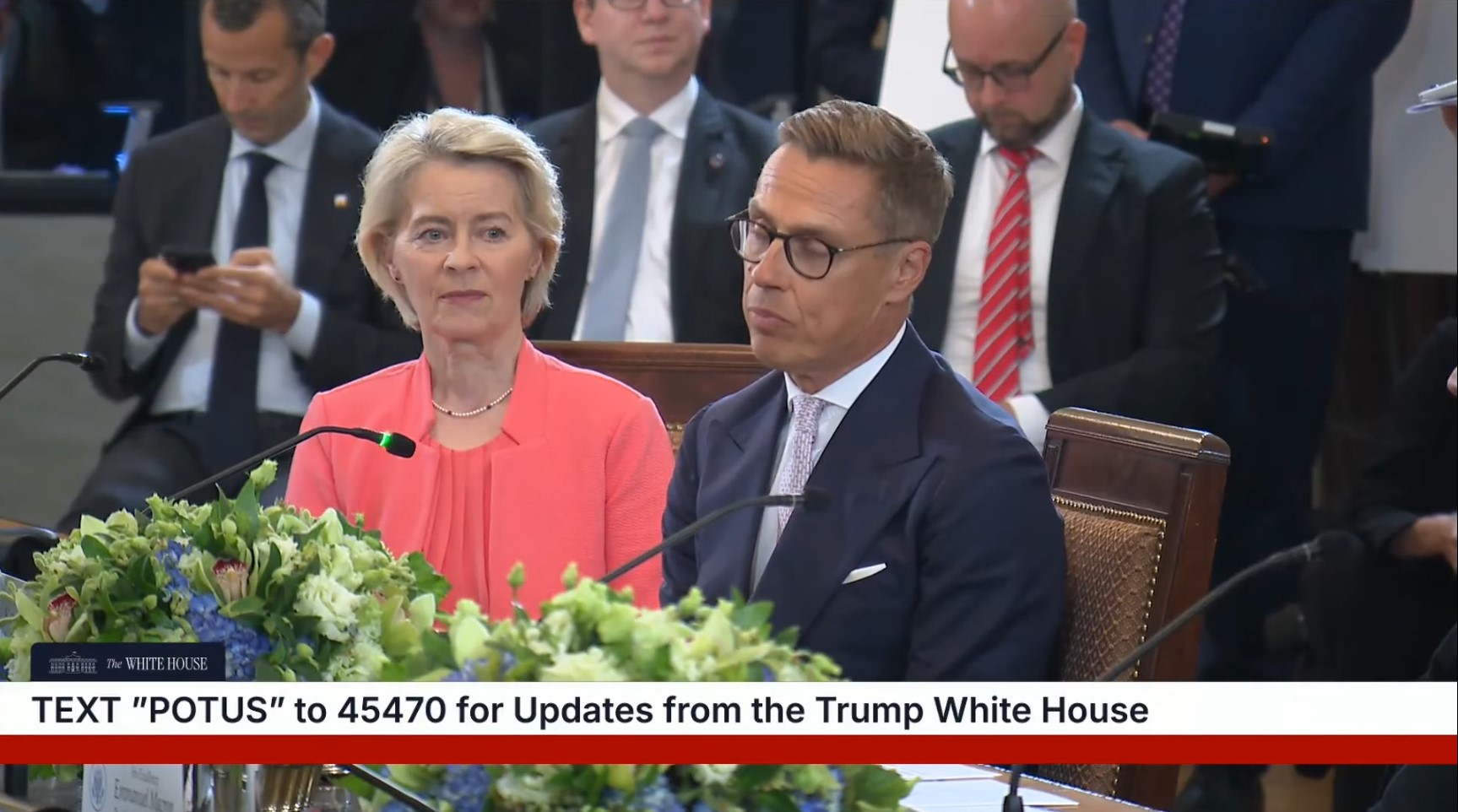
The President of Finland, we are all here. Oh, you look better than I have ever seen. Well done, we all respect you, you have many things to accomplish, success and potential success, thank you very much.
We thank you and the President of the European Commission for coming. We have just reached an important agreement with Ursula, all these countries. I think you may be stronger than all these people at this table. I don’t know. But we had a great negotiation, you will be respected worldwide, so thank you very much for coming.
The Alaska summit reinforced my belief that President Putin agreed that Russia would take significant steps to accept Ukraine’s security guarantees. This is one of the key points we need to focus on. We will also consider who will do what at the table.
We are optimistic that we can achieve something. I don’t think it will be overestimated, mostly words. We will know. I think European countries are bearing many burdens. We will help them and ensure their security.
We also need to discuss possible territorial exchanges, considering that the current contact line means a war zone, the frontline is very clear, very sad.
Besides President Putin, there is also President of Ukraine, you just met. We will try to get a trilateral meeting, maybe we can hold a party meeting soon. I have a feeling you and President Putin will figure something out.
Ultimately, the decision can only be made by President Zelle Lynskey and the people of Ukraine, in agreement with President Putin. I think that’s when good things will come.
I hope we can have a pleasant meeting, and if we do, I will arrange a meeting with President Putin. Not because I want to, but because we want to save many lives from death.
Sometimes five, six, seven thousand people die in a week. All of us clearly want an immediate ceasefire, we are committed to achieving lasting peace.
At the moment we don’t have a ceasefire. I don’t know if it is necessary. You can achieve it through war. But I hope another country can ceasefire. I believe reaching a peace agreement is very possible and can be achieved in the near future.
I have been involved in many wars, and we are only left with this one. Of course, when I walk out the door, there may be a new one starting, and I will stop that too. I thought this would be the easier one, but it is very complicated.
The next step is to hold a trilateral meeting, which will be resolved, and I look forward to a great outcome. We spent a lot of time discussing today, and we are honored you came.
These are the leaders of major countries, and they speak. I should say to a large extent, but for the other European countries, we will reach a resolution today. I think almost everything includes security, and that’s the whole story.
I want to say, Mr. President, would you like to say a few words? There is media, if you like you can come over, you can use mine, or you can just turn around, whichever makes you comfortable.
≫ Thank you very much, I can speak without a microphone. Thank you. I think we had a very good conversation with President Trump, this was indeed the best one. Or maybe the best one is yet to come. But this was really good.
We talked about some very sensitive issues. The hardest one is security guarantees, and we are glad the President said leaders are here, Ukraine’s security depends on the U.S., you and those leaders. They are with us, in our hearts.
They went online before yesterday, and Ukraine was already aware. Our people and all of us want to end this war, stop Russia and stop the war.
We discussed this issue, and we will continue. Security guarantees are very important, and the U.S. has sent such a strong signal to ensure security guarantees.
The second point, or the first humanitarian point. Thank you very much, Mr. President, and thanks again to your wife for hearing us adopt children. I hope this can truly help bring children back to families. And be happy. Yes, this is so important, I am glad.
We discussed this issue. I hope President Trump will make a decision, and then on all sensitive issues, territorial issues, etc., we will discuss a trilateral leaders’ meeting. President Trump will try to organize such a meeting, he said he would come or not. Ukraine will be happy if—
≫ If you want me there, I will go. ≫ Thank you, I think this is very important.
Yes. So security guarantees, bringing the children back, and all our people, not just soldiers, but first soldiers and all civilians, many are imprisoned. So we need them back.
The guarantees we talked about will be valid for years to come. I showed the President a lot of details of the battlefield, on the map, thank you very much. By the way, the map is great too. Yes.
≫ I am wondering how to bring it back. ≫ We will help you get it.
No, no, we had constructive, concrete meetings with all leaders. You helped me a lot. Therefore, we are glad that today we were able to be so united. Thank you, Mr. President, for the reception, thank you.
≫ I think you will find that President Putin wants to do something else. I think when we build it, it will be “when…” not “if.” I think we will see some positive moves.
I know there are tens of thousands of prisoners, I know they are about to release them, and they will release them soon. I immediately liked that, I think it’s great. But we will, we will arrange it. After today’s meeting ends. Very good, very great remarks.
≫ Mark, NATO leader, would you like to say something? ≫ Thank you very much, Mr. President of the United States.
You have already started the dialogue, I think it was in February, the first calendar event. Since then we have had today’s situation, I think if we do well, we can end all this. We must stop the killing, stop the destruction of Ukraine’s infrastructure. This is a terrible war.
I am excited, let’s do our best from today to end this as soon as possible. I want to thank you for your leadership. What you and all European colleagues are doing is really important.
In fact, saying you are willing to participate in security guarantees is a big step, a breakthrough, making everything different. NATO also agreed from 2% to 5%, that is a lot of money. Not the usual 2%, but now 5%. That’s a big difference. Thank you very much.
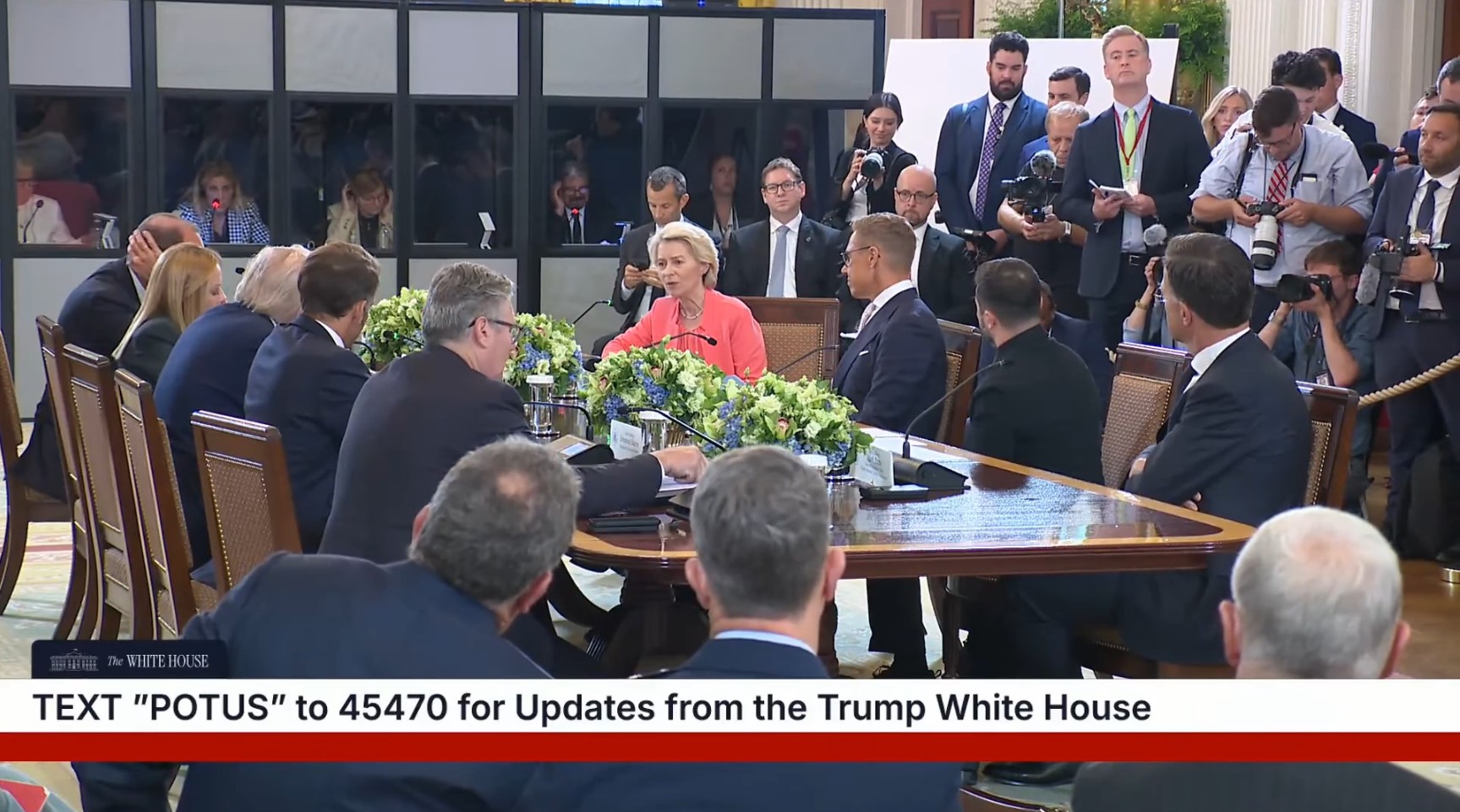
≫ Ursula, maybe you can say a few words on behalf of the Commission. ≫ Ursula: Thank you very much, glad to be here. This is a very important moment.
In fact, we are here, as European friends and allies, we had an excellent NATO summit, the world’s two largest economies. We reached the biggest trade deal ever. Now we are willing to work with you to achieve peace in Ukraine and stop the killing. This really serves our common interest: stop the killing.
Glad to hear we are working on improving security guarantees, Article 5 security guarantees. This is important. I want to thank all of you. You mentioned thousands of kidnapped Ukrainian children, mothers and grandmothers. Every child must return to their family. This should also be one of our top priorities — to ensure children return to their families in Ukraine.
≫ Trump: We reached the largest trade agreement in history a few weeks ago. This is a big deal, very good. Thank you very much!
German Chancellor. ≫ Germany: Thank you very much for having us today.
I think this meeting was very helpful, hearing that you both had such a pleasant meeting in Washington today. The next steps are now more complicated. The road has been opened, it was you who opened it last Friday. But now, the complicated path of negotiations has opened.
To be honest, we all want to see a ceasefire. For the next meeting, I can’t imagine it happening without a ceasefire, so let’s work together. Let’s try to put pressure on Russia, because the credibility of these efforts, the work done today, depends on reaching a ceasefire from the start of negotiations.
The next step, so I want to stress this point, and hope to see a ceasefire, starting from the next meeting, which should be a trilateral meeting, wherever it may take place.
≫ Trump: We will let the President go to the President, and we will see how it goes. If we can reach that point, what I want to say is, among the six wars I calmed down, we just entered ceasefire talks. One of those wars, like Congo, lasted thirty-one years.
Last week we worked with two great nations, it has been thirty-five years, and we had no ceasefire. So if we can have a ceasefire, that’s great. If not, many points are for us. We got a lot of points. Great points.
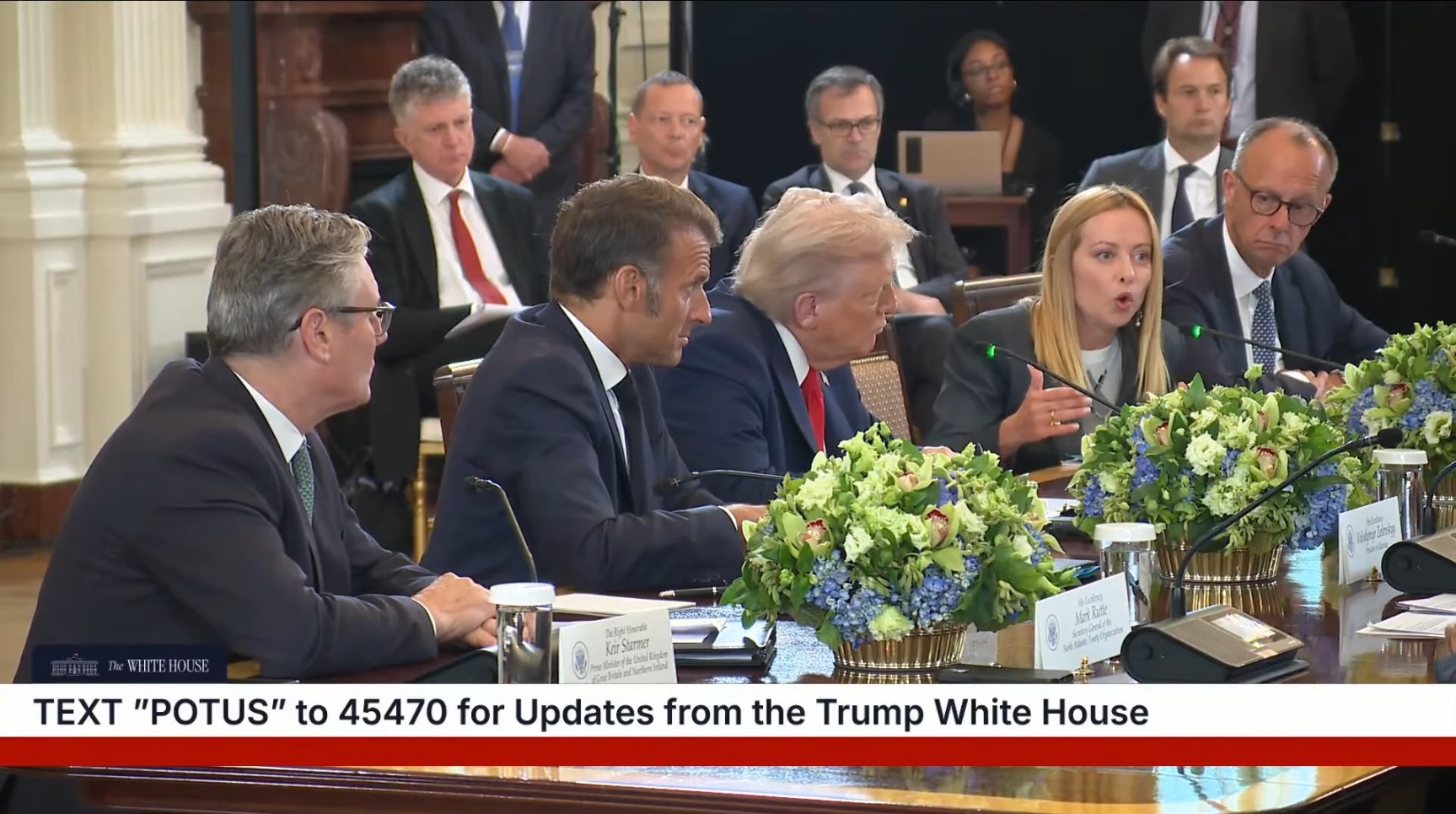
≫ Italy: Thank you very much, President Trump, for hosting us at this important meeting today. I think this is an important day. A new face, after more than three years without signs, Russia shows willingness to dialogue, so things are changing, some things have already changed.
Also thanks to those who achieved on the battlefield, with the courage of Ukrainians and the unity of us all. We must remind that if we want peace, if we want justice, we must unite. That is why today is a very good day.
You can clearly count on Italy, because we first stand with Ukraine, and we absolutely support your efforts for peace.
We will discuss many important topics. The first is security guarantees, how to ensure this never happens again, this is a prerequisite for peace. I am glad we will discuss this issue. I am glad we will start with a proposal, the Article 5 model originally came from Italy. So we are ready at any time to present our peace proposal and start dialogue. This is something we must work on together to ensure peace and defend the security of our nations. Thank you, Mr. President, thank you for your warm reception.
≫ Trump: Thank you very much, Emmanuel. ≫ Emmanuel: Thank you, sir.
The President organized this powerful and important meeting, your commitment and your words, I can only say, everyone at this table is interested in peace. We have worked hard over the past years, but peace was taken away. That is why the idea of this meeting is so important, because it is the only way to solve the problem.
I think, as a follow-up, we may need to convene a meeting. Because when we talk about security guarantees, we are talking about the security of the entire European continent. That is why we are all standing with Ukraine on this issue.
To organize such power, your idea of calling for a ceasefire, or at least agreeing to stop the killing, is necessary. We all support this idea.
For Ukraine to have such long-lasting peace, for the entire continent, we indeed need security guarantees. The first is clearly to build a reliable Ukrainian army for years and decades to come; the second is our own commitments. We have been working hard for months, building security guarantees with NATO support and making our commitments.
You can be sure that we will have our fair share. Ukraine’s security is also our security. In this case, you can trust us, because we can trust you, to bring peace to Ukraine and Europe. Thank you.
≫ Trump: Thank you very much, Emmanuel, Prime Minister. ≫ British Prime Minister: Thank you very much, sir.
Mr. President, thank you for hosting us here. We all want peace. The Ukraine war has had a huge impact, not only on Ukrainians but also on Europe and the UK. No family or community is unaffected.
We are discussing the responsibilities of Europe and the UK, which is why this is so important. I think as a group we have discussed many times, called the President several times. Let’s push this forward together.
I believe that with the right approach, we can make real progress this afternoon, especially on security guarantees. Article 5-style guarantees fit with what we have been doing, we started months ago, countries gathering to show readiness to承担 security responsibility. With the U.S. joining, I think we can reach something very important today. This meeting could actually take a historic step, laying the foundation for Ukraine and Europe’s security. I also feel we can truly achieve progress, a just and lasting result. A trilateral meeting is a wise next step.
≫ Trump: This is the first time at the White House. You can’t say that often. Since the 19th century, specifically 1799, but this is the first time we’ve had so many prime-time ministers, presidents, and European leaders.
By the way, Alex, I want you to say a few words. You are such a strong young man. Before I finish, I want you to say a few words.
≫ Finnish President: Thank you, Mr. President. I think in the past two weeks, we may have made more progress ending this war than in the past three and a half years. Everyone here today is of great symbolic significance, because this is Europe and the U.S. helping Ukraine together.
The progress we are making, looking forward to this meeting, is about security guarantees, which is a very important part. Of course, next is the trilateral talks with you, President Putin, and President Zelle Lynskey.
Some people may ask why Finland is here. I think the reason is that we may come from a small country, but we have an 800-mile border with Russia, and we have our own historical experience. We also fought Russia in World War II. If you look at the frontline now, we found a solution back in 1944, and I believe we can end Russia’s war of aggression in 2025, and achieve lasting, just peace. The situation is very difficult, but that is why we are here.
≫ Trump: Thank you very much, Alex. Well done. We will meet shortly and discuss some issues. I don’t think anything is too complex. People are now at a stage of wanting to do something. I truly believe, I have known him for a long time, I think President Putin also wants to find an answer. In one or two weeks we will know if we will solve this, otherwise this terrible fight will continue.
We will try our best to end all this, I believe with two willing people to cooperate, usually that’s good news. Two parties willing to reach agreement, we will walk together, witness together. If it can be done, it will succeed; if not, it may fail. But we must try. Thousands of lives can be saved each week, so this is what we must do.
Or at least we must try our best, that’s all. You can do your best, but I think we may have a very good outcome.
I want to thank everyone in the media. I will work here, you will return to your great nations to work. We may be in different places, but we know how to do it, and that is work.
I want to thank the media, overall quite fair. I think that is important. They are fair, because it is very important, this is a very important thing. We must end it. So we only ask the media to be treated fairly.
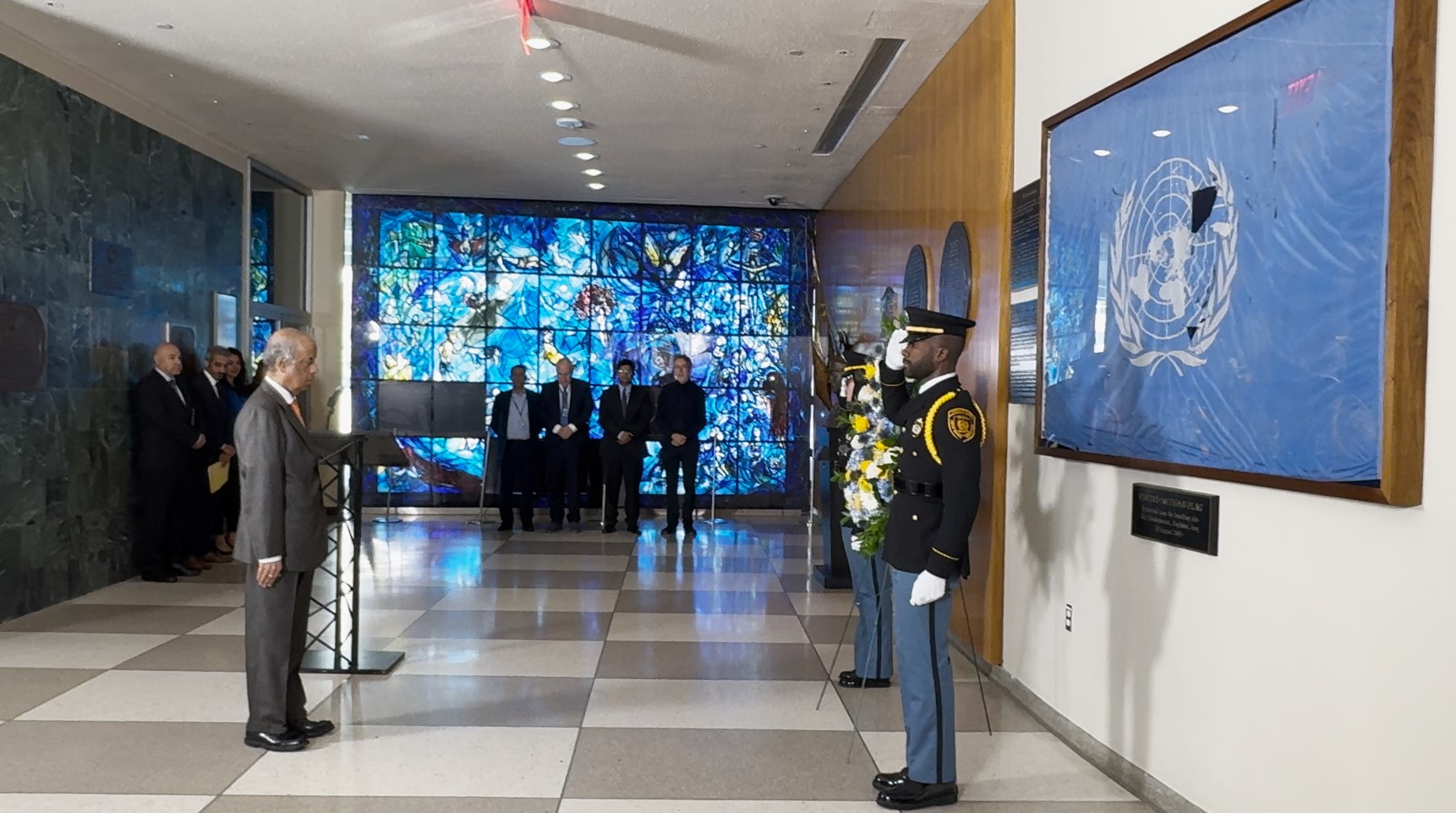
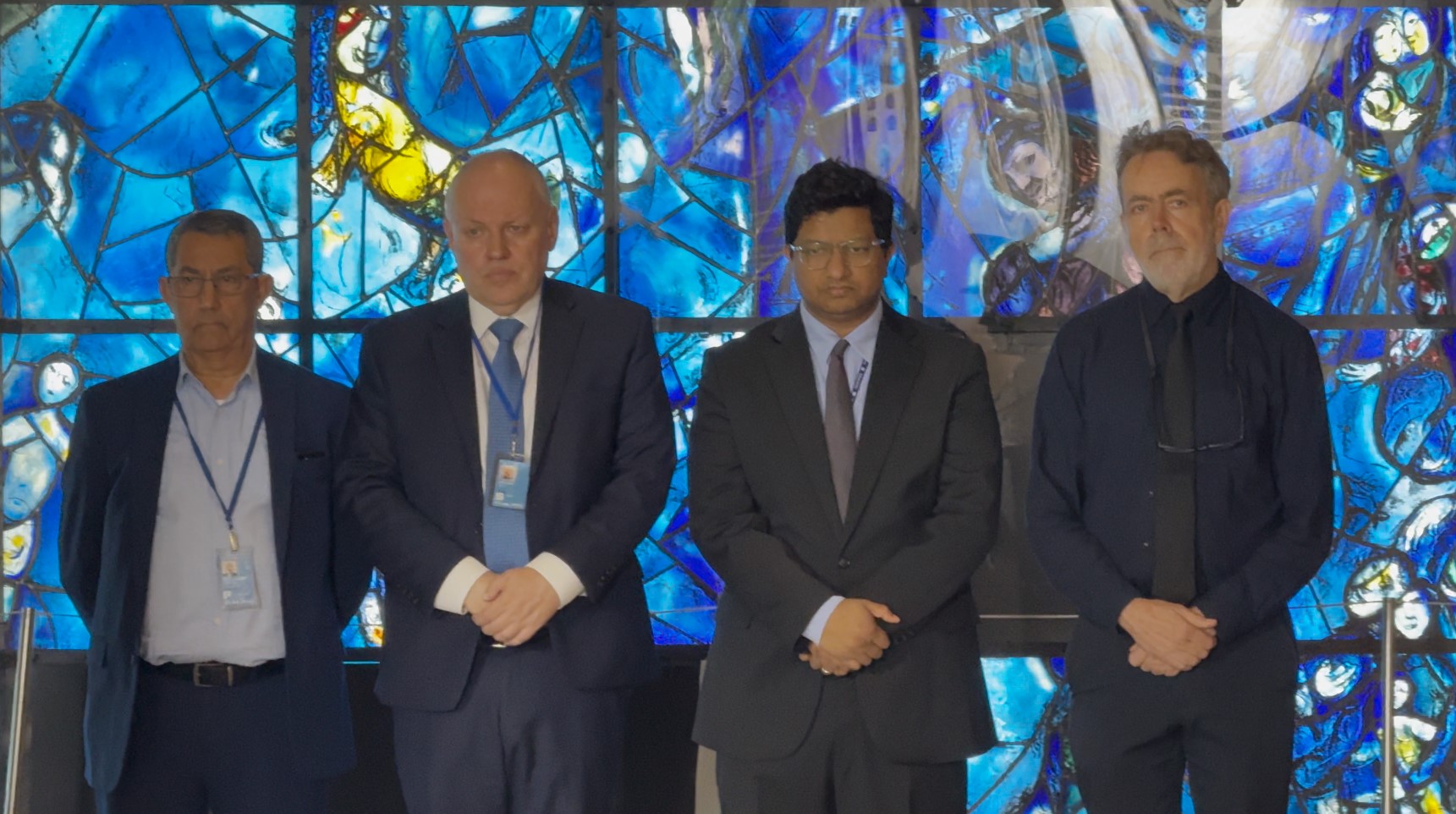
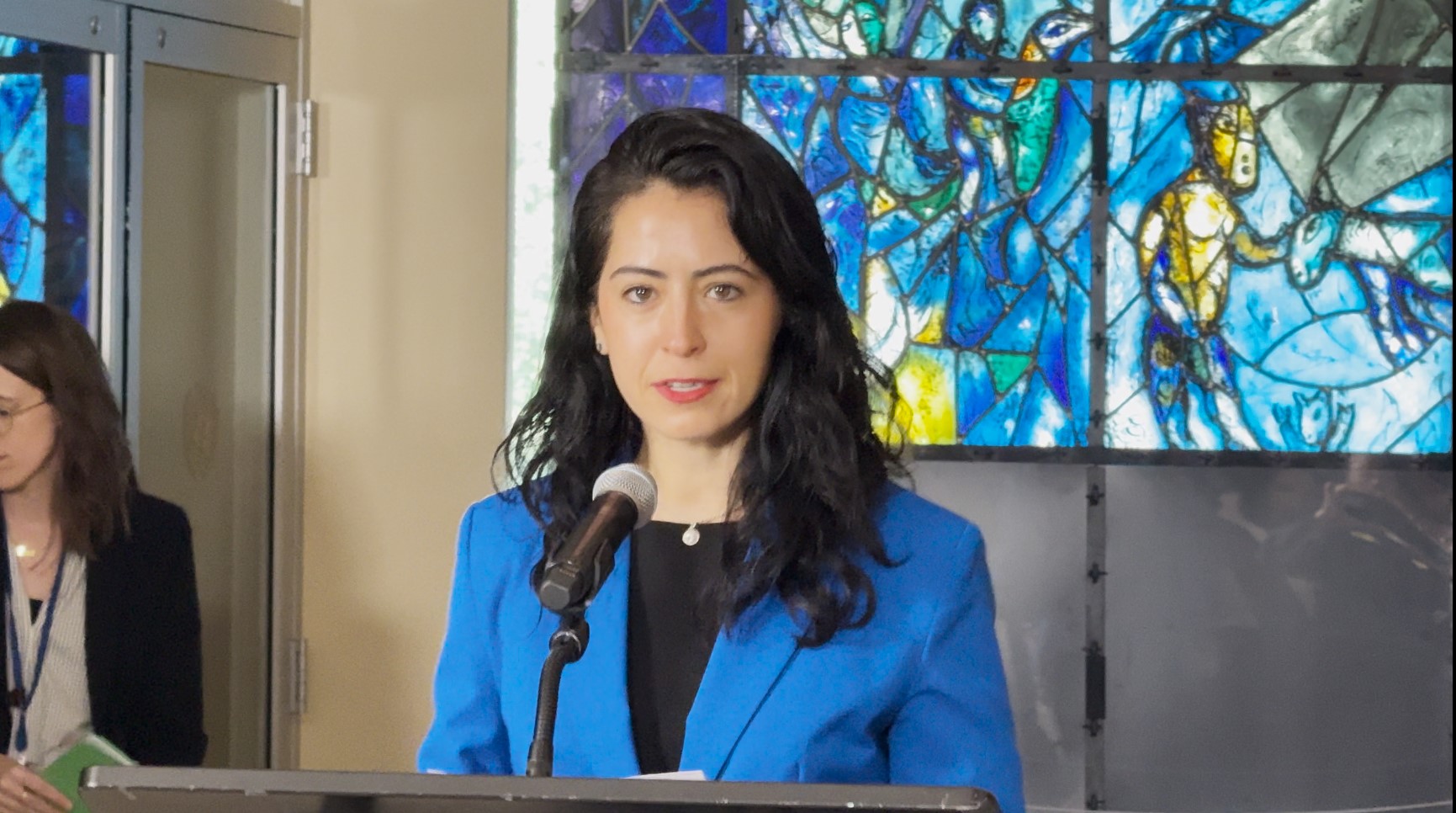
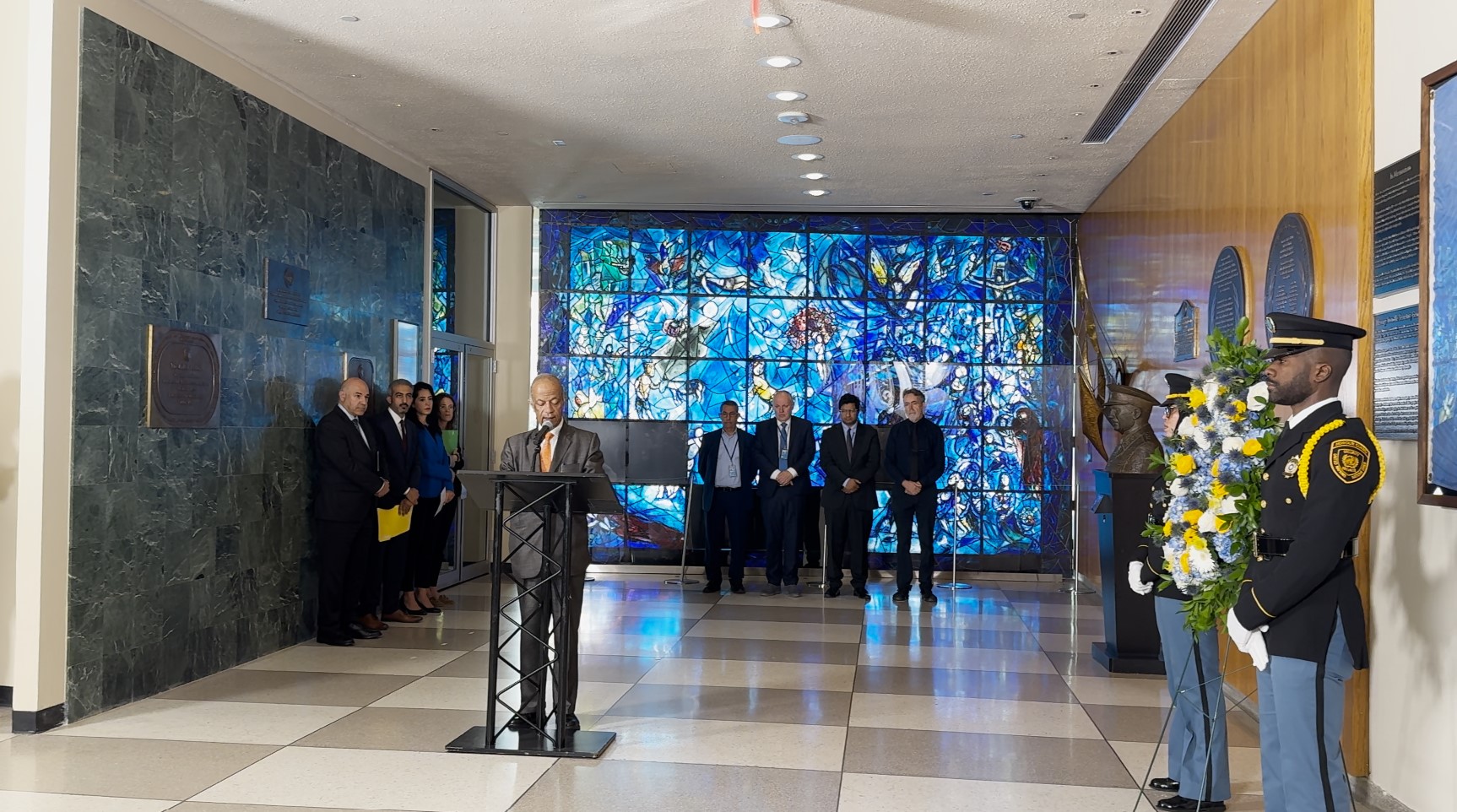
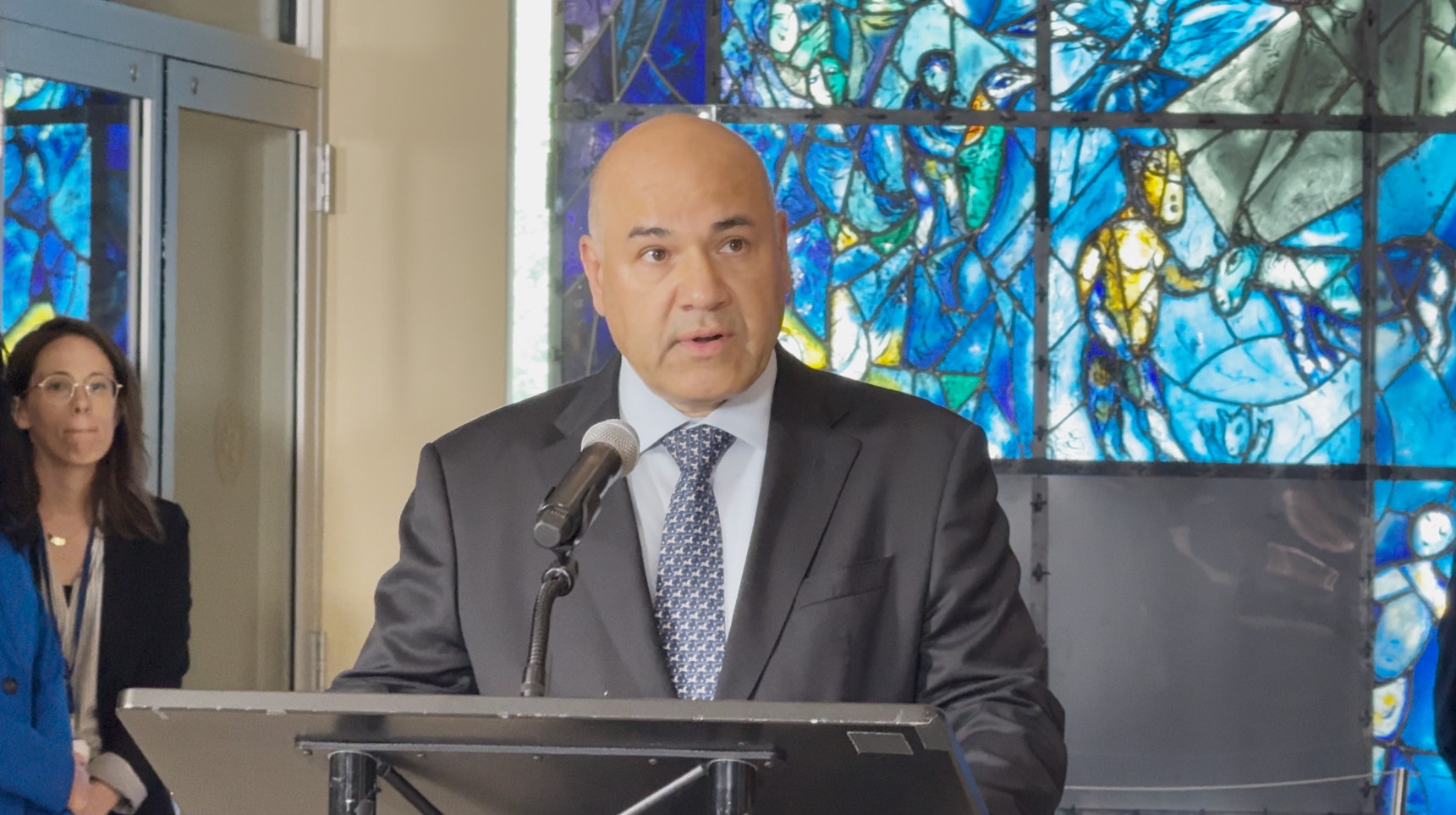
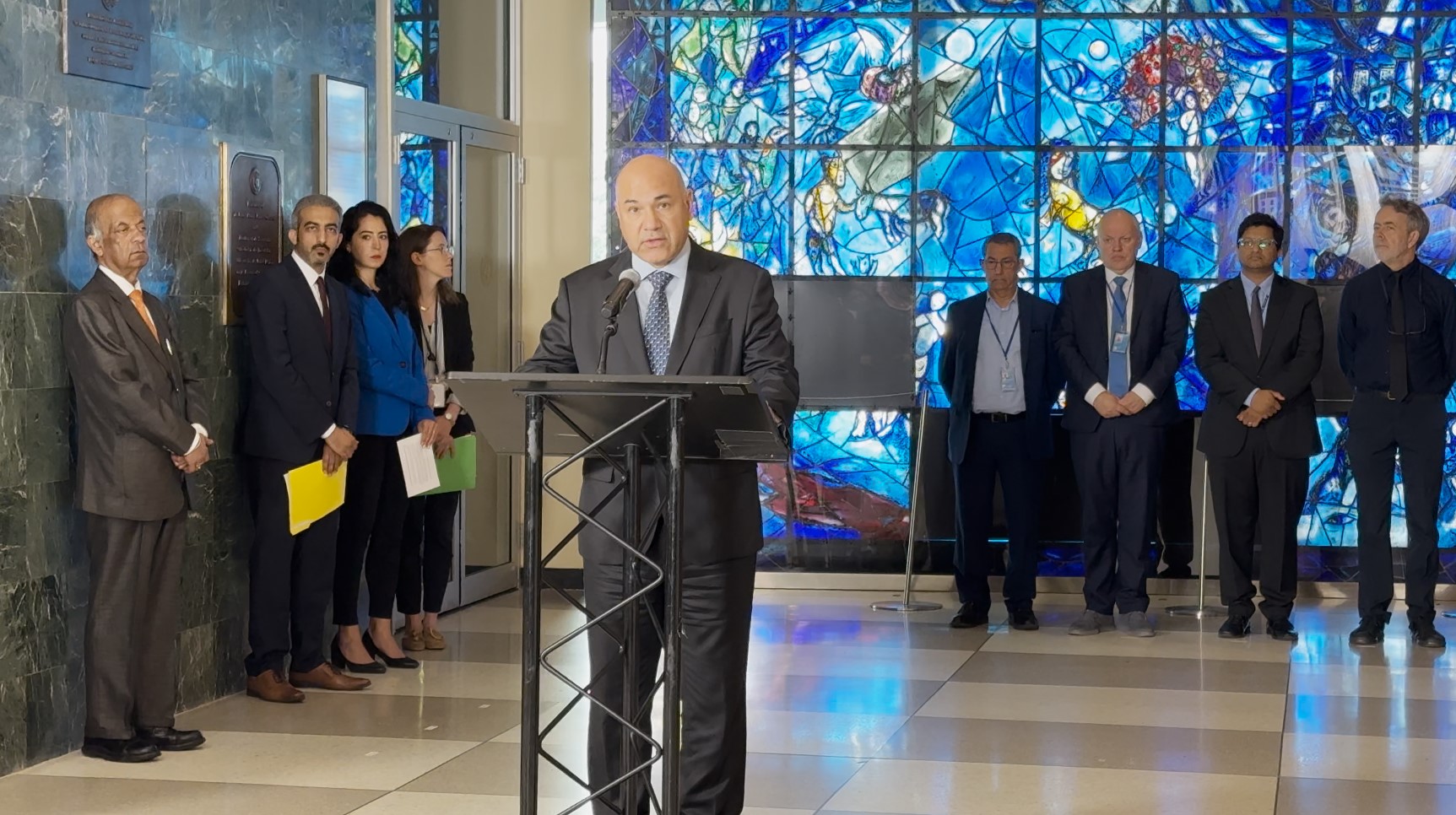
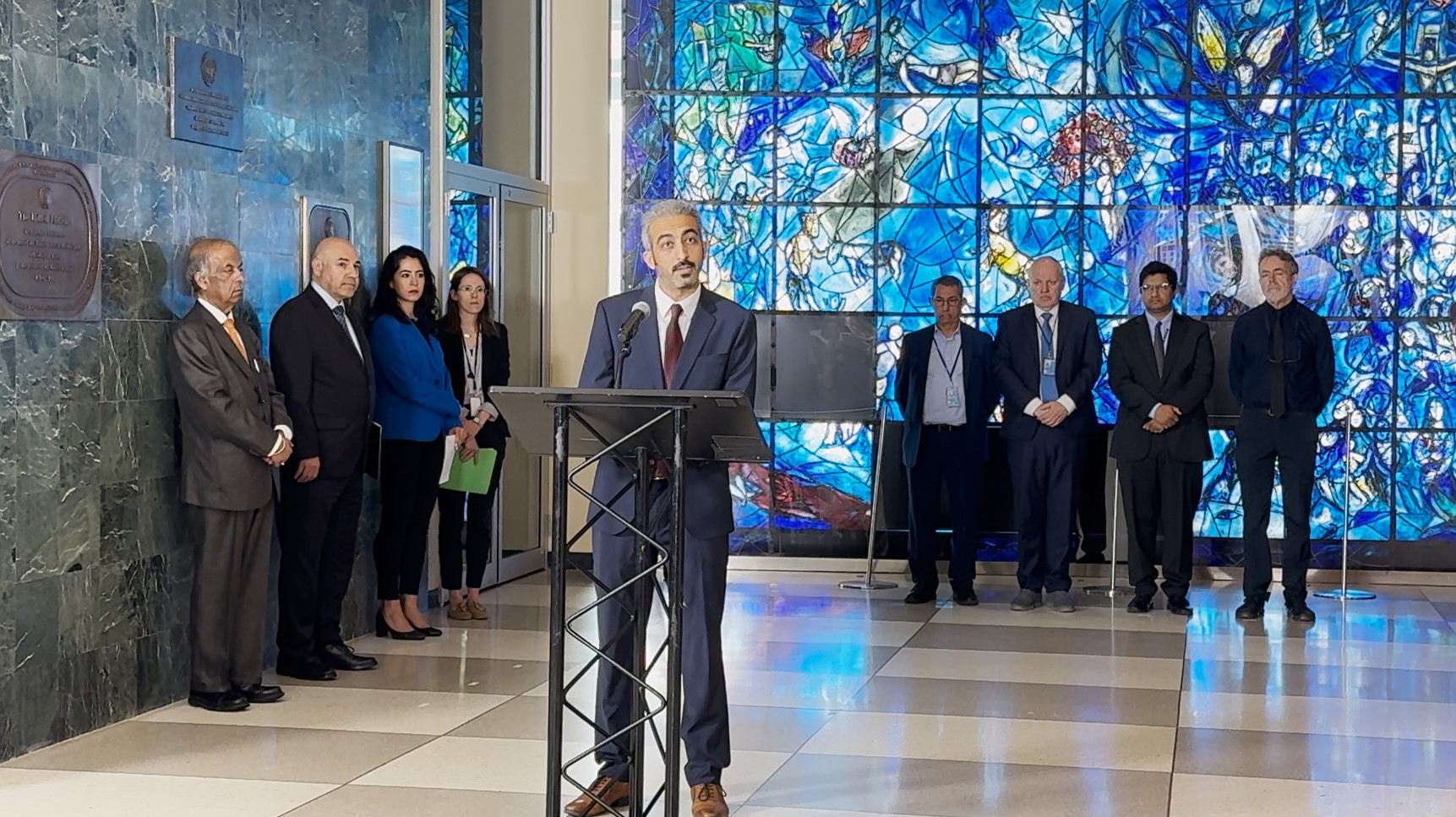
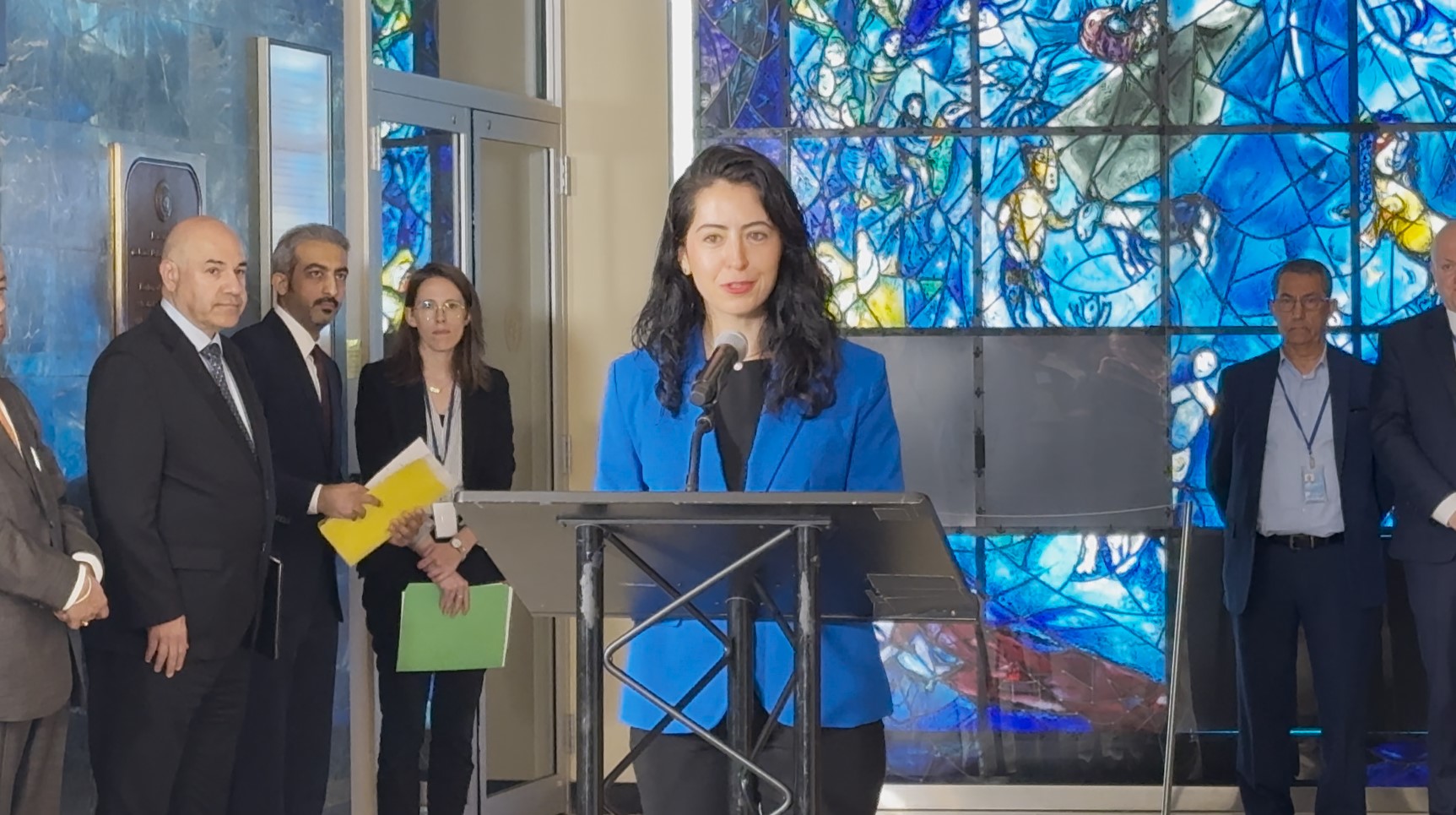
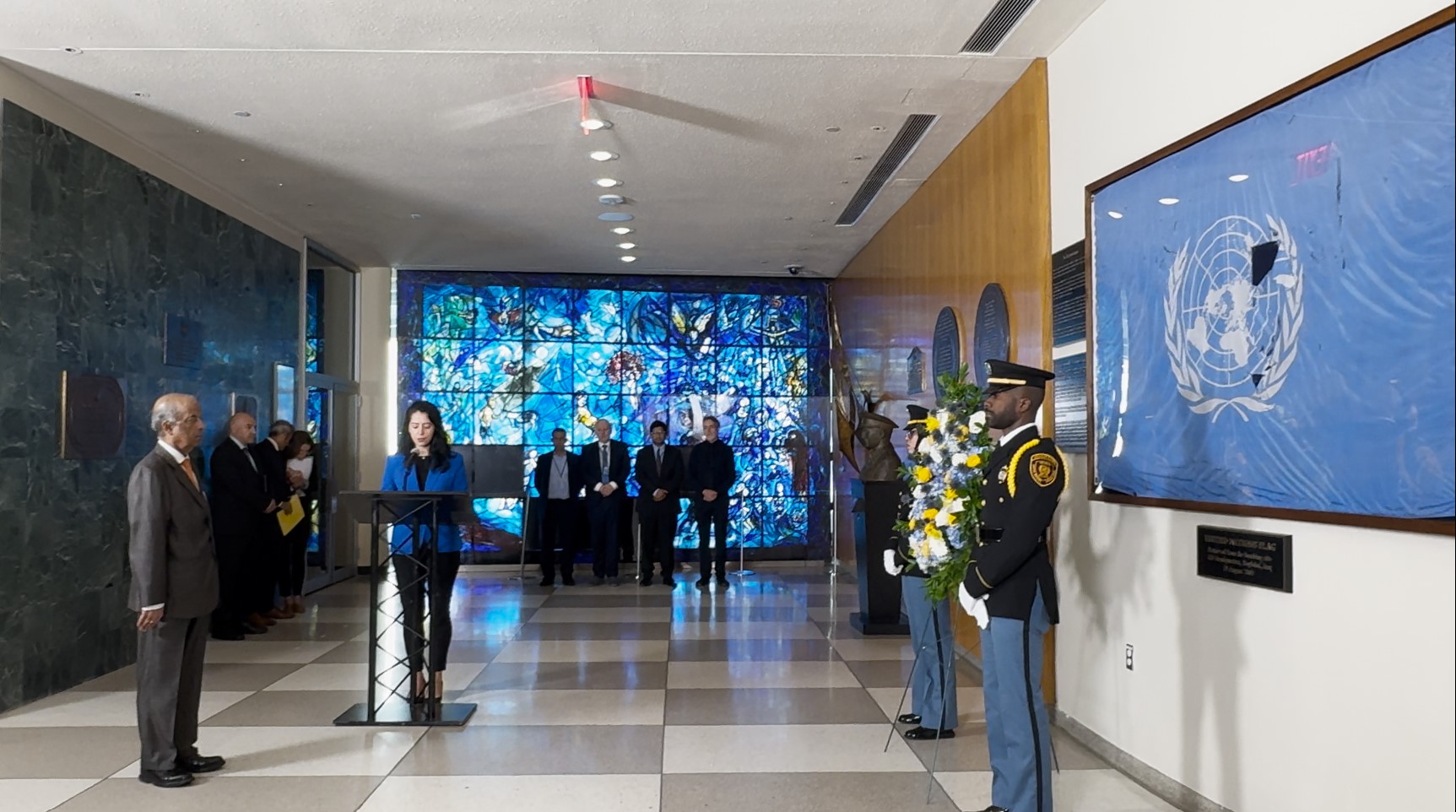
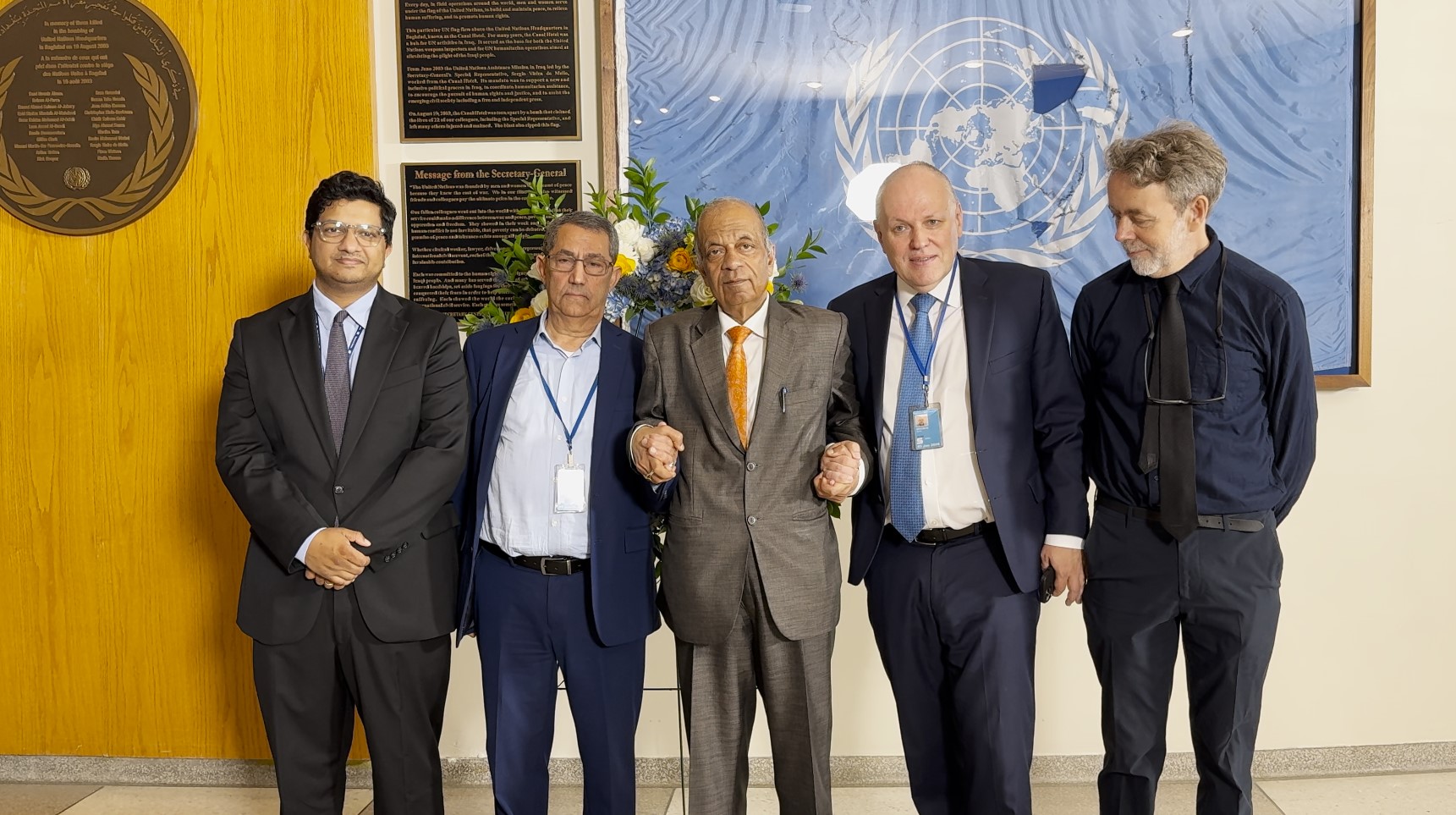
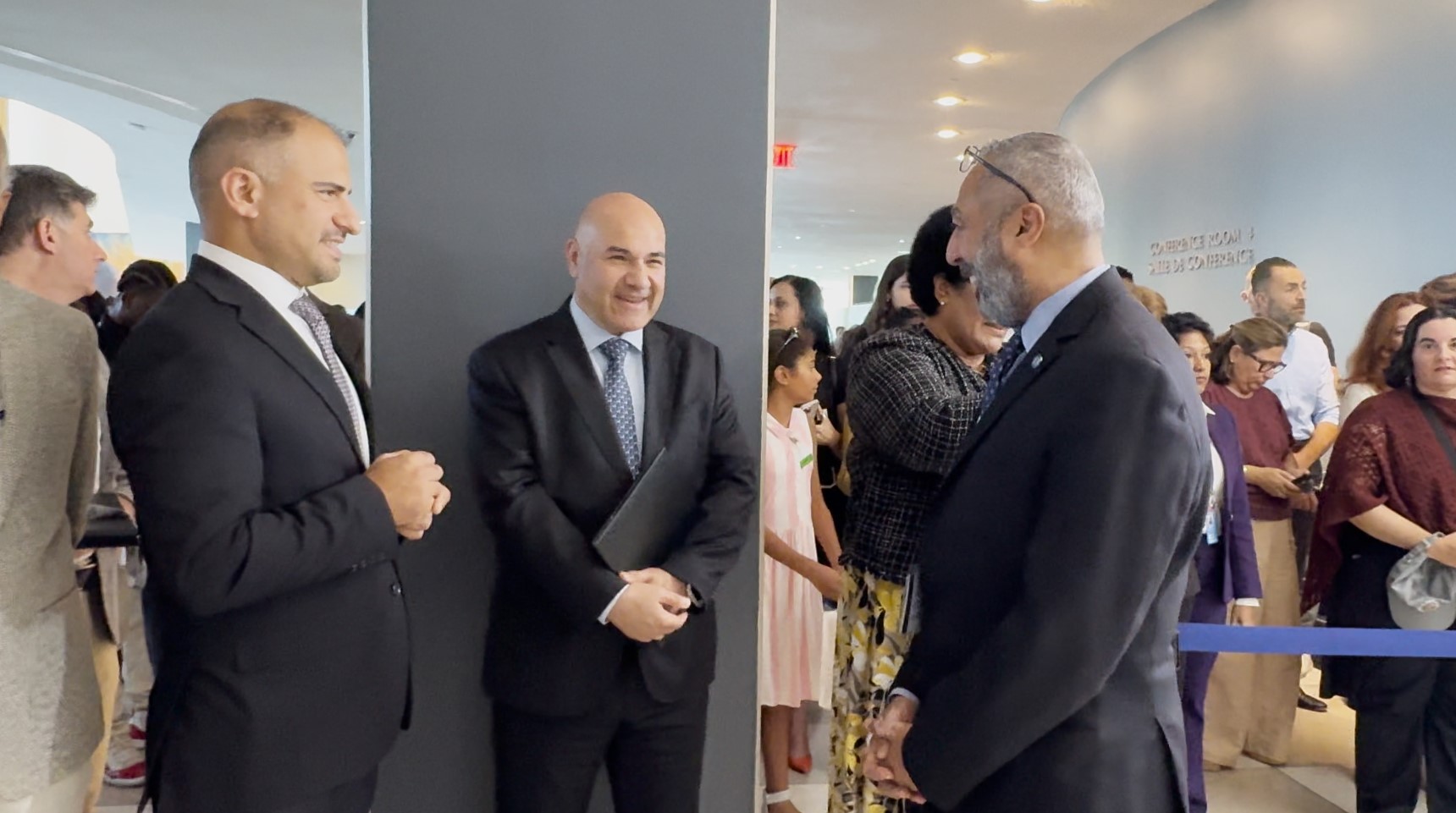
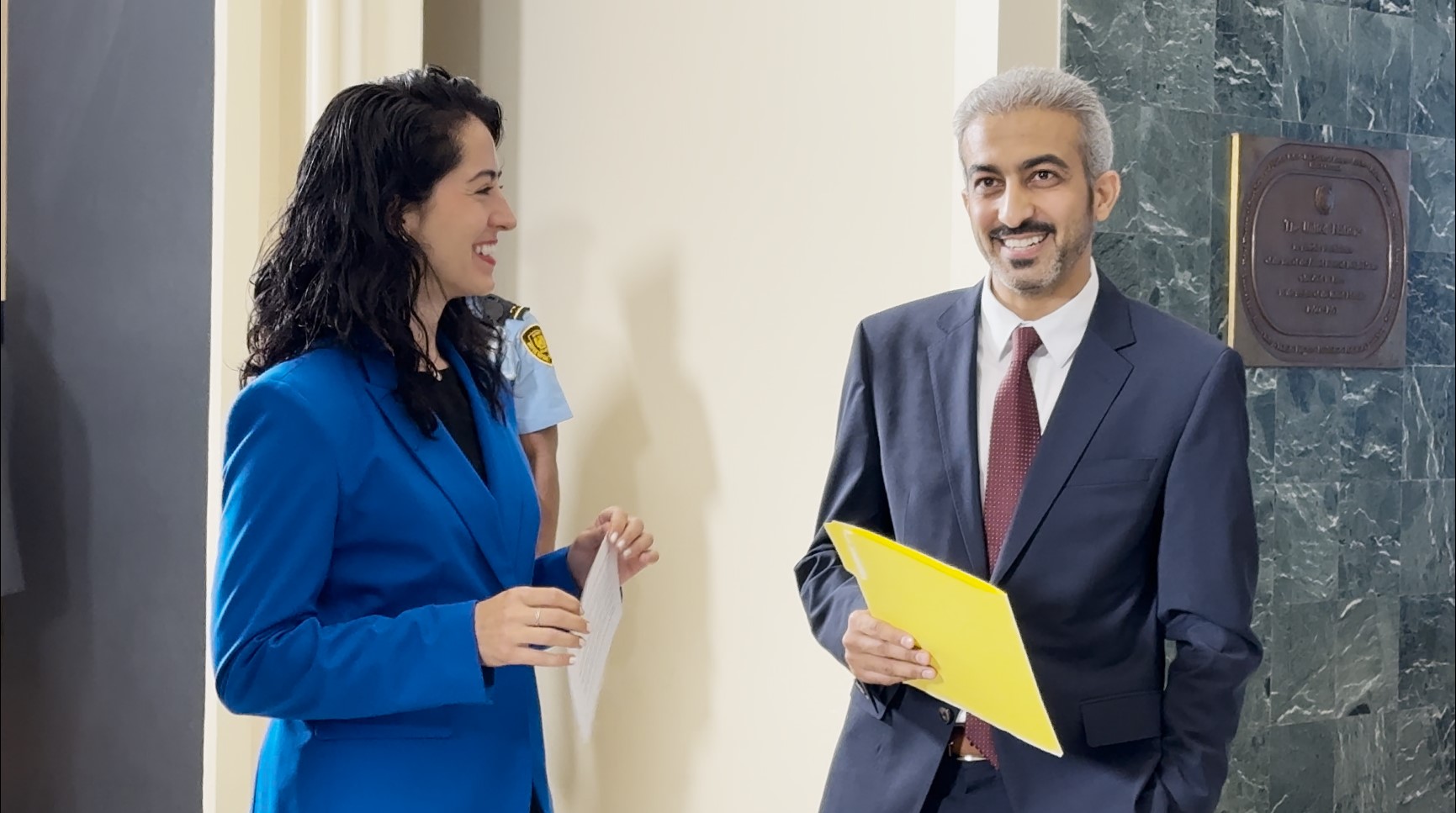
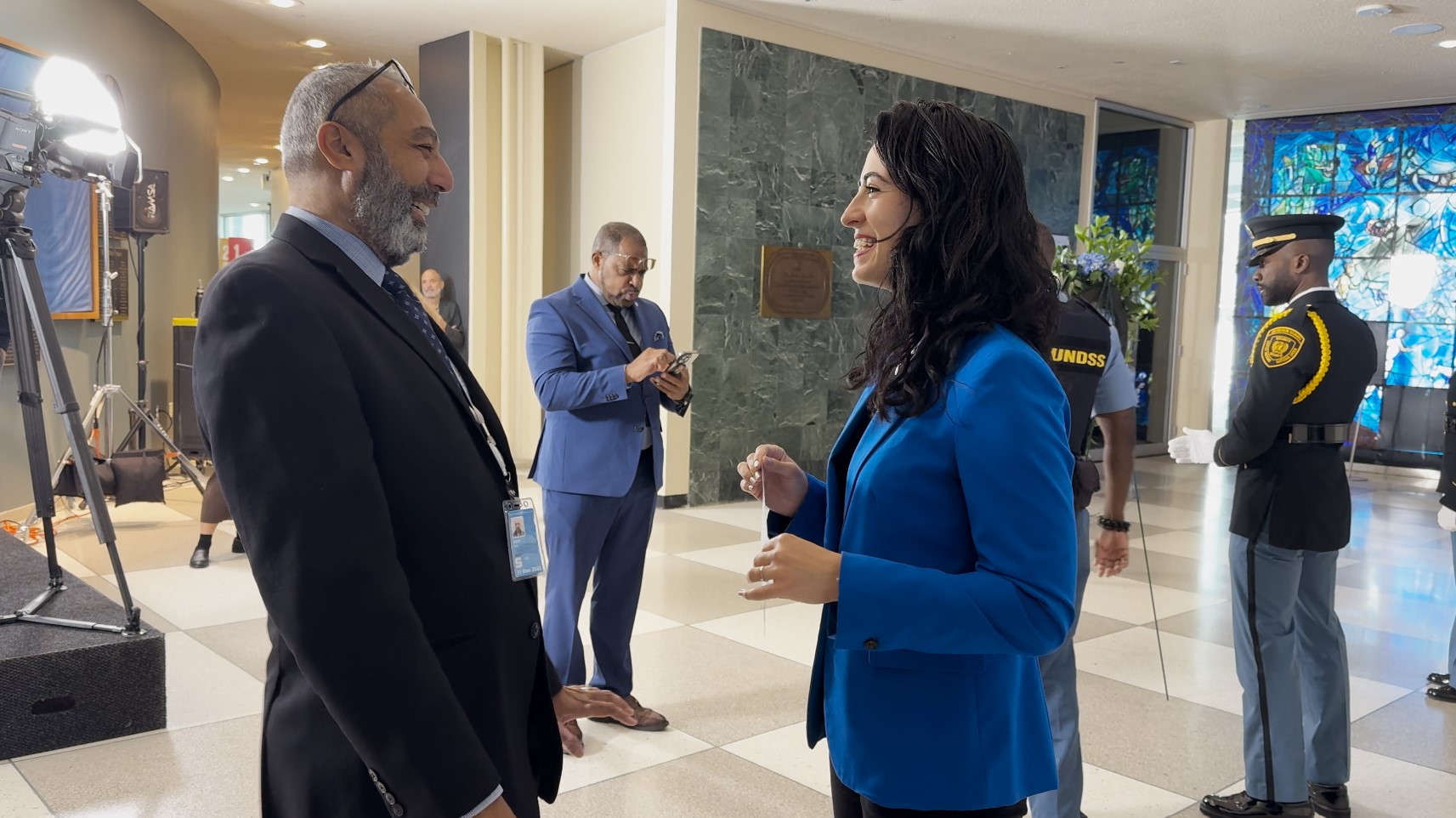
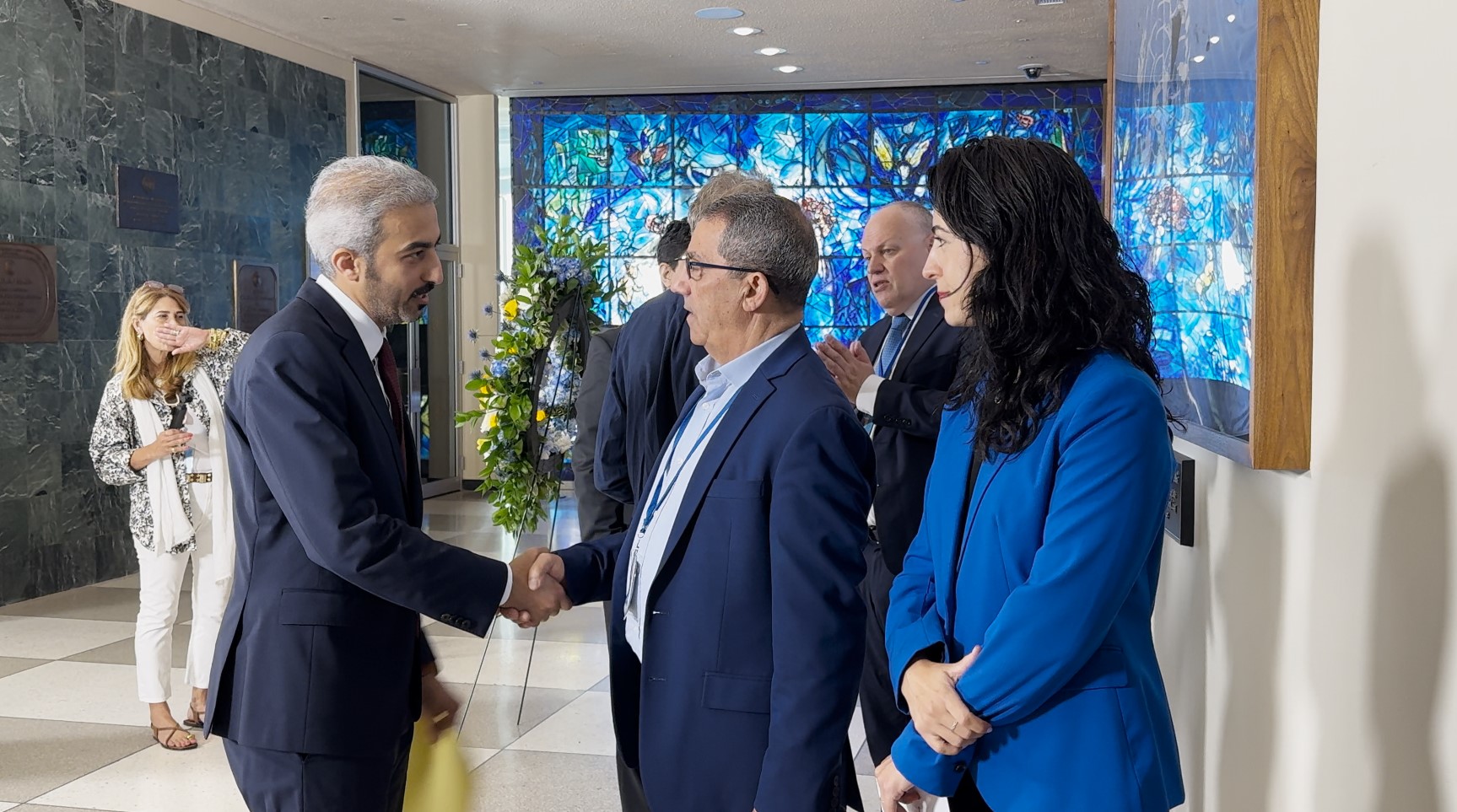
Celebrity Media Commentator: On this day twenty-two years ago, August 19, 2003, the Canal Hotel in Baghdad was struck by a terrorist attack. Twenty-two of our UN colleagues in Iraq lost their lives, including the Special Representative of the Secretary-General, Sérgio Vieira de Mello. This bombing not only shocked Iraq but also became one of the most painful memories in United Nations history.
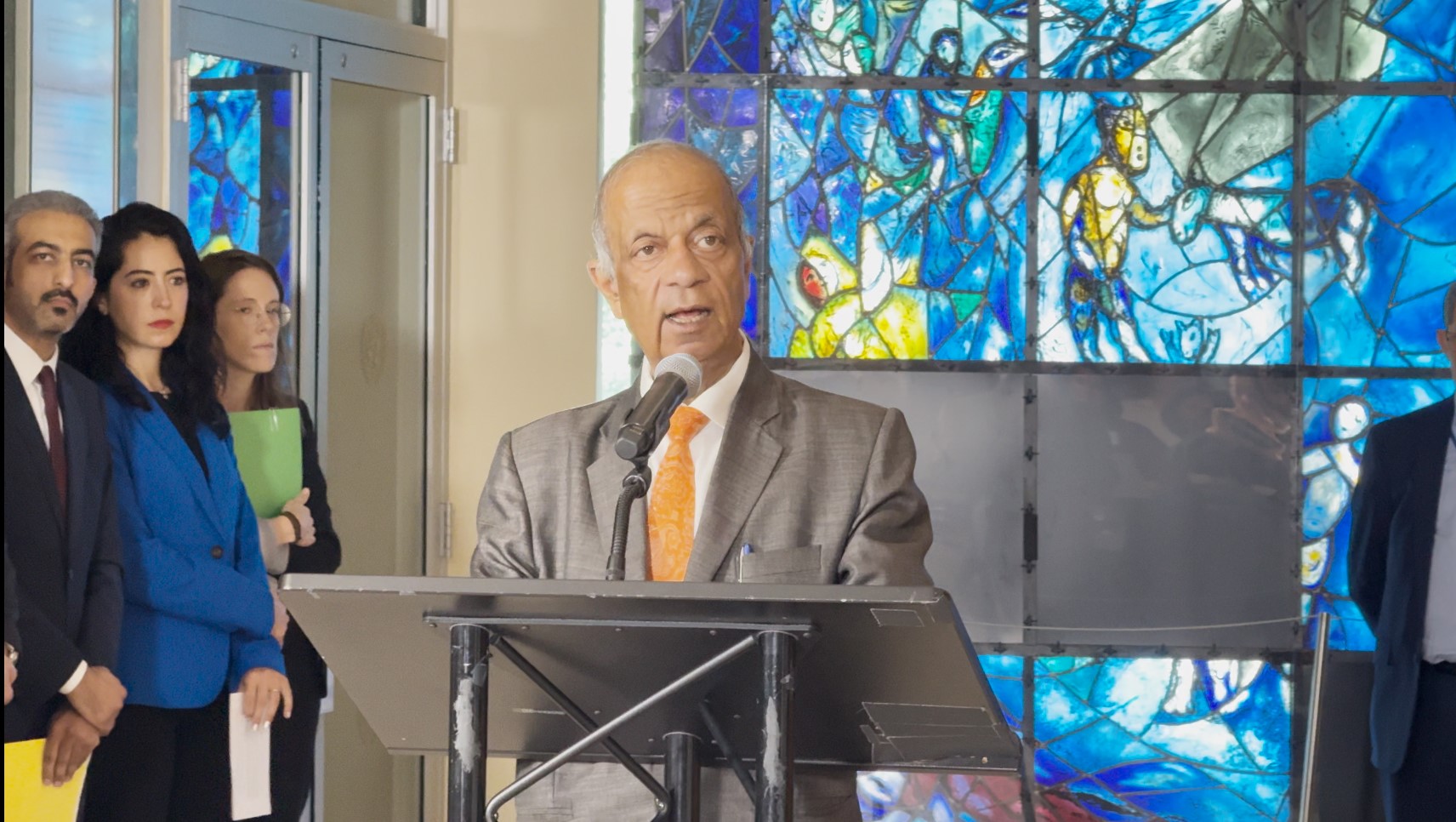
At the commemoration held at United Nations Headquarters in New York, Deputy Secretary-General Atul Khare spoke with deep respect. He emphasized that the Canal Hotel was not only the UN’s mission base in Iraq but also a symbol of its presence and purpose. The attack happened precisely because it represented peace, dignity, and justice. He urged: “Today, as we lay the wreaths, let it be our pledge: we will not forget, we will carry on their legacy.”
Iraq’s Permanent Representative to the UN, Ambassador Lukman Al-Faily, spoke with deep emotion. He recalled the tragedy of that day and noted that six years later, on the same date, Iraq’s Ministry of Foreign Affairs was again targeted by terrorists, killing 47 people. He said: “Terrorism is the common enemy of all humanity. Iraq will steadfastly stand alongside the international community, support humanitarian efforts, and fight against terror and violence.” His words expressed Iraq’s gratitude to the UN while revealing its yearning for lasting peace.
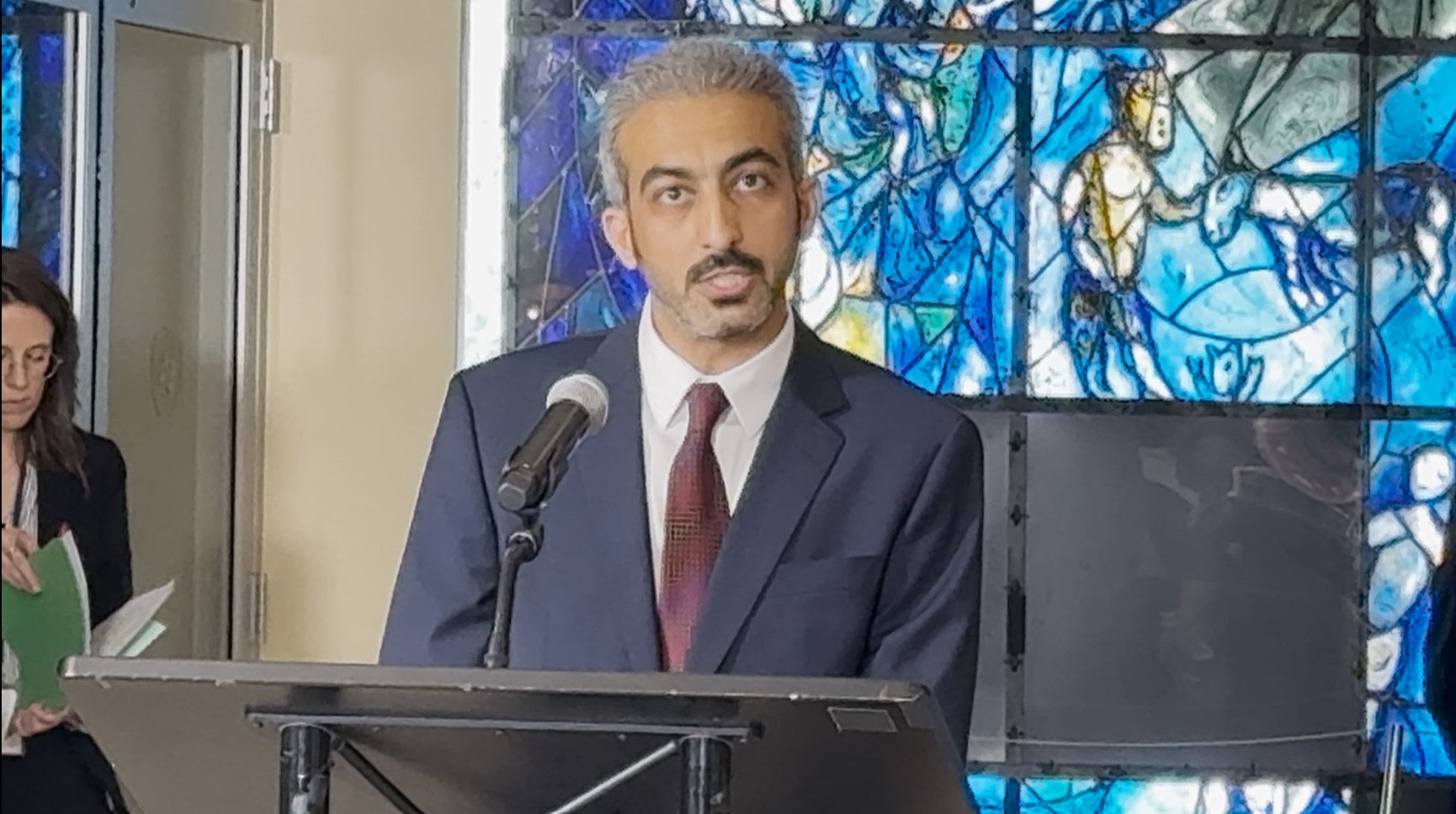
Meanwhile, Abdul Al-Rashid, representing the Security Council, shifted the focus to the present. He pointed out that this year has become the most dangerous so far for UN humanitarian workers, with 380 attacks leading to more than 120 aid workers killed. Nearly two-thirds of them lost their lives in Gaza, and UNRWA alone has lost 243 staff members. He asked gravely: “How can those responsible for the deaths of aid workers and civilians continue to go unpunished?” His words were not only a condemnation of terrorists but also a challenge to the international community.
We believe these three speakers, from different perspectives, revealed a common theme: remembrance belongs not only to the past but also to the future. The Deputy Secretary-General emphasized the UN’s values and commitment, the Iraqi Ambassador expressed the suffering and resilience of the victimized nation, while Al-Rashid highlighted today’s urgent concern for humanitarian workers’ safety. Together, they painted a vivid picture of the international community confronting the challenge of terrorism.
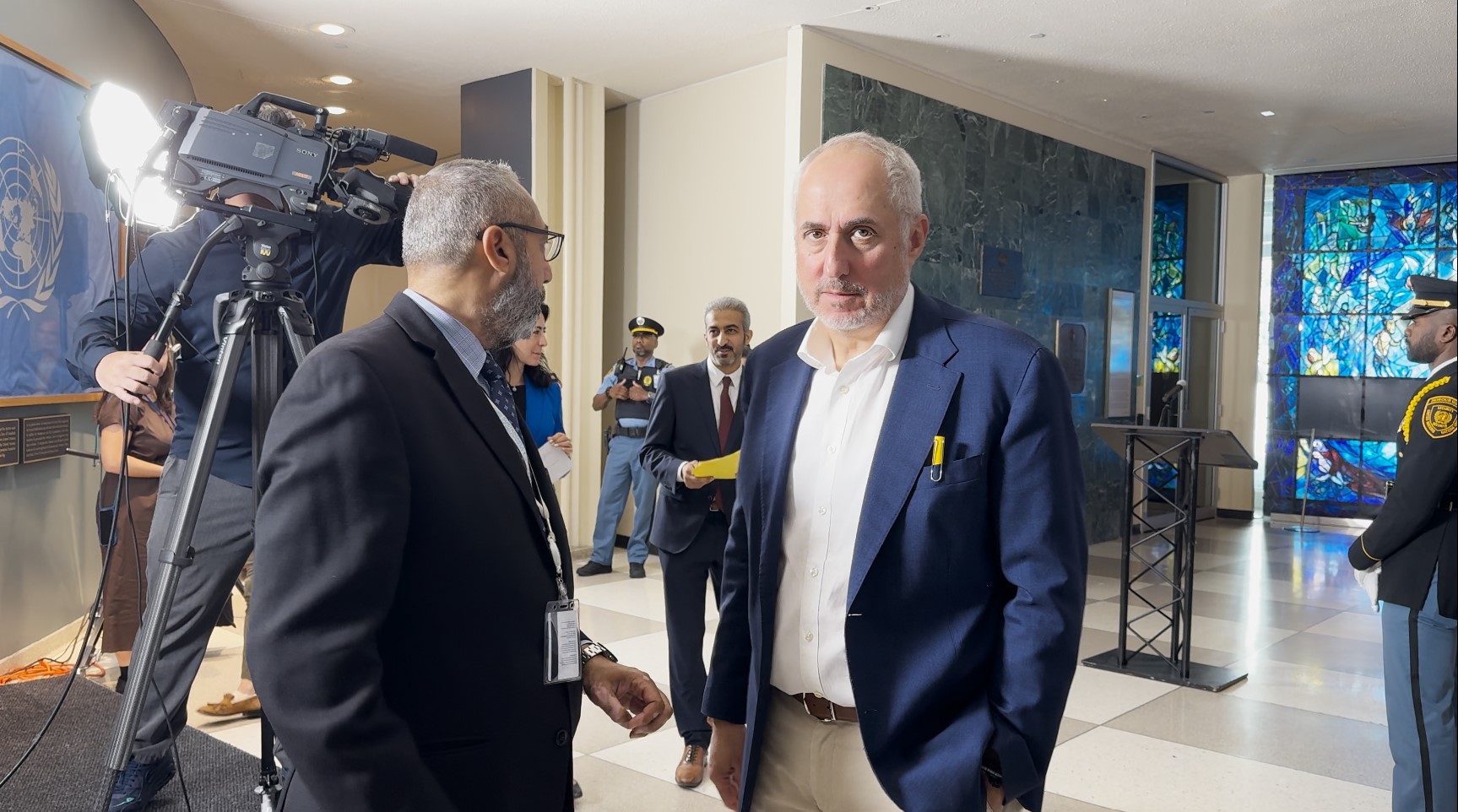
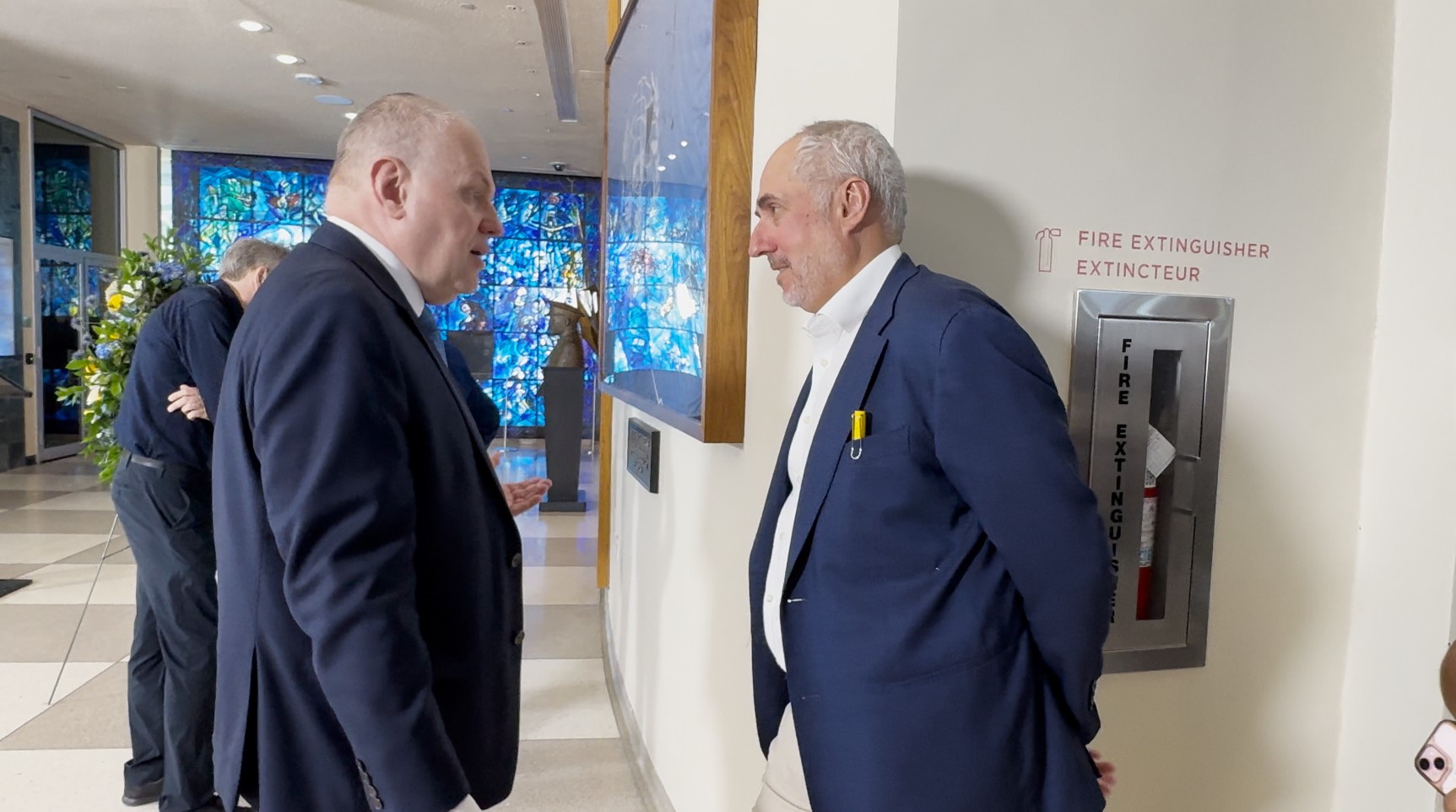
UN Secretary-General Spokesperson: Stéphane Dujarric de la Rivière
However, it is heartbreaking that terrorist attacks have not diminished over time, but in some regions have even worsened. Commemoration cannot remain at the ceremonial level alone; it cannot answer the sacrifice of the victims. True remembrance must be action: strengthening protection for humanitarian personnel, ensuring international law and accountability mechanisms are enforced, and preventing humanitarian work from becoming a casualty of violence.
As flowers were laid and silence observed, Celebrity Media joins all participants in underscoring: to carry on their legacy is not only mourning but also responsibility. Each life lost reminds the international community that peace and dignity are not abstract words, but commitments written with the lives of generations of dedicated people. True remembrance is to ensure their unfinished mission continues today.
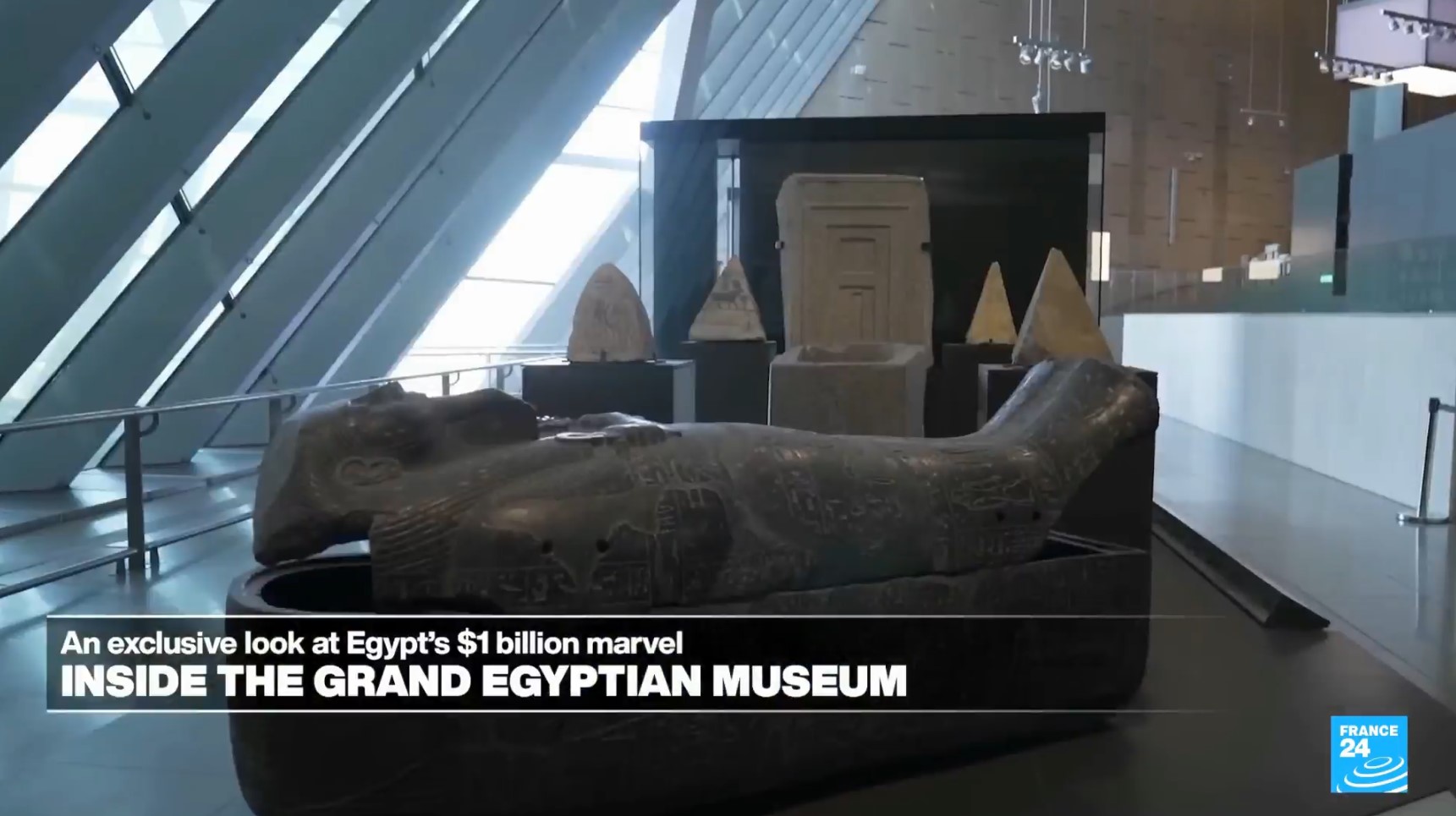
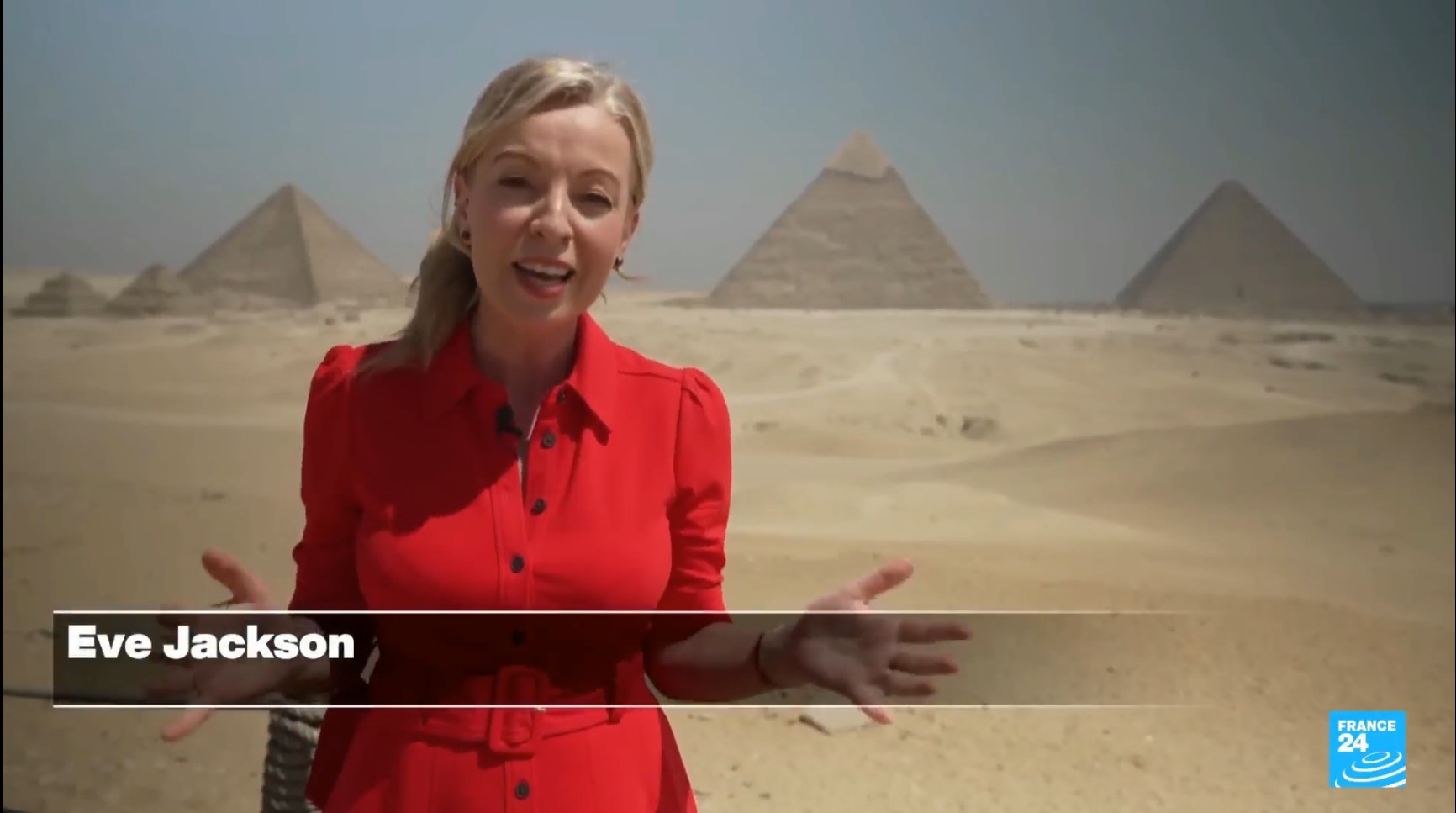
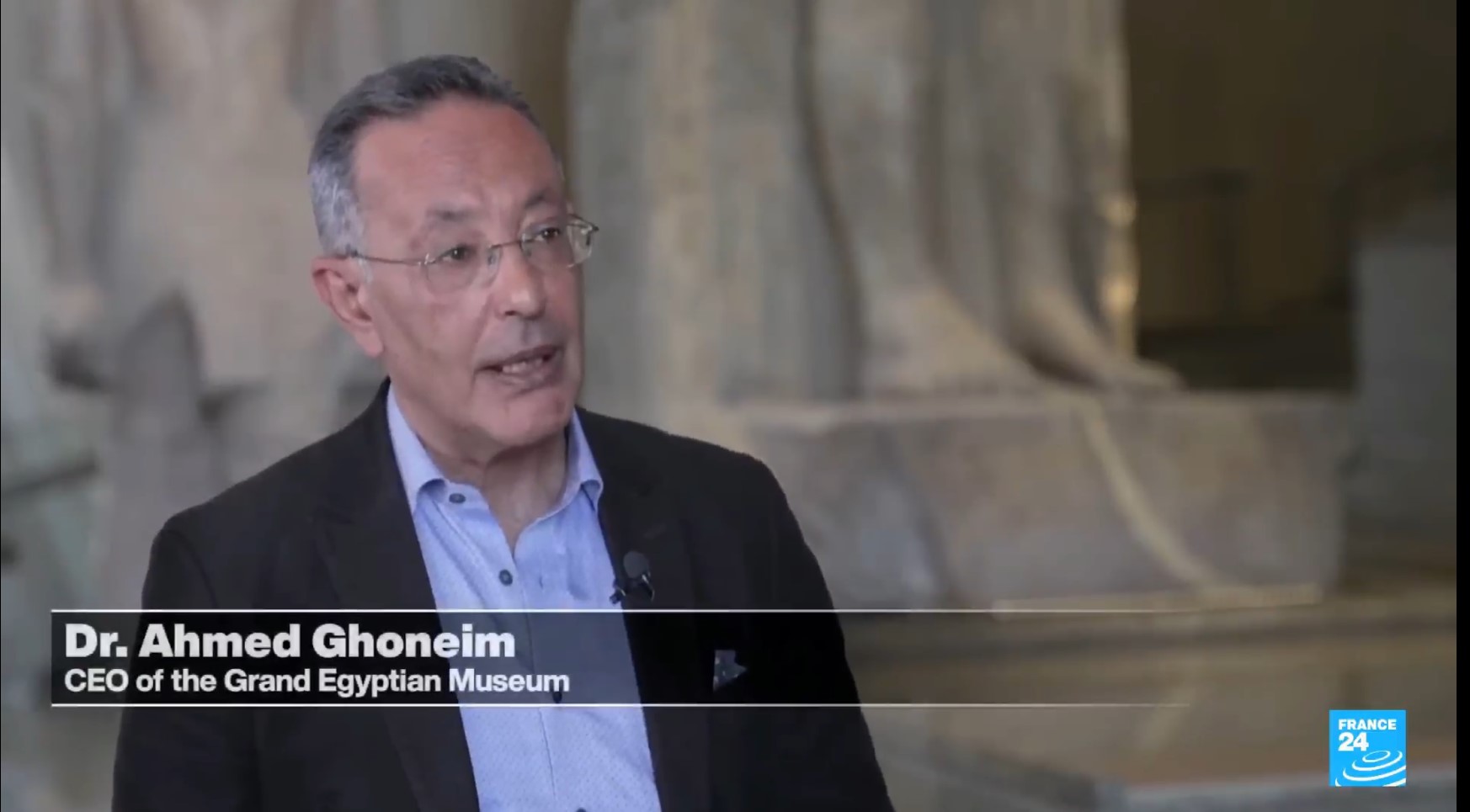
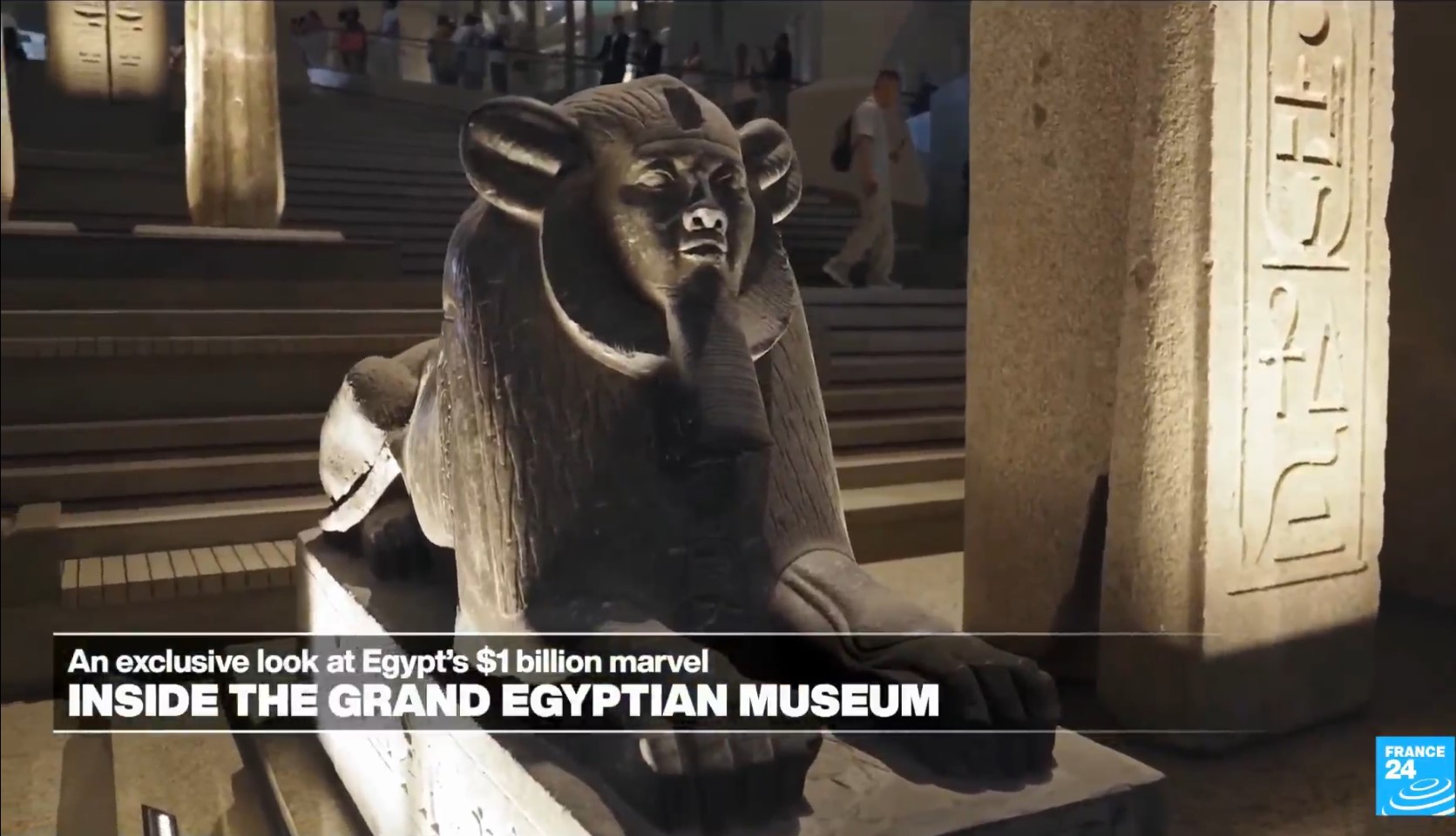
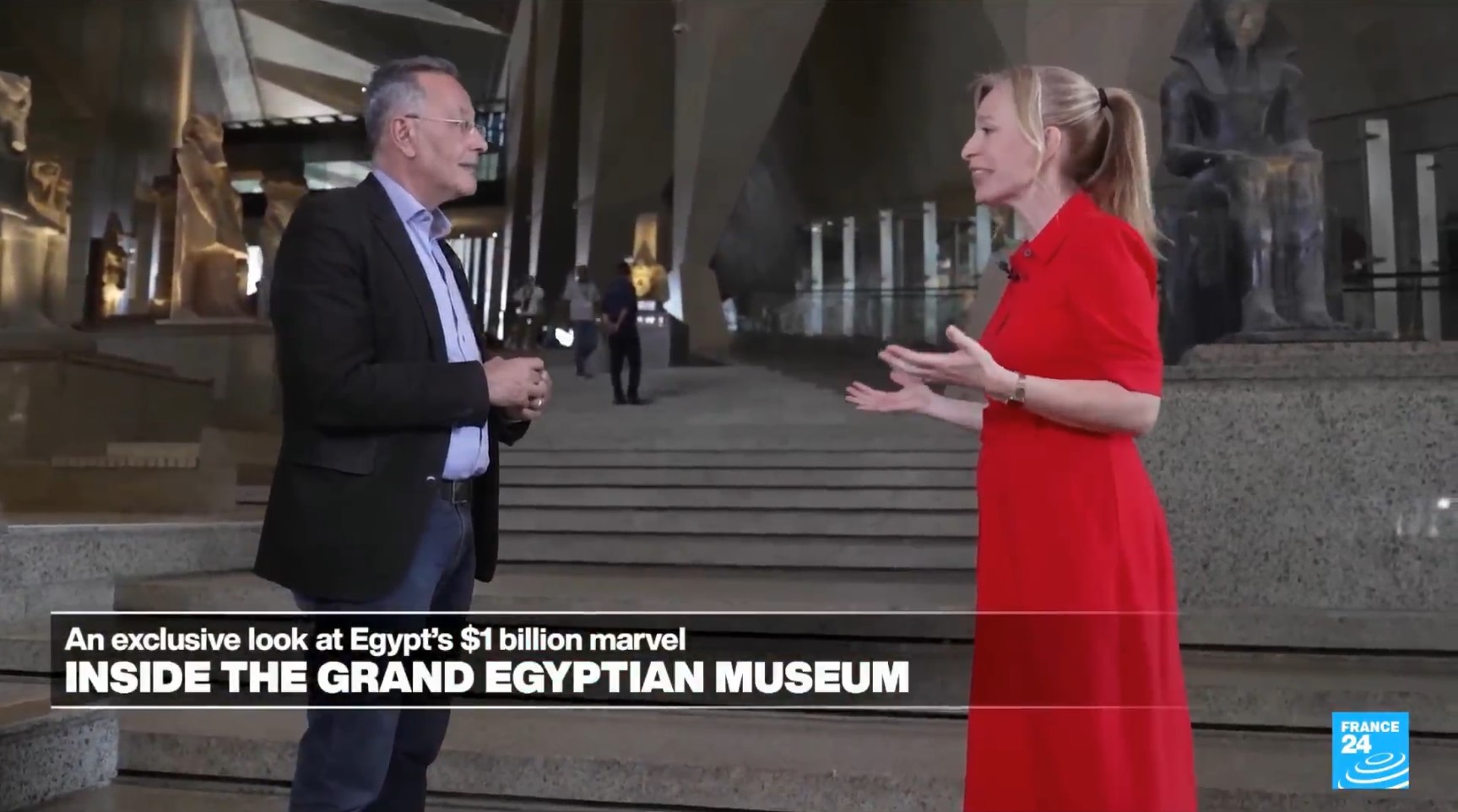
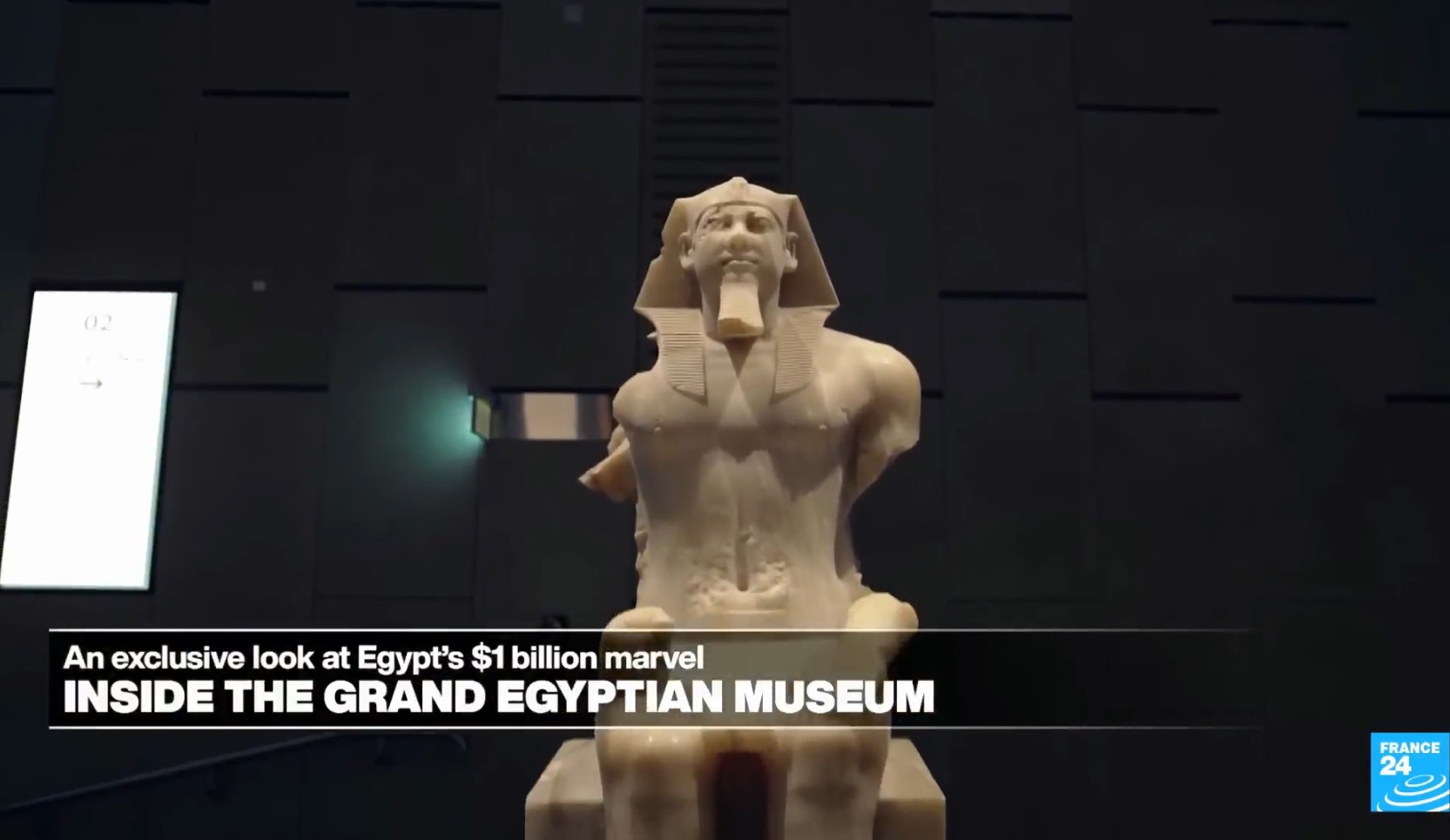
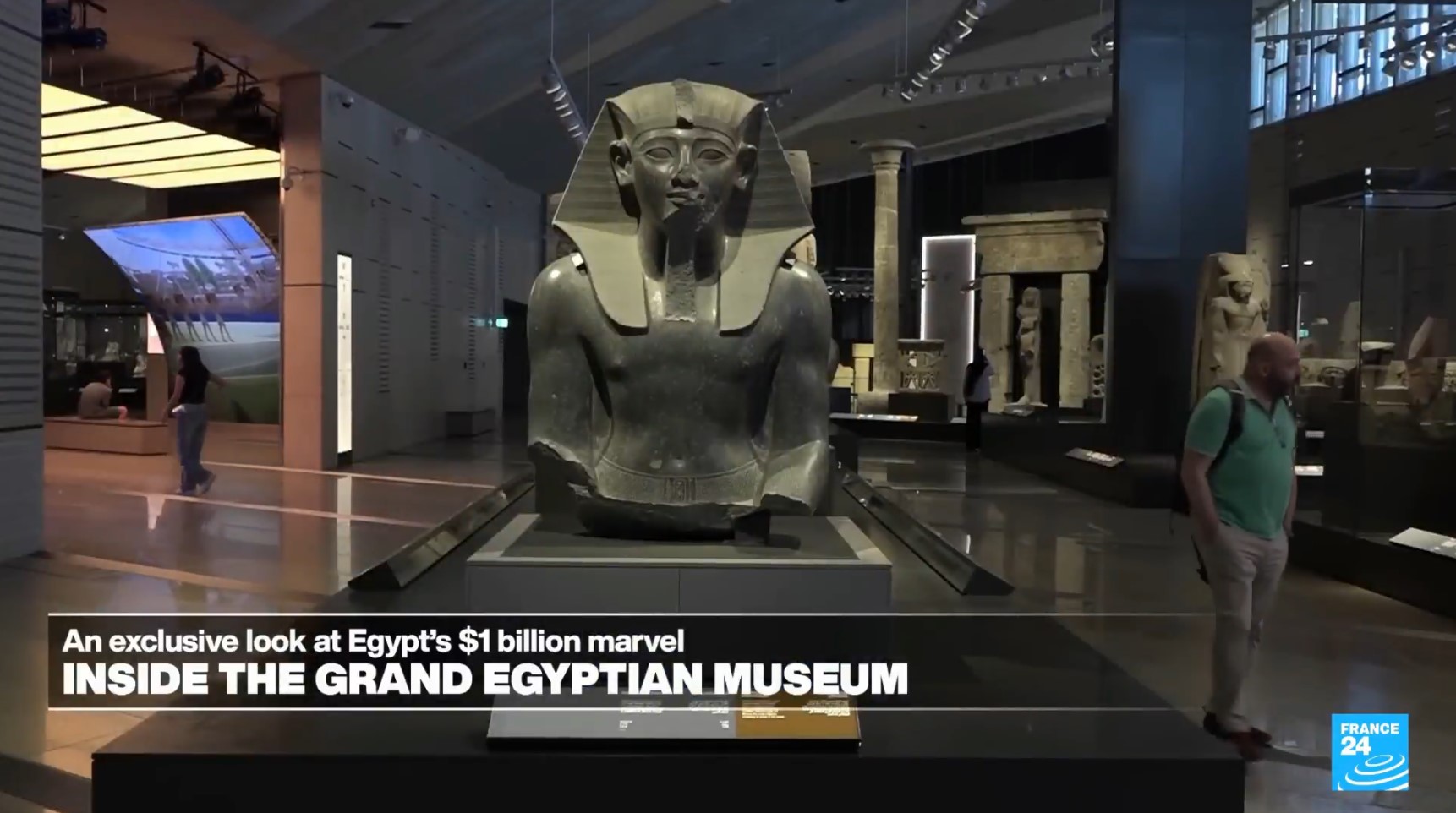
Celebrity Media Commentator: According to reports, the Grand Egyptian Museum (GEM), located in the Giza Pyramid tourist area, will be fully opened on November 1, 2025. On that day, heads of state, senior officials, cultural leaders, and renowned artistic groups from around the world will gather in Cairo to witness how this cultural giant, whose construction took more than twenty years, finally celebrates its “coming of age.”
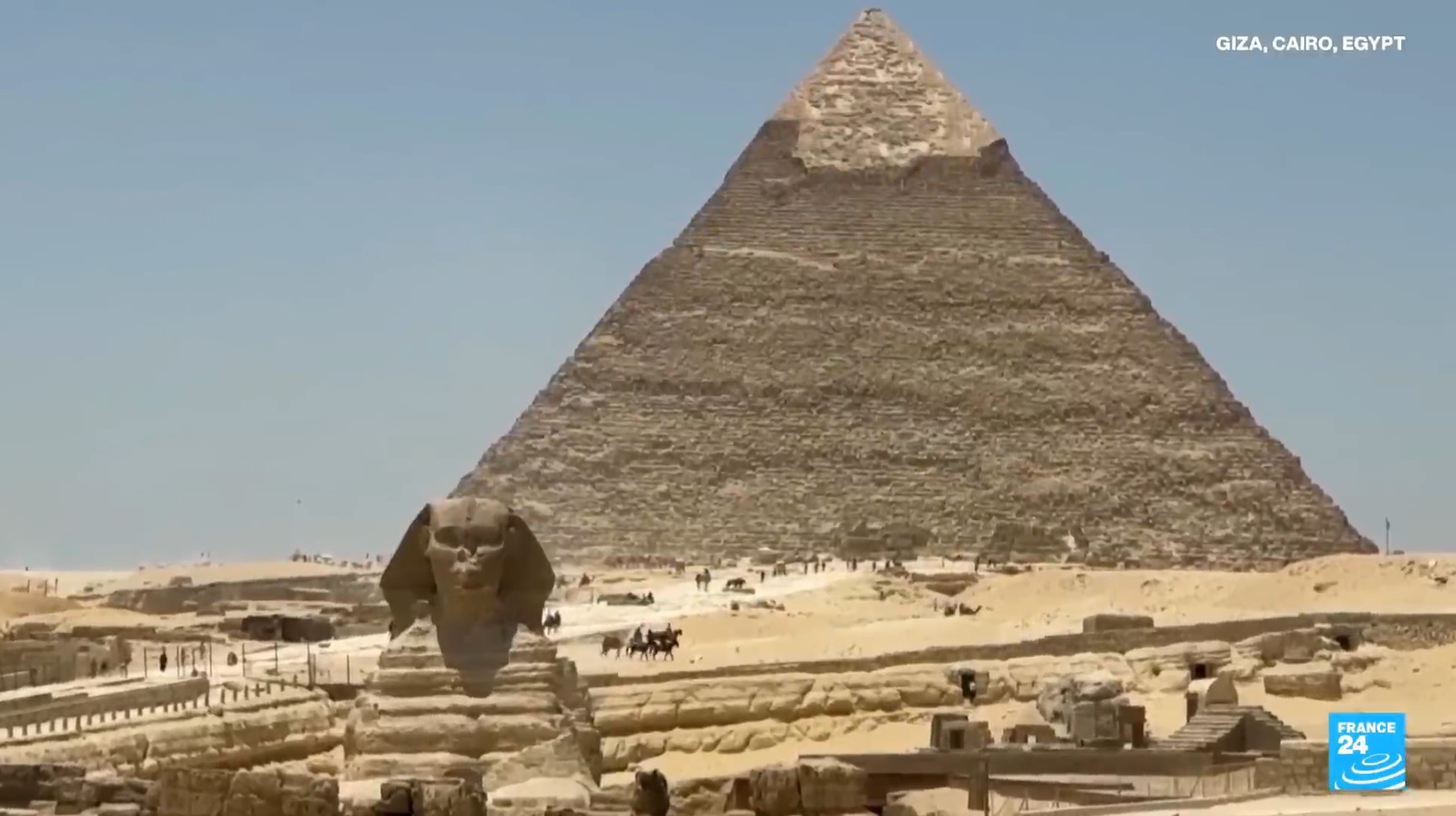
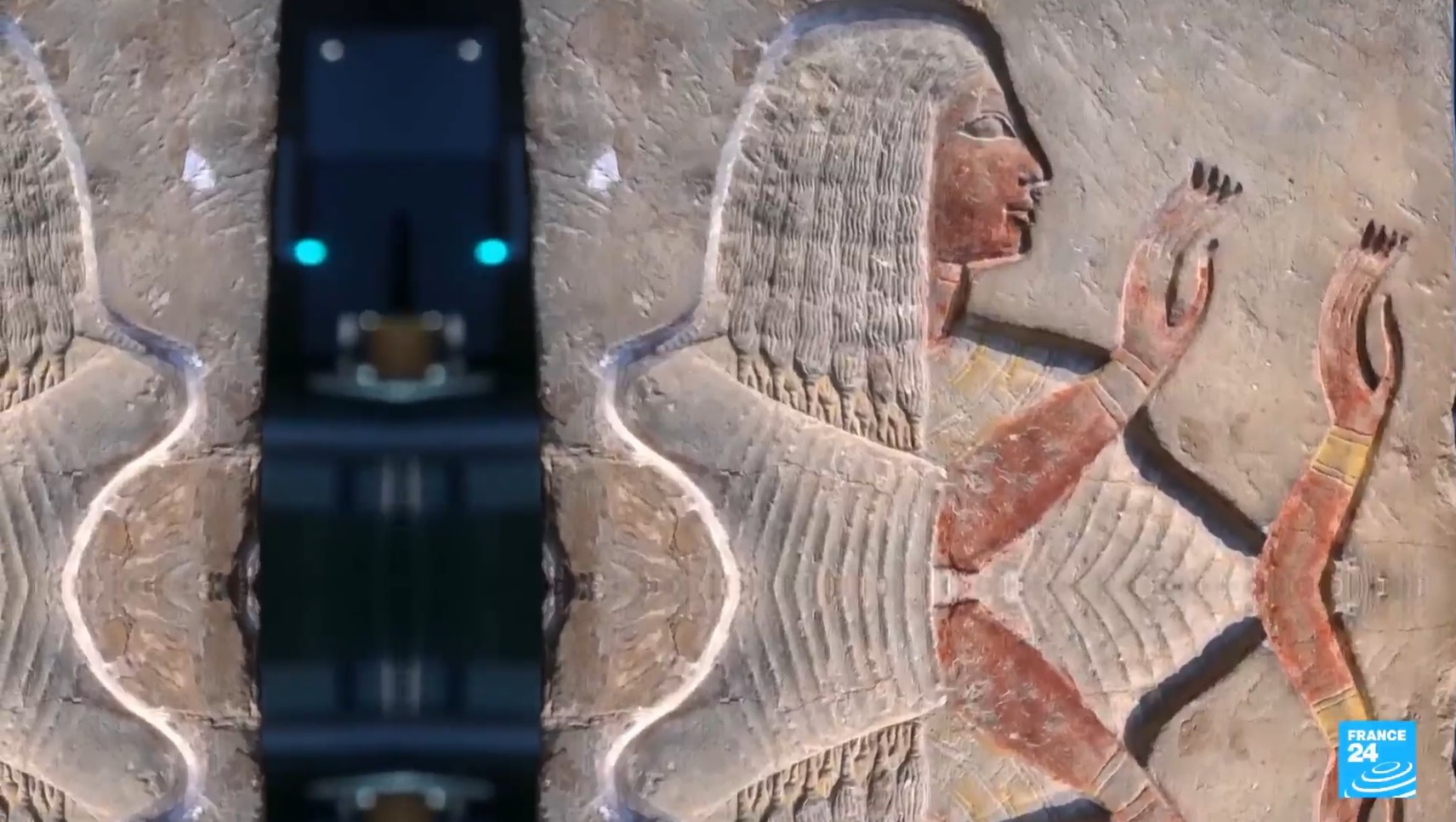
From the outside, this is not just a museum but a true work of architectural art. It harmoniously echoes the pyramids, blending ancient stone civilization with modern geometric aesthetics, like two banks of a river of time — one belonging to Egypt over three thousand years ago, the other to today’s globalized world. From the very beginning of the project, the United Nations Educational, Scientific and Cultural Organization (UNESCO) was involved, providing support in the international design competition, construction management, and shaping its cultural value. In late 2024 and early 2025, GEM was awarded the UNESCO “World’s Most Beautiful Building” Pritzker Architectural Aesthetics Award — recognition not only of its exterior design but also of the civilizational significance it embodies.
The history of the Grand Egyptian Museum (GEM) is full of patience and perseverance. In 2002, an international design competition was launched; in 2005, construction began; in 2011, work was halted due to regional instability; in 2014, it resumed — and only today is the museum ready for full opening. Of the one billion dollars invested, part came from long-term concessional loans from Japan, and part from years of waiting by the Egyptian people for their cultural dream. This lengthy construction process made its completion itself a glorious page in modern Egyptian history.
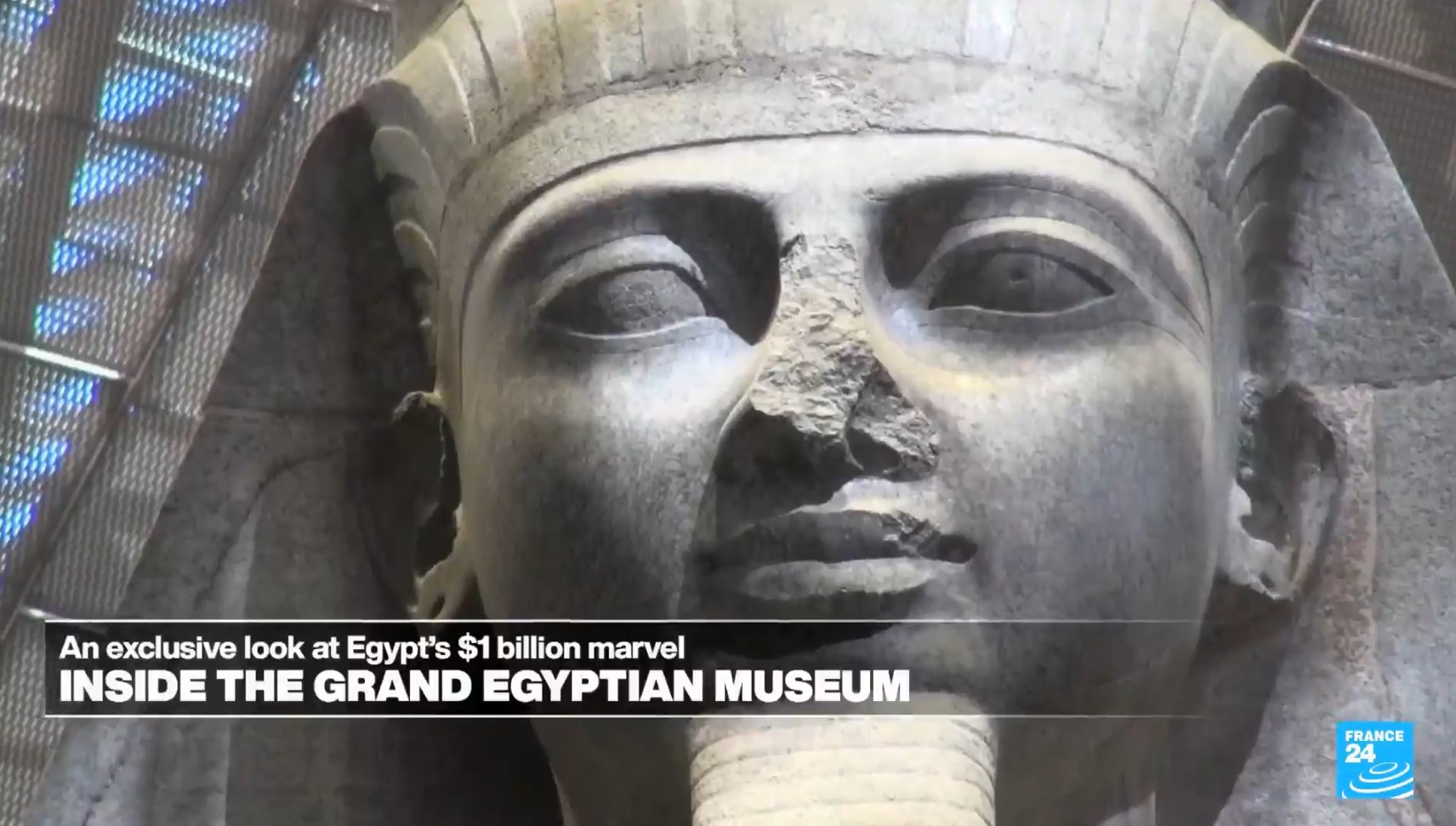
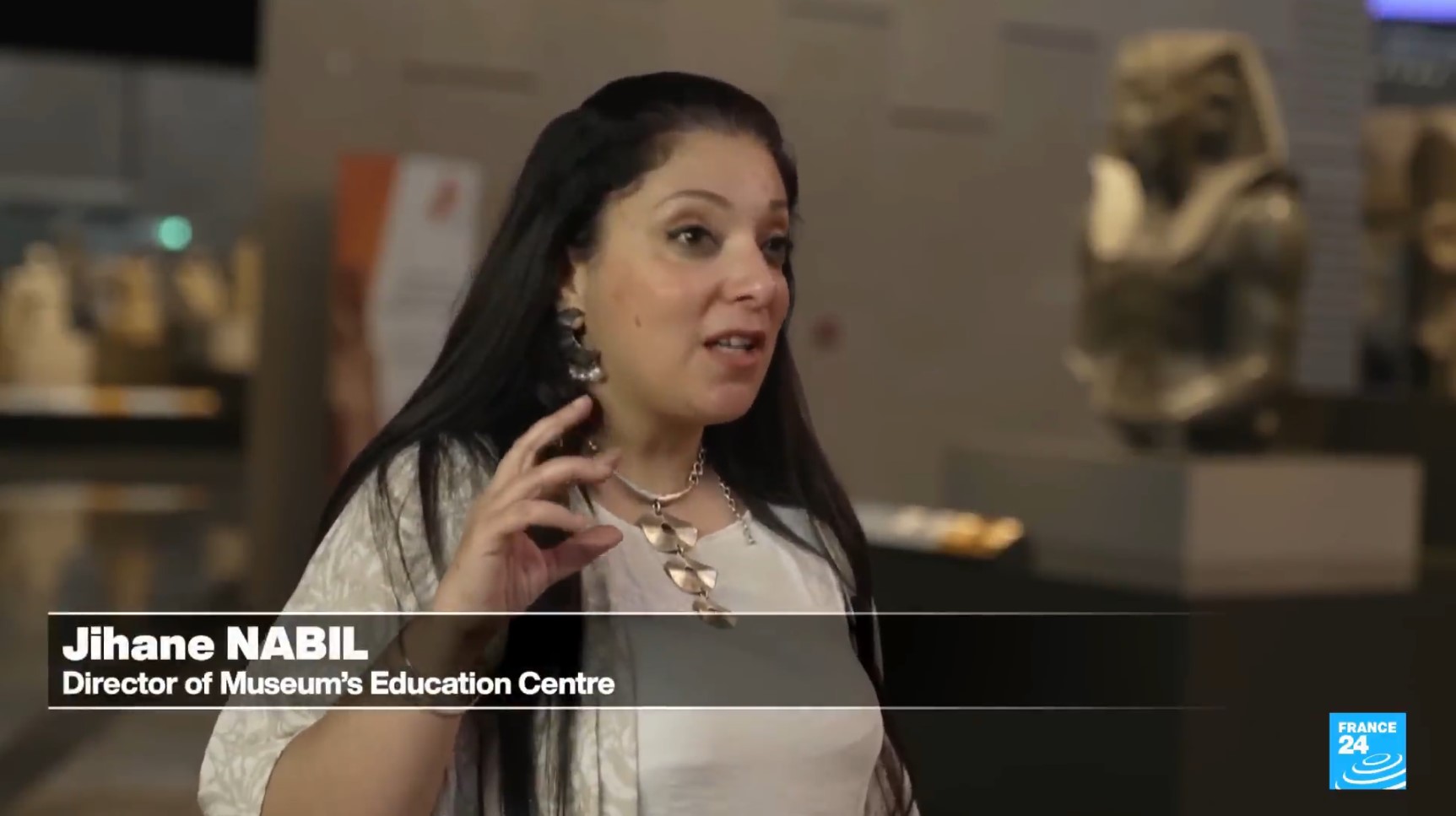
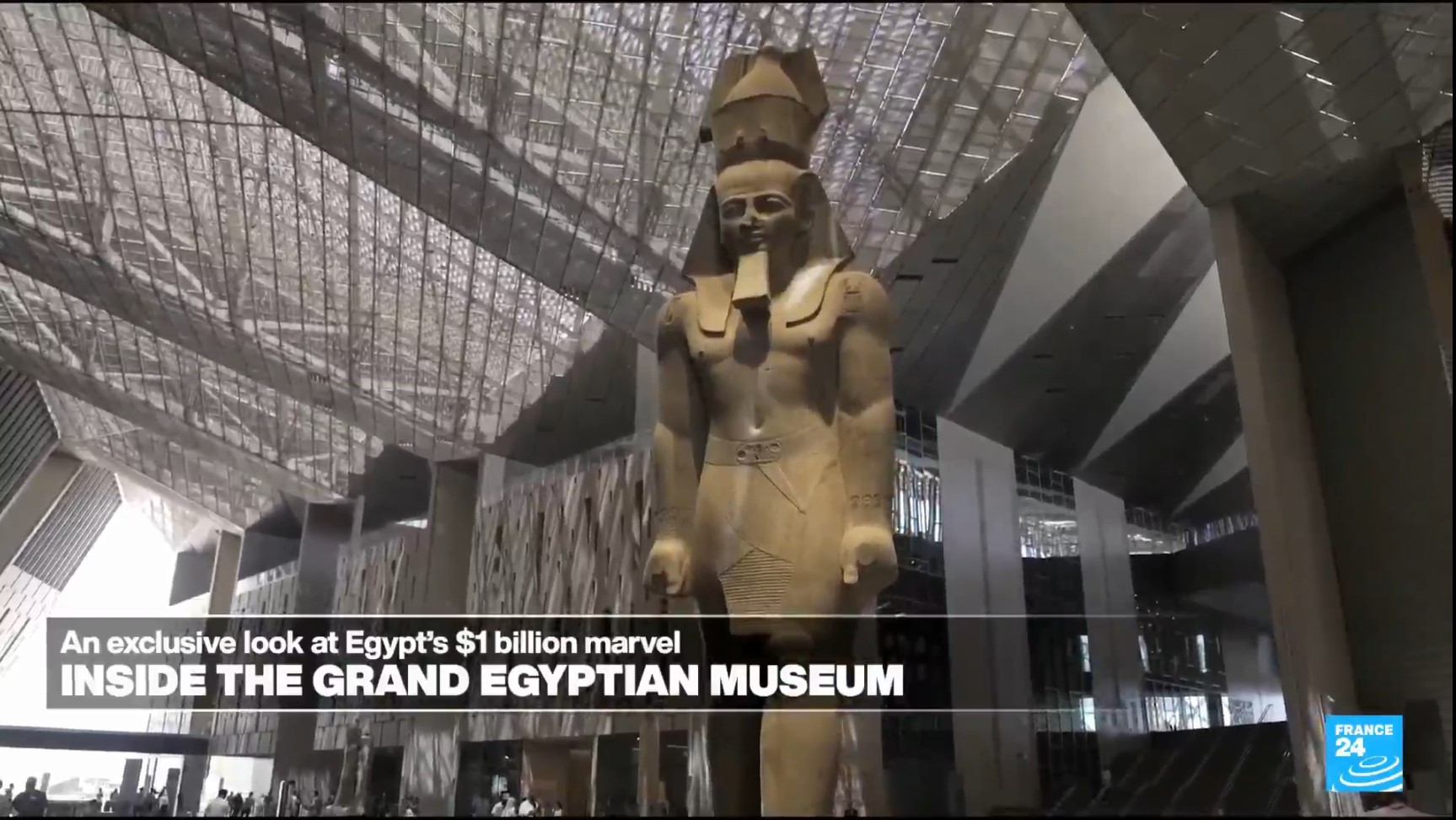
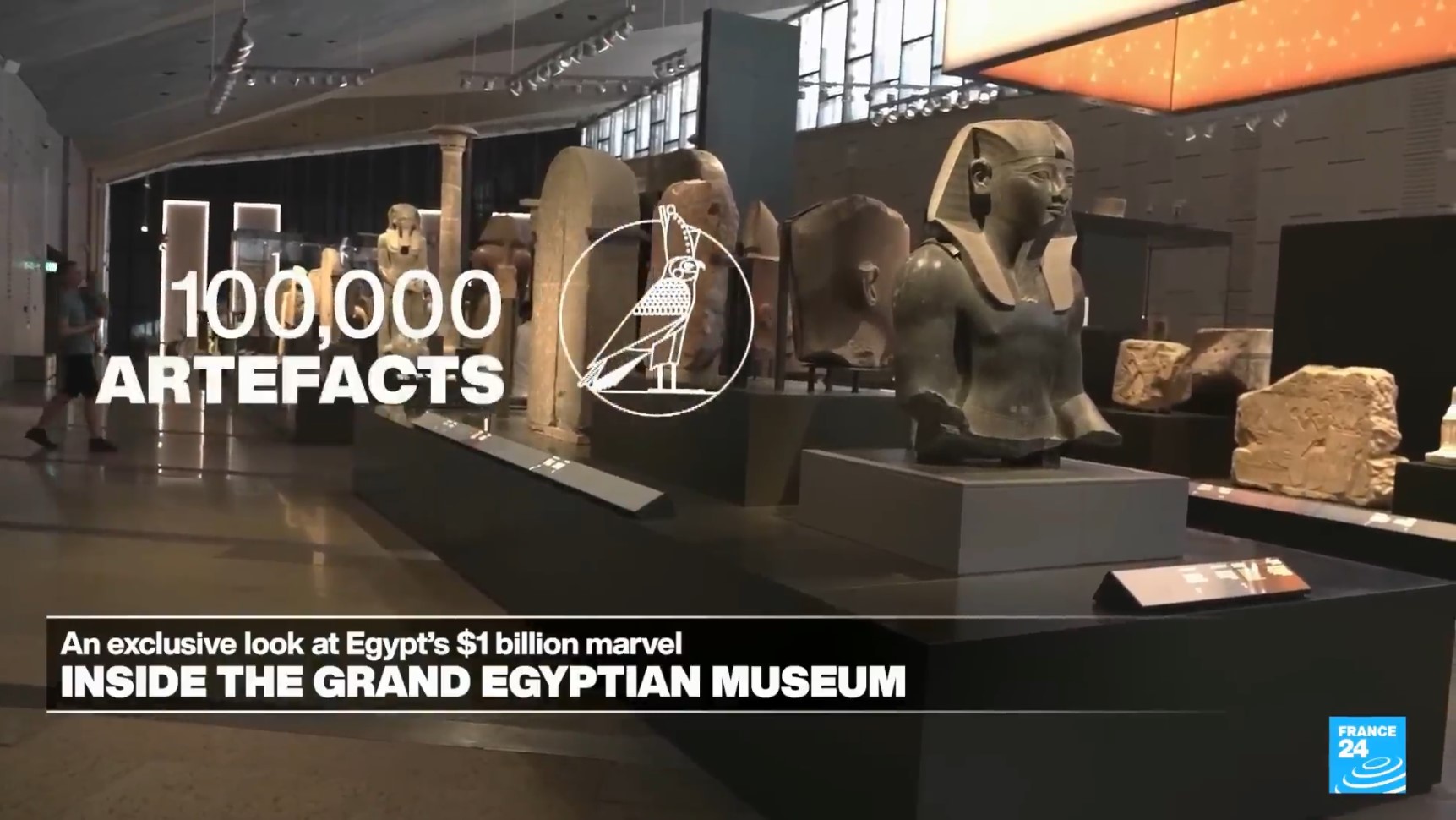
Before its full opening, GEM had already been in trial operation for some time. From February 2023, the entrance hall and commercial area were opened, and from October 16, 2024, twelve main exhibition halls — covering artifacts from prehistoric times to the Roman era — became accessible. Visitors’ first impressions are often of awe: a French tourist, standing at the feet of the massive statue of Ramses II, exclaimed, “It’s as if I am being looked at by eyes from three thousand years ago”; a Japanese historian remarked that here “ancient civilization and modern technology have truly shaken hands”; a member of an American cultural tour group, upon seeing Tutankhamun’s golden mask, said, “This is an eye-to-eye meeting with history — it brings tears to your eyes.” These impressions show that this museum is not only a physical container but also a trigger for emotions and memories.
A musical performance during the trial opening further strengthened my belief that GEM is not only a space for displaying artifacts but also an important stage for global cultural exchange. On January 20, 2023, Egyptian soprano Fatma Said and the “United Philharmonic Orchestra and Choir” performed in the museum, with diplomats and cultural figures from various countries in attendance. A European ambassador said afterward that it was “an evening where art and history intertwined perfectly.” If artifacts allow us to see the past, music and art let us feel the heartbeat of the present.
In the eyes of commentators, the significance of GEM lies not only in preserving the splendor of ancient Egypt but also in providing a platform for encounters between different civilizations. Here, artifacts not only tell history but also remind us: no great civilization exists in isolation, and the vitality of culture comes from exchange and mutual learning. For today’s world, where division and cooperation coexist, such a symbol is especially precious.
When the morning sun on November 1 shines on the museum’s facade, it will not only highlight Egypt’s cultural confidence but also open a window for the world to look into the past, understand the present, and reflect on the future. The Grand Egyptian Museum is not only Egypt’s pride — it belongs to all humankind.
In such a globally significant cultural gathering, the presence of China may also be worth anticipating. In recent years, China and Egypt have established a solid partnership in cultural relics protection, archaeological cooperation, and museum exchanges — from Chinese experts participating in the restoration of Egyptian sites to Egyptian artifacts being exhibited in China. All this reflects mutual understanding between the two sides in civilizational exchange. If the Chinese government or cultural organizations attend the opening ceremony, it will not only be a gesture of diplomatic courtesy but could also become a new starting point for deepening China–Egypt cultural cooperation. One can imagine Chinese artists performing traditional Chinese music on the GEM stage or the museums of both countries jointly holding an exhibition — a vivid embodiment of civilizational dialogue in the new era.







 We are all working towards one goal, and that goal is simple: we want to stop the killing and calm things down.