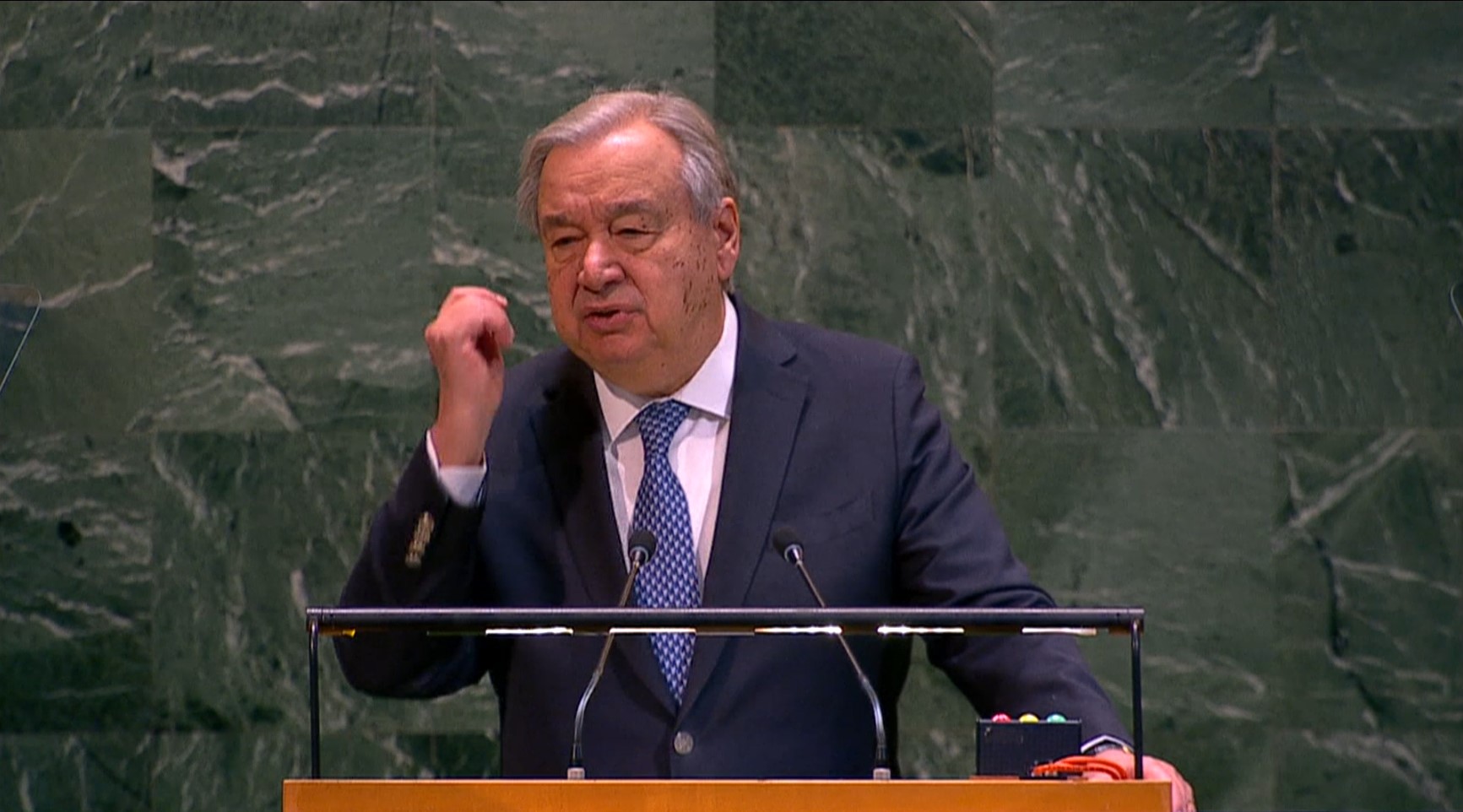
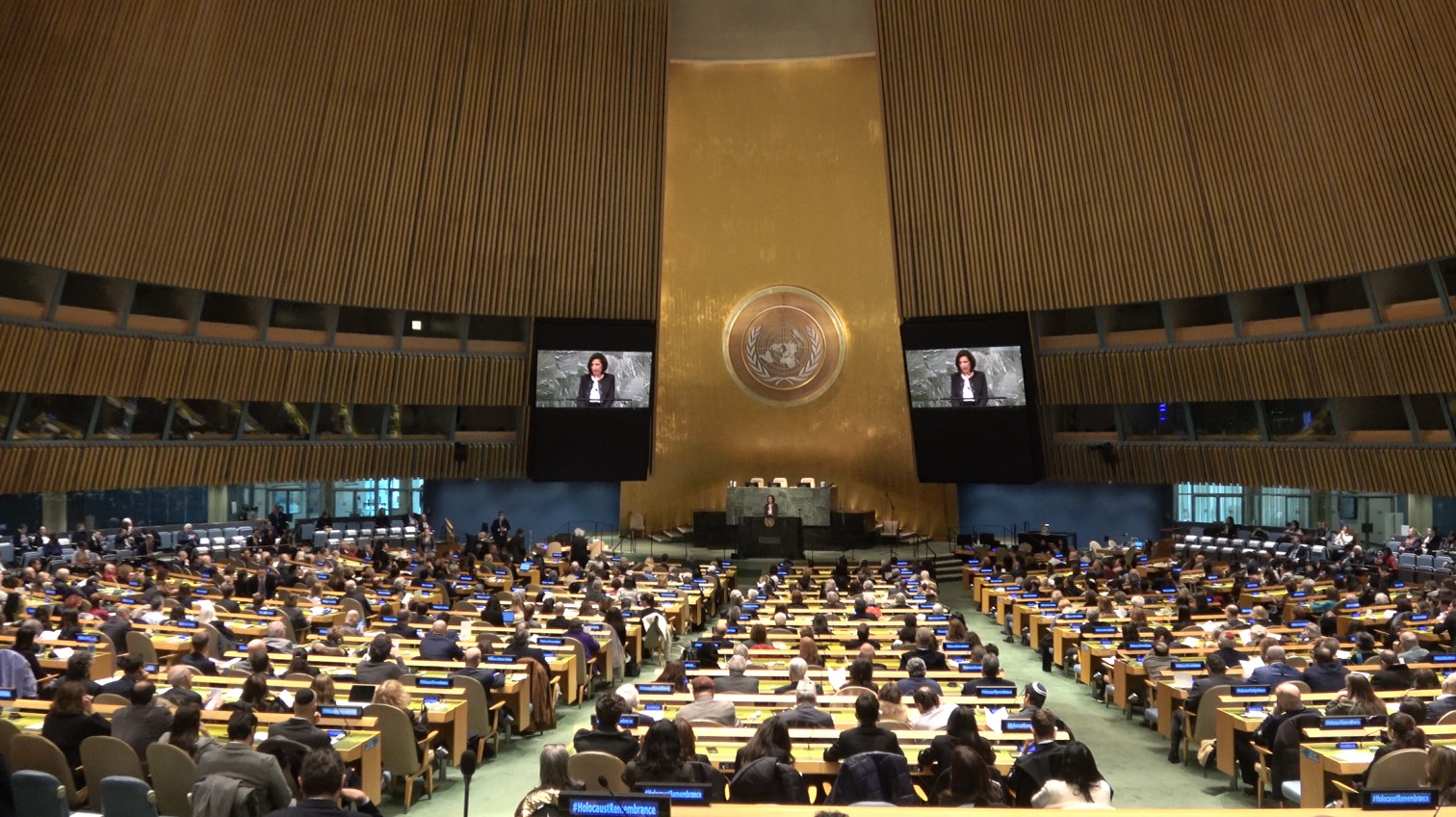
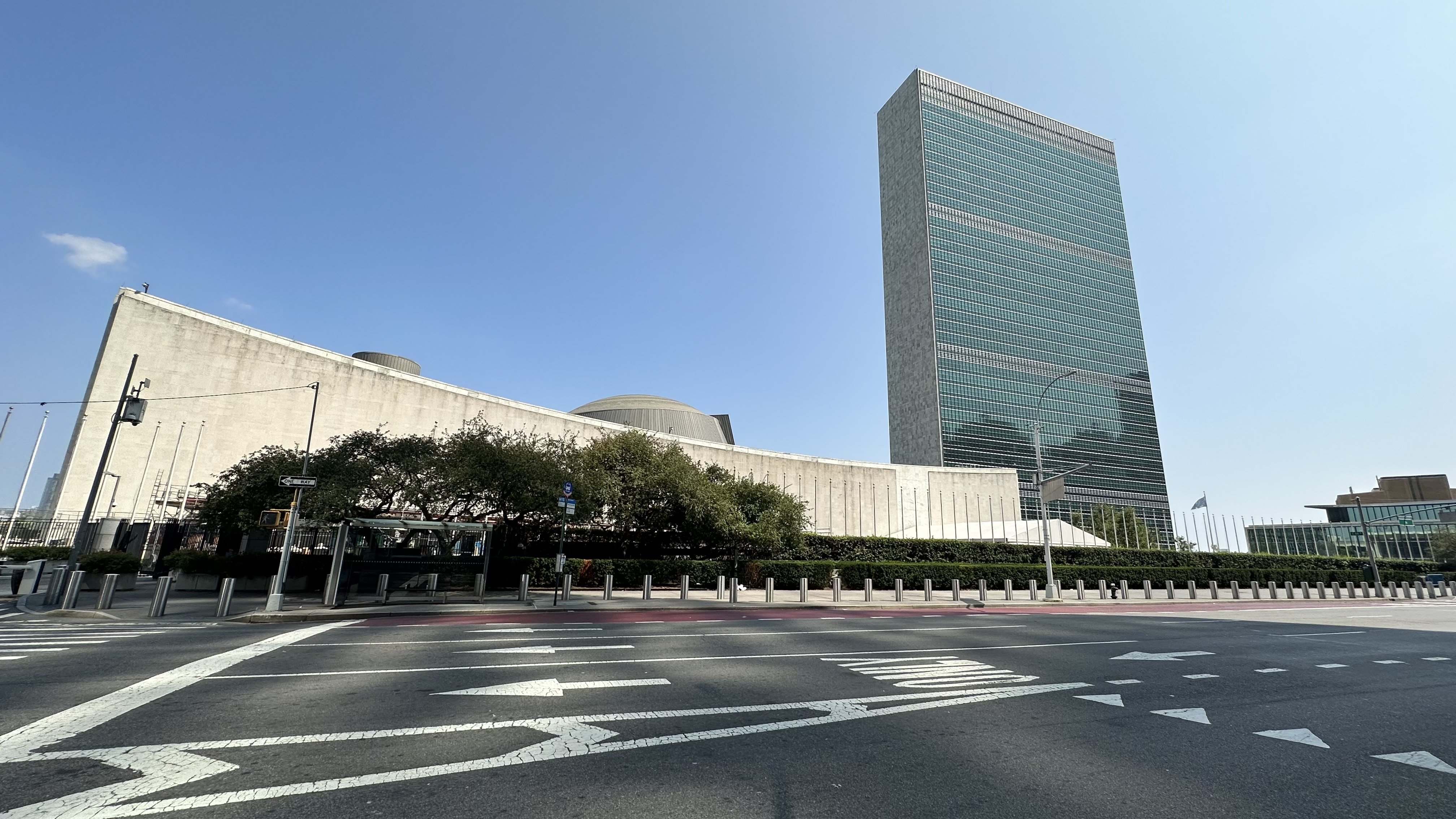
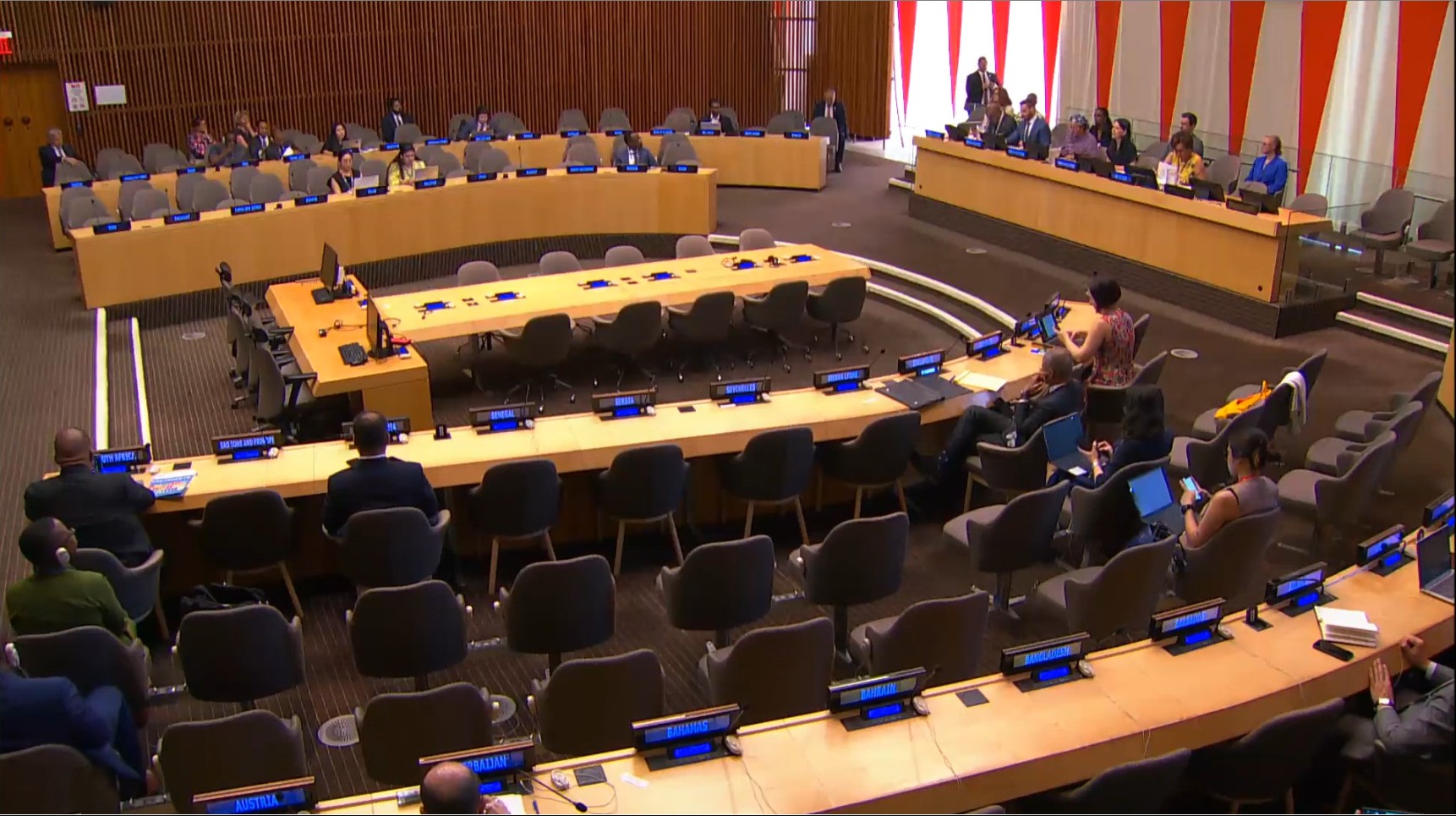
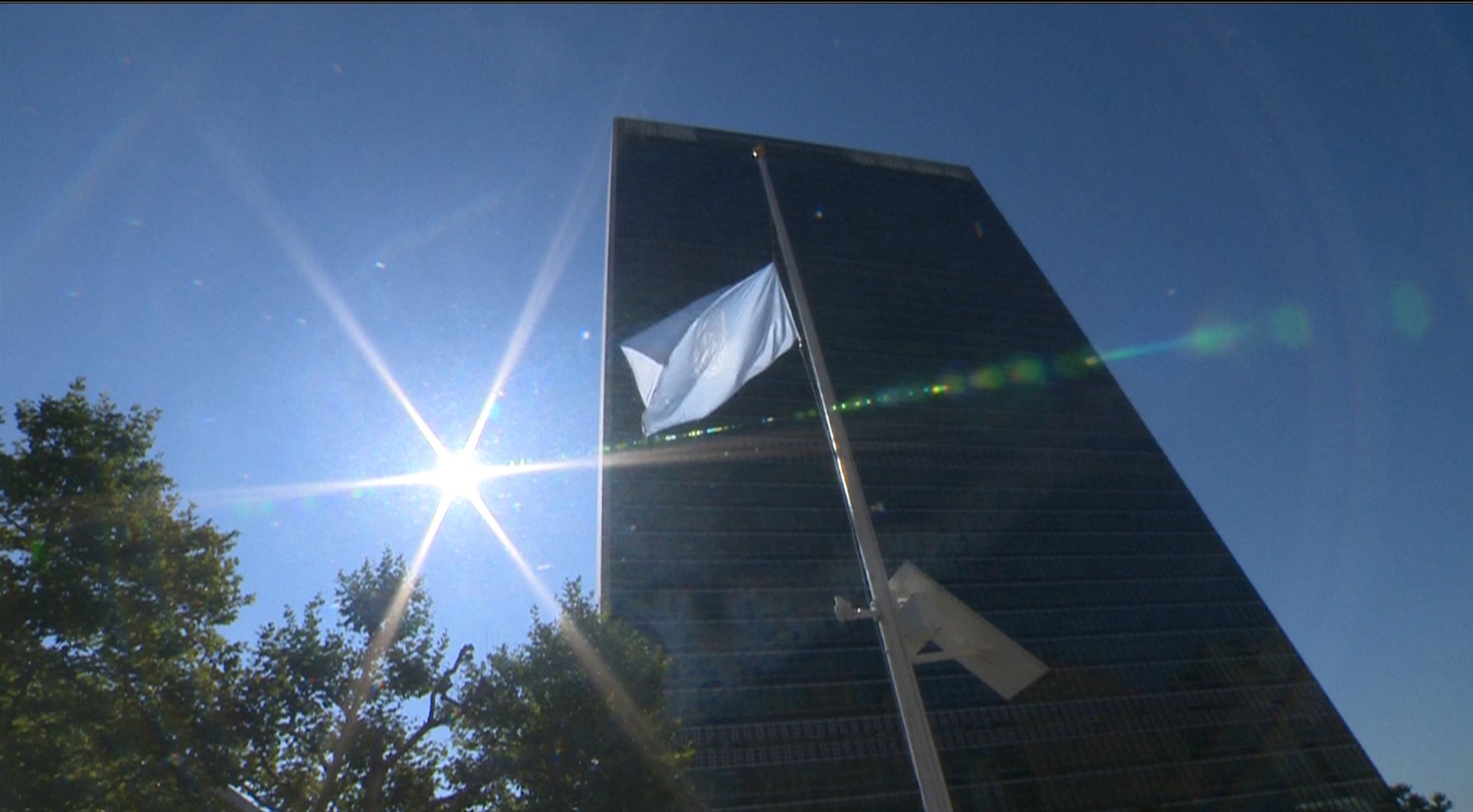
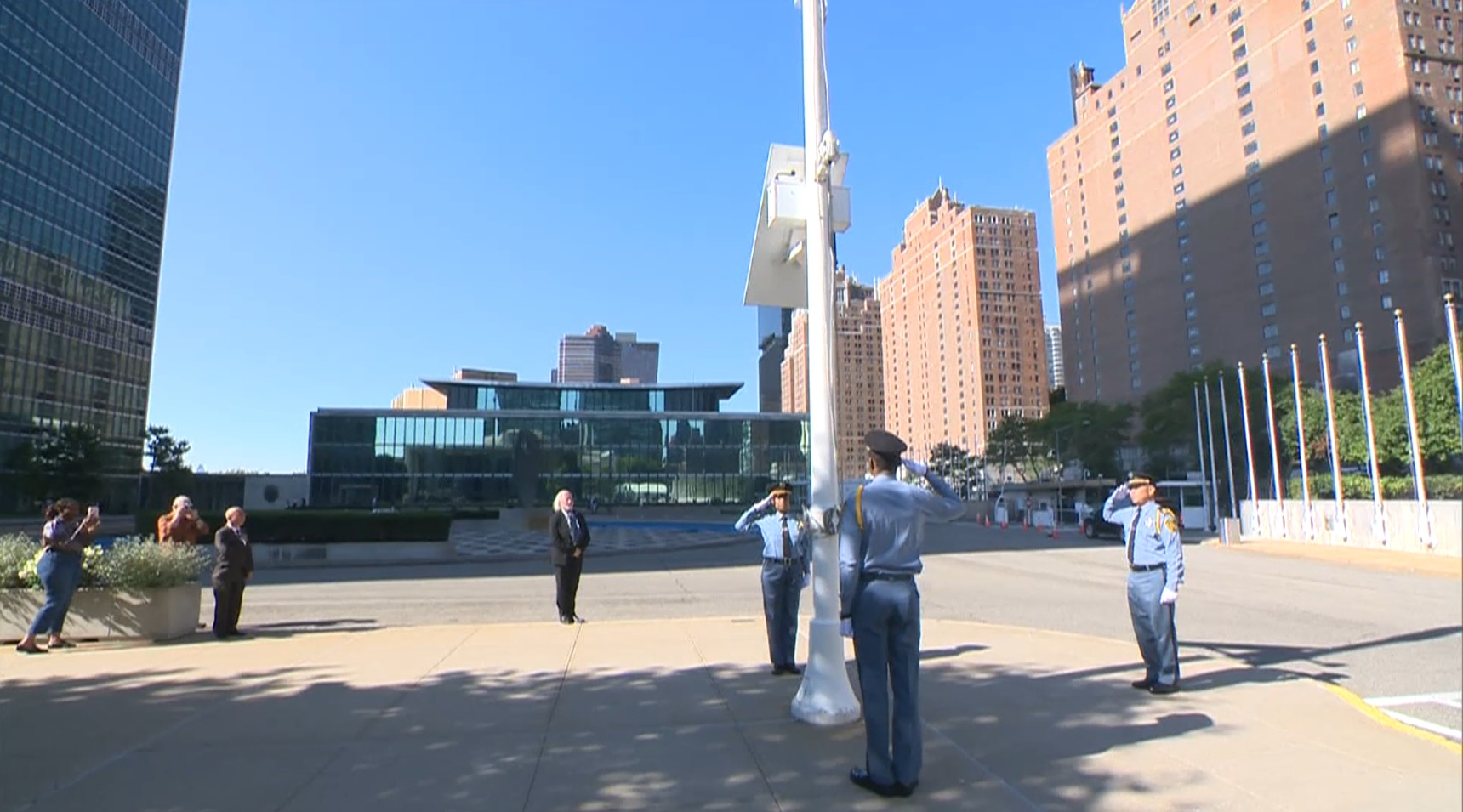
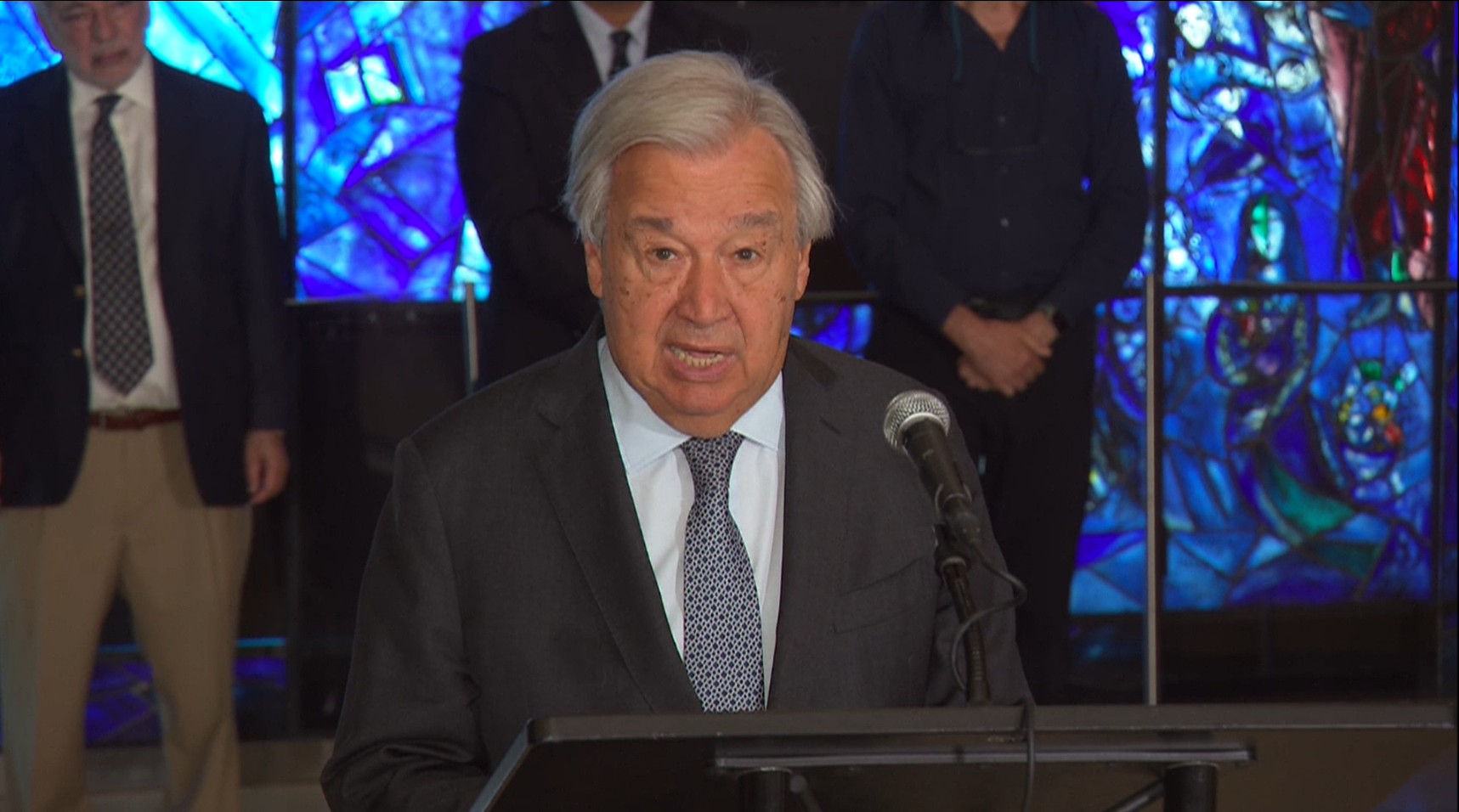
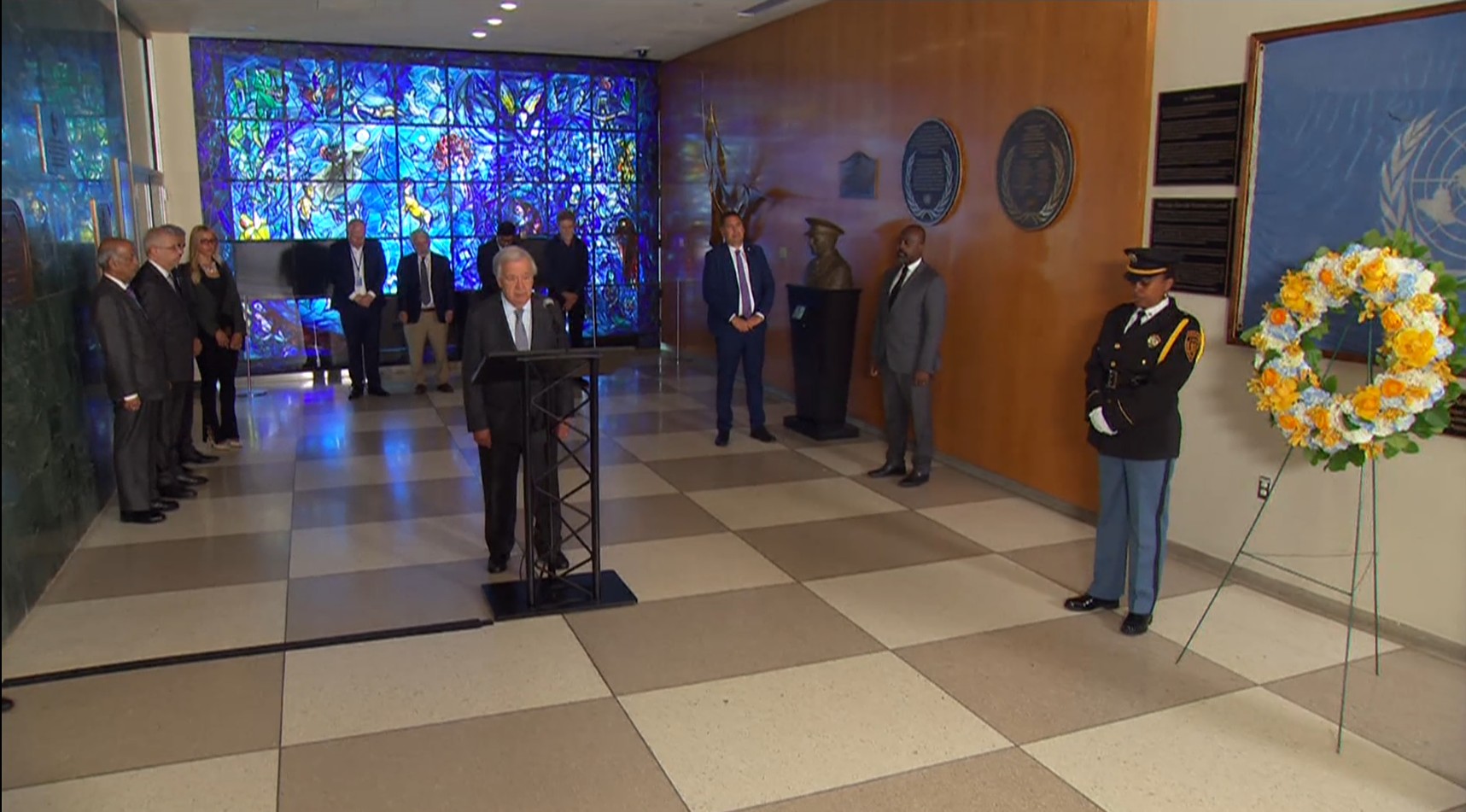
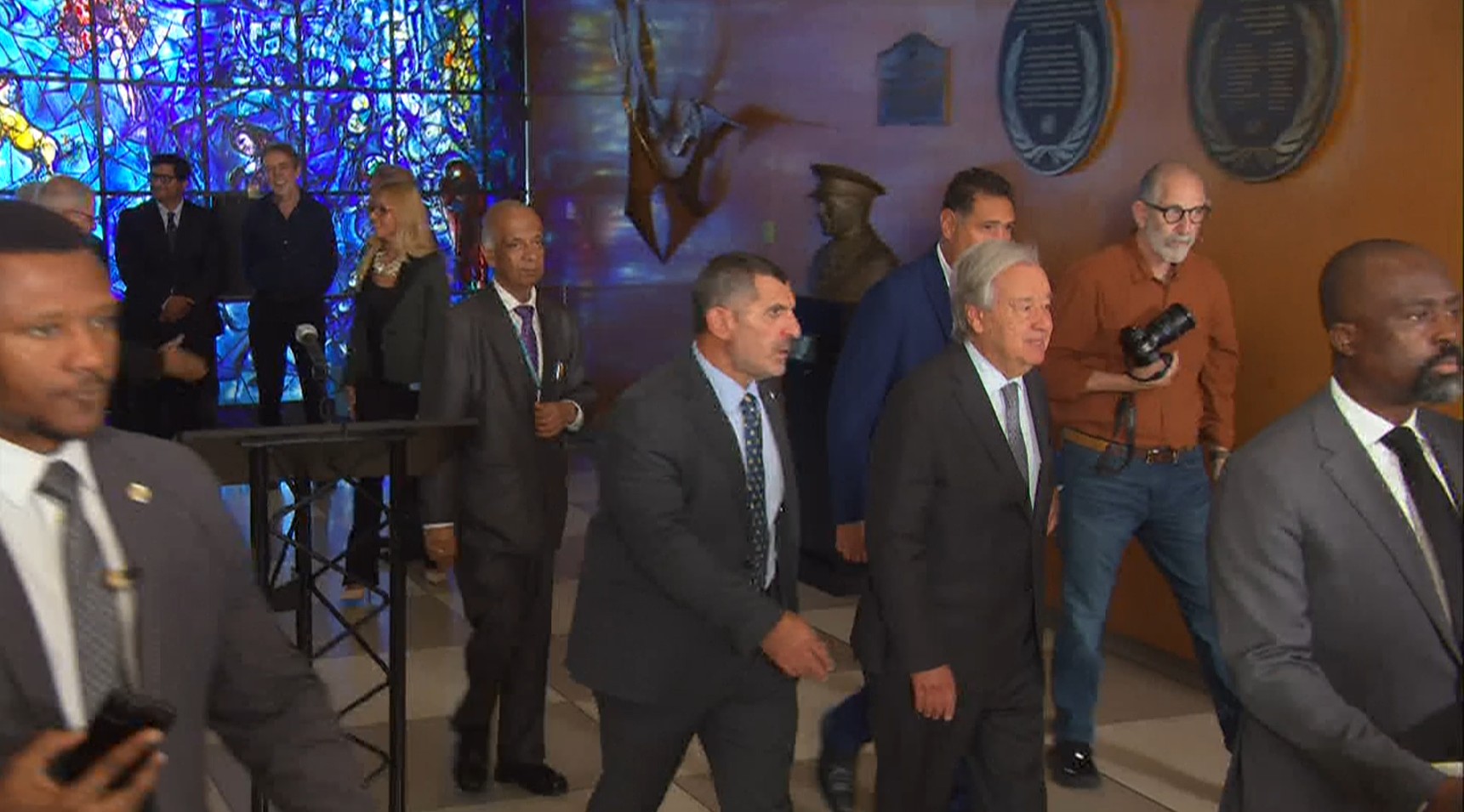
Marking the 23rd anniversary of the bombing of the United Nations Headquarters in Baghdad, Secretary-General António Guterres today (19 Aug) said, “around the world, humanitarians face escalating dangers – attacked, detained, injured and killed,” while, the rules designed to protect humanitarian personnel “are being violated with alarming frequency and impunity.”
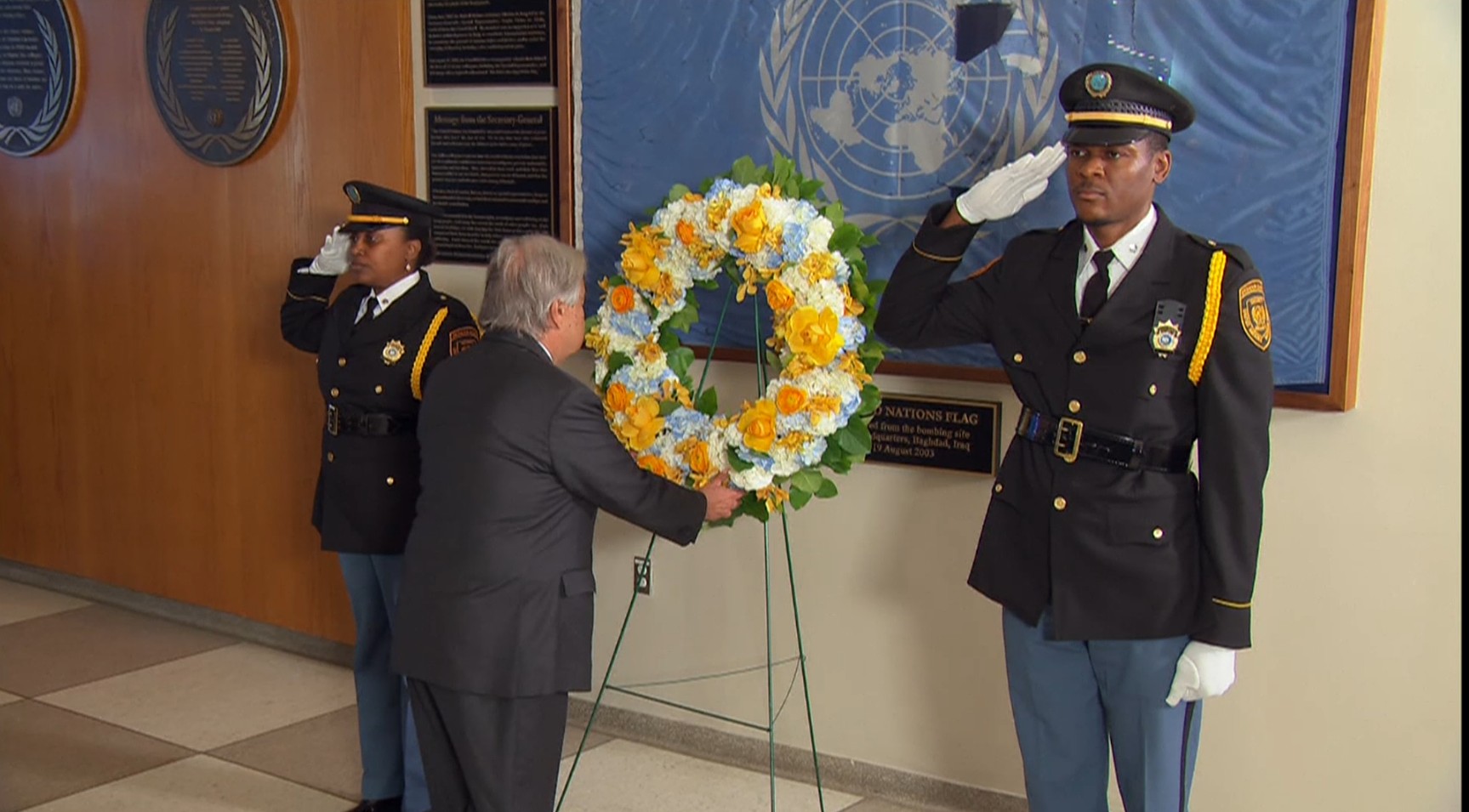
Following a wreath-laying ceremony in front of the plaque honouring those who lost their lives in Baghdad, Guterres said the Canal Hotel, where the UN Headquarters in Baghdad were housed, “was a place filled with people driven by a shared conviction: that even in the most difficult circumstances, humanity, solidarity and hope must prevail.”
Among them, he recalled was Sérgio Vieira de Mello, “a remarkable servant of peace,” while alongside him were “women and men of exceptional courage and dedication, from many countries and backgrounds, united by a commitment to serve others.”
Their legacy, the Secretary-General said, “lives on in every humanitarian worker delivering assistance amid conflict, disaster and despair.”
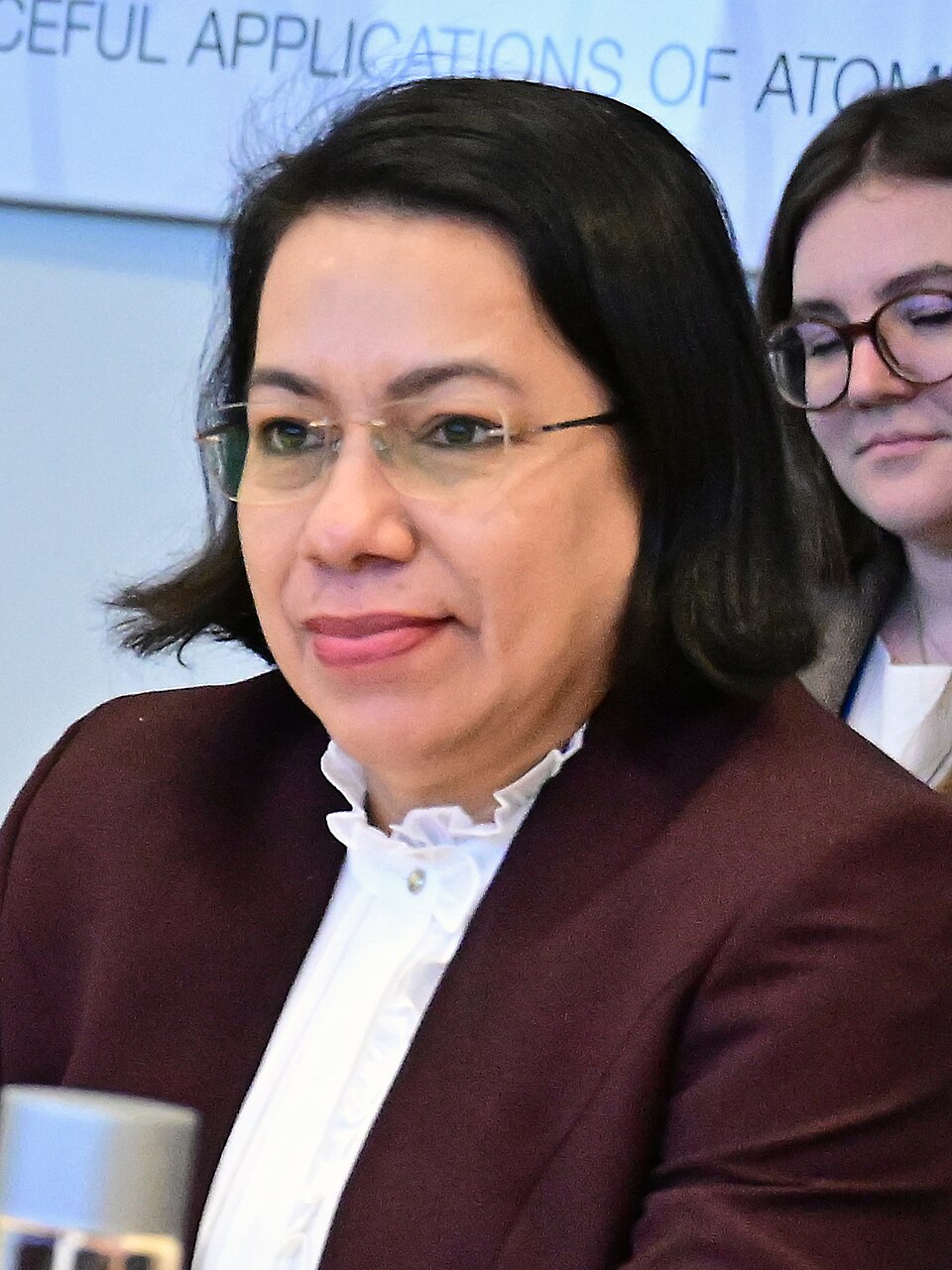
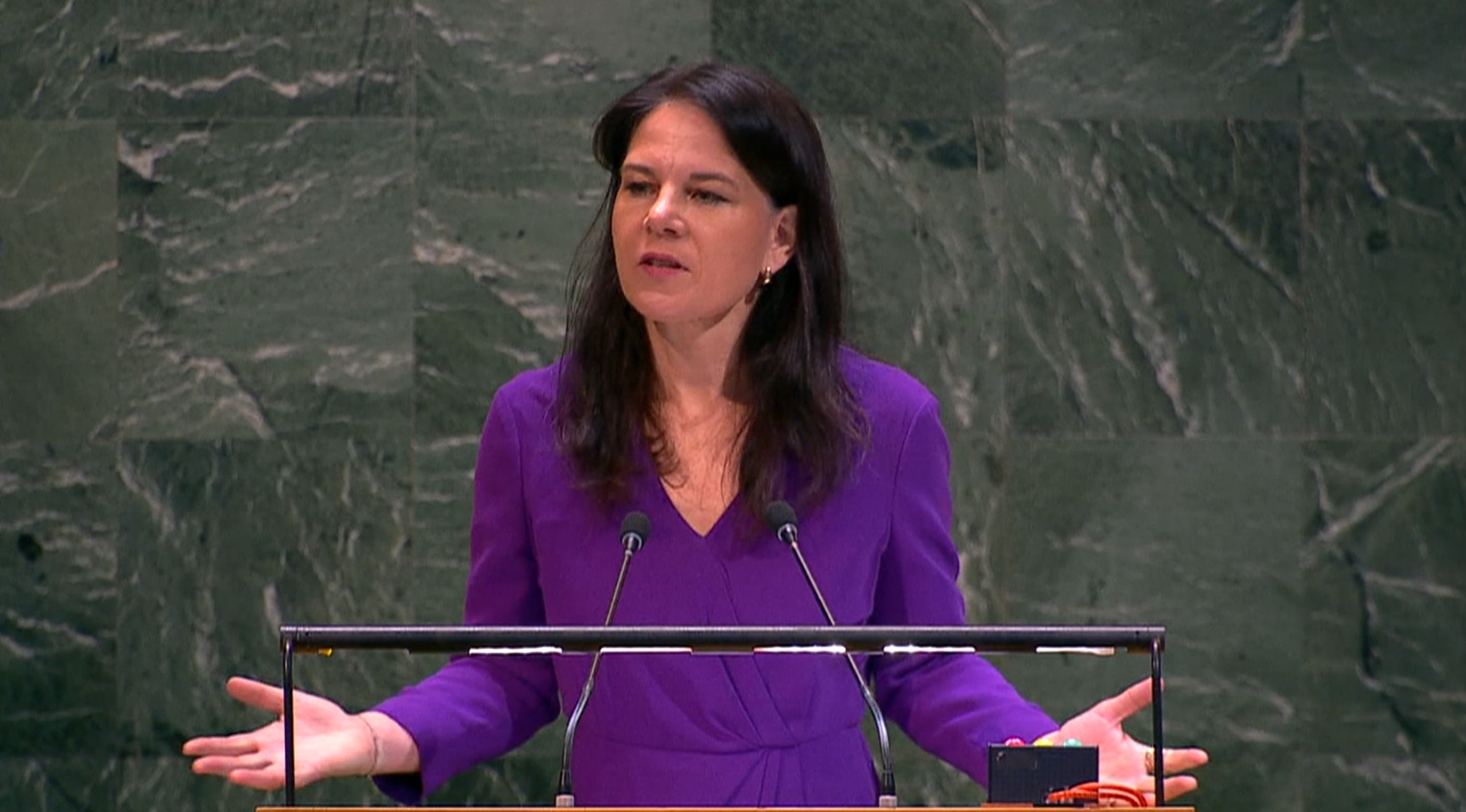
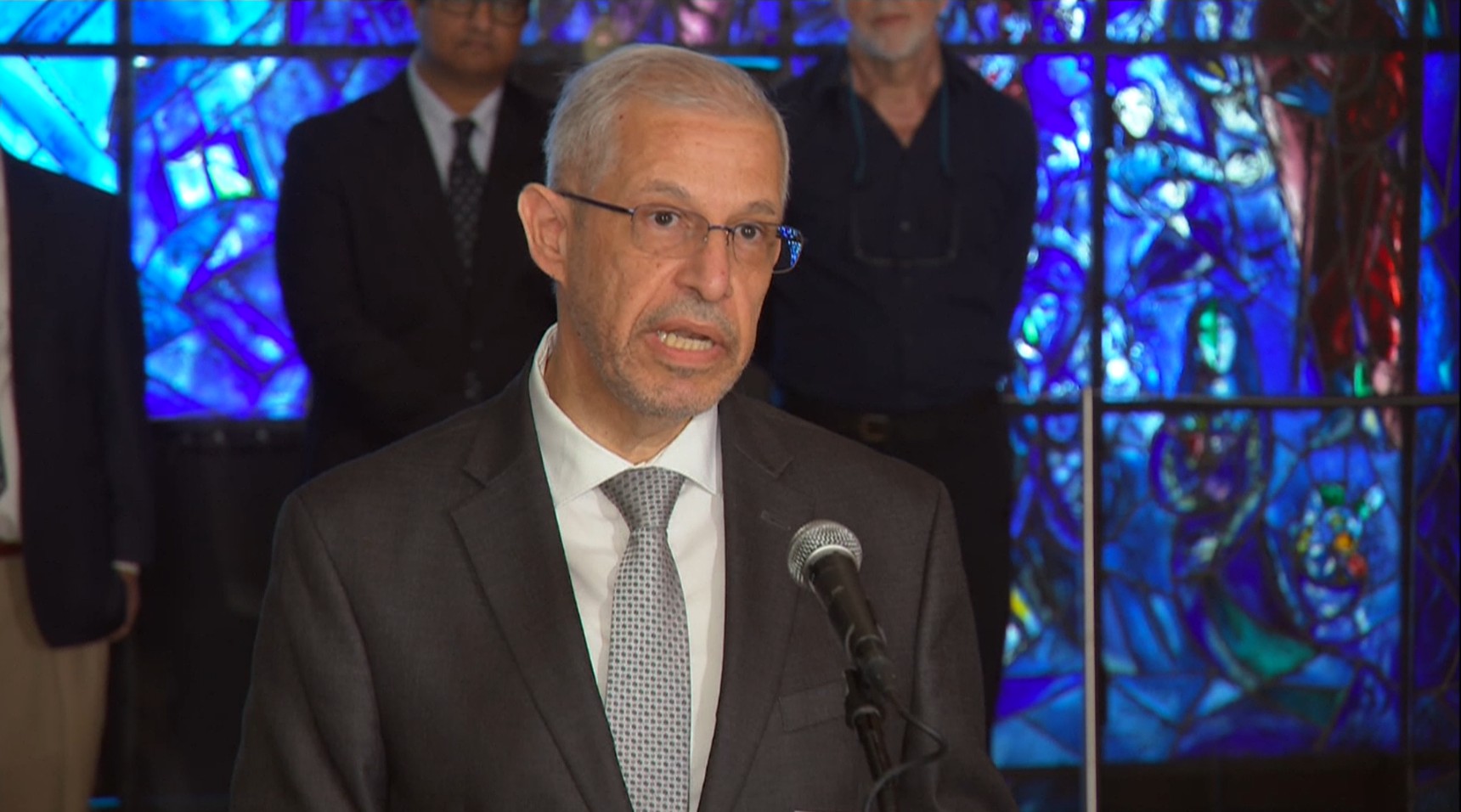
For his part, Iraq’s Deputy Permanent Representative Mohammed Marzooq said, “terrorism knows no nationality, no religion or border. It's against of humanity. And it must be confronted with unity, determination and courage.”
Marzooq reaffirmed Iraq's “unwavering commitment to supporting all efforts to alleviate human suffering, and to continuing our collective fight against terrorism,” and expressed “deep appreciation to the men and women of the United Nations who served or have served and continue to serve in Iraq.”
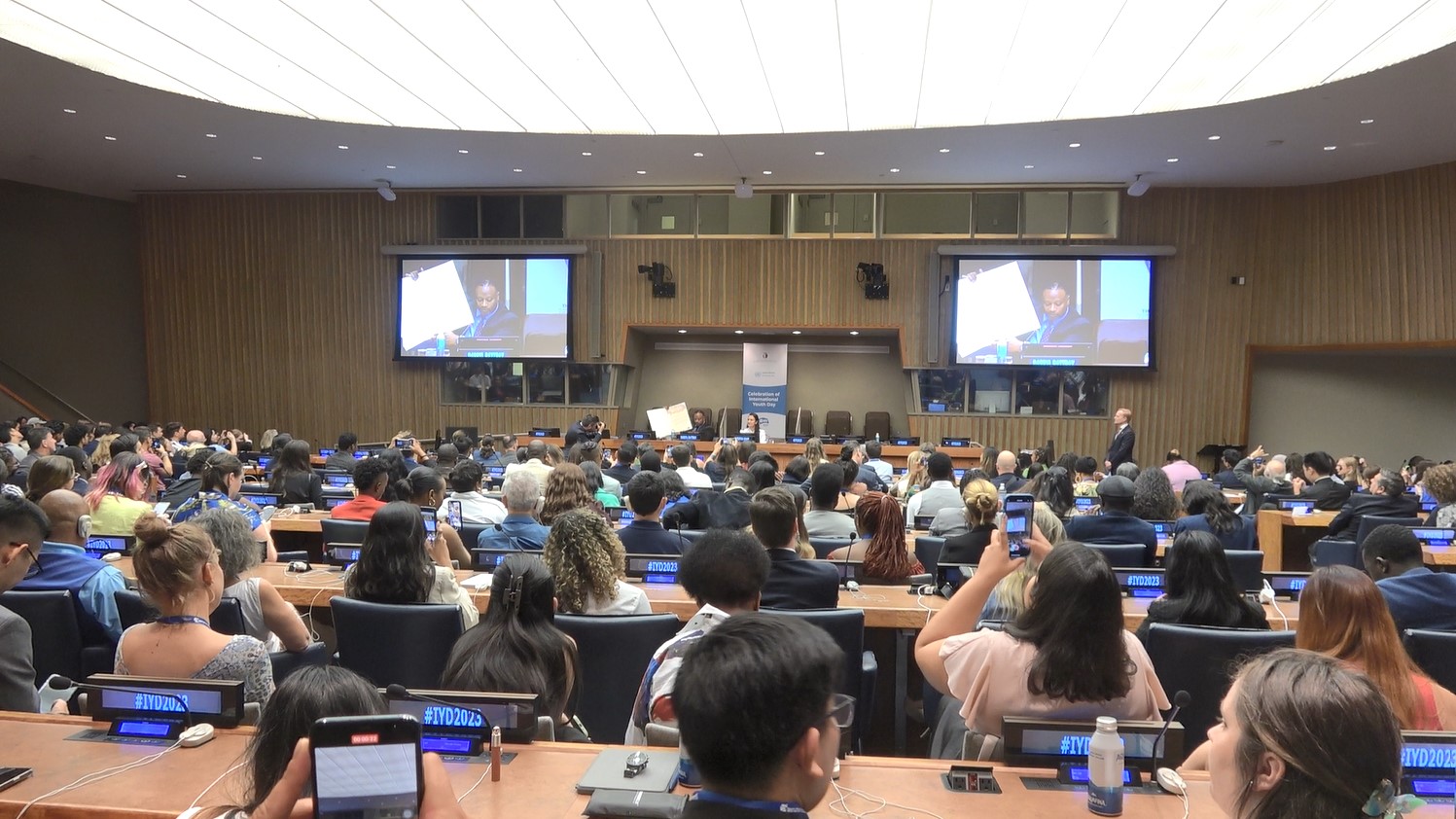
The ceremony also marked the observance of World Humanitarian Day designated by the General Assembly in 2008 to coincide with the date of the bombing in Baghdad. The Day also honours humanitarian aid workers who have been killed or injured in the course of their work.
— What the Viral Success of Niu Lai Reveals About Audience Sovereignty and the New Rules of Media Distribution
Recently, a previously little-noticed film titled Niu Lai suddenly became a widely discussed topic online.
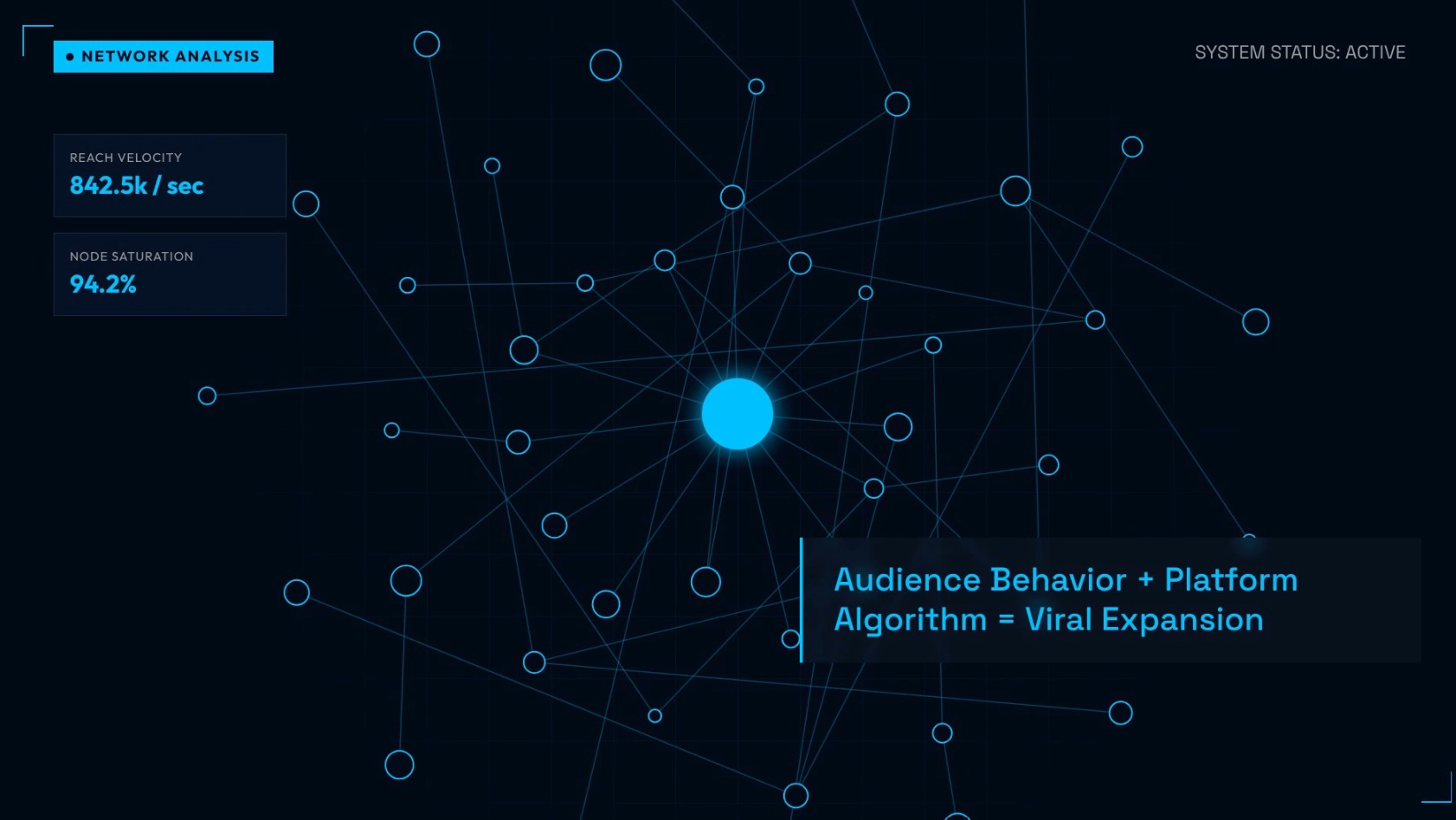
This phenomenon deserves attention—not simply because a film “unexpectedly went viral,” but because it once again reveals how the rules of media distribution are changing. In the age of the internet, and especially artificial intelligence, how far a piece of content can spread is no longer determined solely by professional institutions, media editors, or creators themselves. Instead, it results from the combined influence of audiences, platform algorithms, and social networks.
More precisely, audiences express their preferences through watch time, clicks, comments, shares, and derivative creations, while platform algorithms record and amplify those choices. Their interaction determines which content will be seen by more people.
In the era of traditional media, content distribution generally followed a relatively clear path: professional institutions produced content, editors selected it, media organizations published it, and audiences received it.
Before a news story could enter the public eye, it first had to pass through professional gatekeepers. A story could become a headline only if editors considered it important. A project could receive resources only if producers believed it had value. A program could be broadcast only if television networks thought it met audience needs. A film could receive additional screenings only if theaters judged it to have market potential.
Traditional media thus established a powerful content-filtering system. It could screen information, verify facts, and maintain certain professional standards. At the same time, it meant that a small number of institutions held the power to select and distribute content for many years.
The internet first disrupted this relatively centralized structure of media distribution.
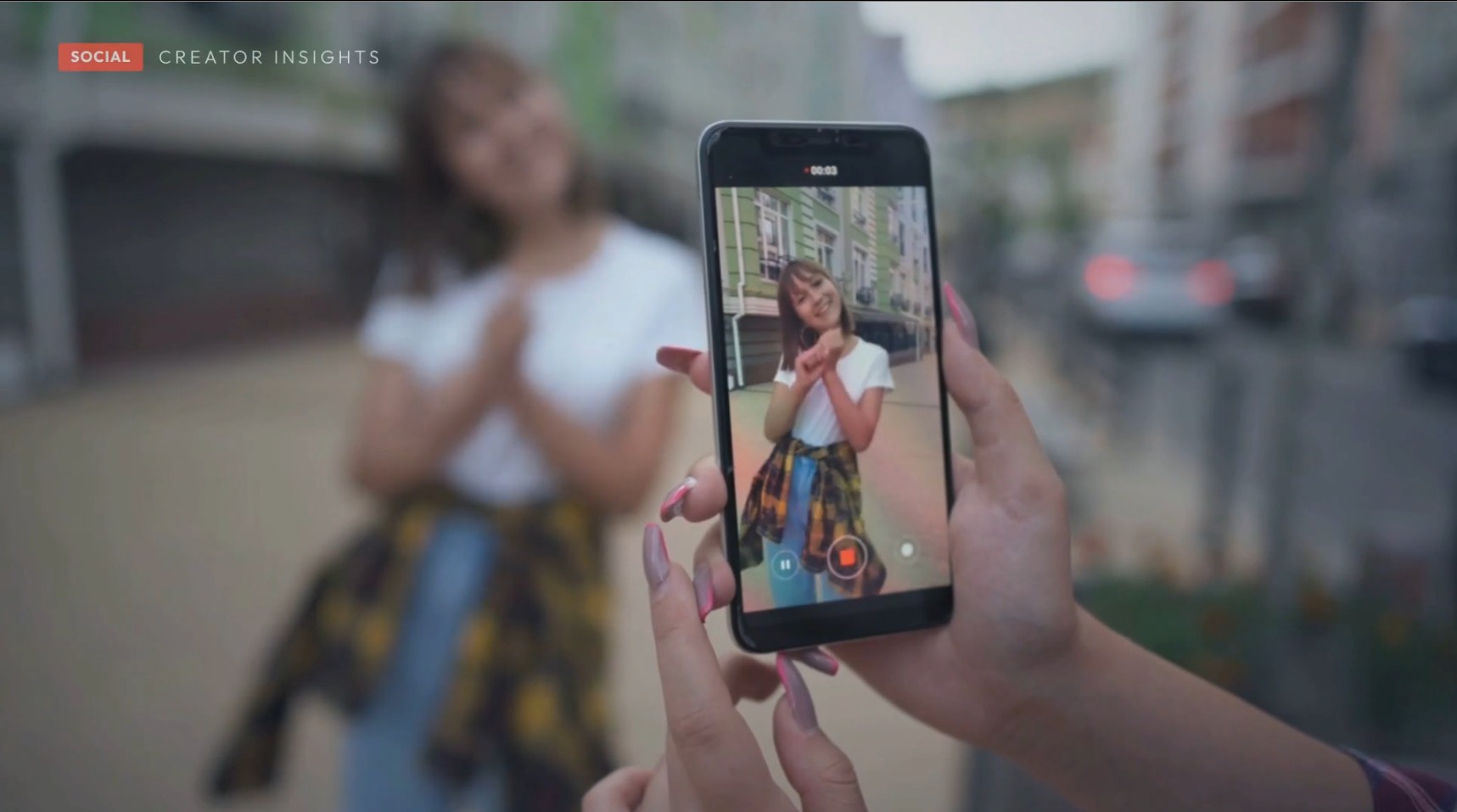
With the rise of YouTube, TikTok, and numerous social platforms, ordinary people gained access to communication tools that had once belonged only to media institutions. A smartphone and an account could now constitute a small media outlet. Creators no longer had to depend on television networks, newspapers, publishers, or professional distribution channels to reach the public.
However, an even more profound change than “everyone can produce content” is that audiences have begun to participate directly in deciding which content deserves to continue spreading.
Whether anyone watches a video after it is published is no longer determined entirely by editors. It depends on whether viewers are willing to stop scrolling, continue watching, and respond. Platform algorithms continuously analyze these behaviors and use them to determine whether the content should be recommended to more people.
How Algorithms Are Changing the Rules of Distribution
When explaining its “For You” recommendation system, TikTok has stated that user interactions—including likes, shares, comments, follows, views, and replays—serve as important signals for identifying user interests. Video information such as captions, sounds, and hashtags also influences recommendation results.
YouTube has similarly explained that its recommendation system considers signals such as clicks, watch time, shares, likes, dislikes, and user surveys to determine which content is most likely to satisfy viewers. YouTube has also stated that recommendations generate more viewing activity than subscriptions or searches.
This means that the fundamental logic of media distribution has changed.
In the past, the dominant model was “editors decide what is worth watching.” Today, it is increasingly becoming “audience behavior tells algorithms what content should continue to be recommended.”
However, this does not mean that audiences directly determine the quality of content, nor does it mean that algorithms can judge whether something is truthful, important, or socially valuable. Algorithms primarily identify behavioral signals rather than make value judgments. They can measure how long people watch and whether they interact, but they may not understand why people are watching. Nor can they automatically determine whether the content is trustworthy.
Consequently, algorithms often amplify not “the best content,” but the content most likely to provoke a reaction.
“Good Content” Is Not the Same as “Highly Shareable Content”
This also explains a phenomenon that confuses many traditional media professionals: Why can some crudely produced short videos attract millions or even tens of millions of views, while professionally produced programs requiring substantial human and financial resources may receive little attention?
The reason is that “content quality” and “distribution potential” are two different dimensions.
A film may have considerable artistic value but lack strong social-sharing potential. A simply produced video, however, may surprise people, make them laugh, provoke anger, or stimulate curiosity, prompting users to comment, share, and imitate it.
From a distribution perspective, it has already met the conditions necessary for further amplification.
The internet competes first not for awards, but for attention. In a constantly refreshing information feed, the first threshold for distribution is not “Is this an excellent work?” but “Is the user willing to stop scrolling?”
More importantly, in a social media environment, even “dislike” can be converted into distribution.
When users like a video, they may click “Like,” save it, or share it. When they dislike it, they may leave a critical comment or even forward it to friends with a message such as, “Look at this ridiculous thing.”
As a result, approval can generate distribution, but so can criticism, ridicule, controversy, and curiosity. Recommendation systems may interpret all these behaviors as evidence that the content has attracted attention and interaction.
Therefore, high traffic does not necessarily indicate high quality, nor does it mean widespread approval. It only shows that the content successfully triggered a large volume of user behavior.
In the AI era, it will become increasingly important to distinguish among content value, news value, social value, and distribution value.
The Distribution Chain Behind the Viral Success of Niu Lai
What makes Niu Lai especially worthy of study may not be the film itself, but how it entered the public eye and gradually became a trending topic.
Its distribution followed a typical internet pathway: the content first appeared and attracted the attention of a small number of users; controversy and commentary followed; users began sharing, editing, imitating, and reinterpreting it; the topic stimulated greater curiosity; and new views and interactions encouraged platforms to recommend it further.
Once such a cycle forms, distribution may gradually move beyond the creator’s control.
Creators cannot completely determine how the public interprets their work. Media organizations cannot fully control how a topic develops. Platforms do not create popularity out of nothing; they continually adjust their recommendations by tracking user behavior.
What truly drives distribution is a complex system composed of content, audiences, algorithms, social relationships, emotional responses, and derivative creations.
Within this system, the original work is merely a “seed.” Only when large numbers of users begin discussing, adapting, and reinterpreting it can it develop into a complete media phenomenon.
AI Makes Content Easier to Produce—but Attention More Scarce
If the mobile internet enabled “everyone to become a media outlet,” generative AI is now taking this transformation further by allowing everyone to produce media content at a low cost.
In the past, producing a professional video required collaboration among camera operators, lighting technicians, editors, voice actors, translators, designers, and other specialists. It also required substantial funding and time. Today, AI is rapidly lowering these barriers.
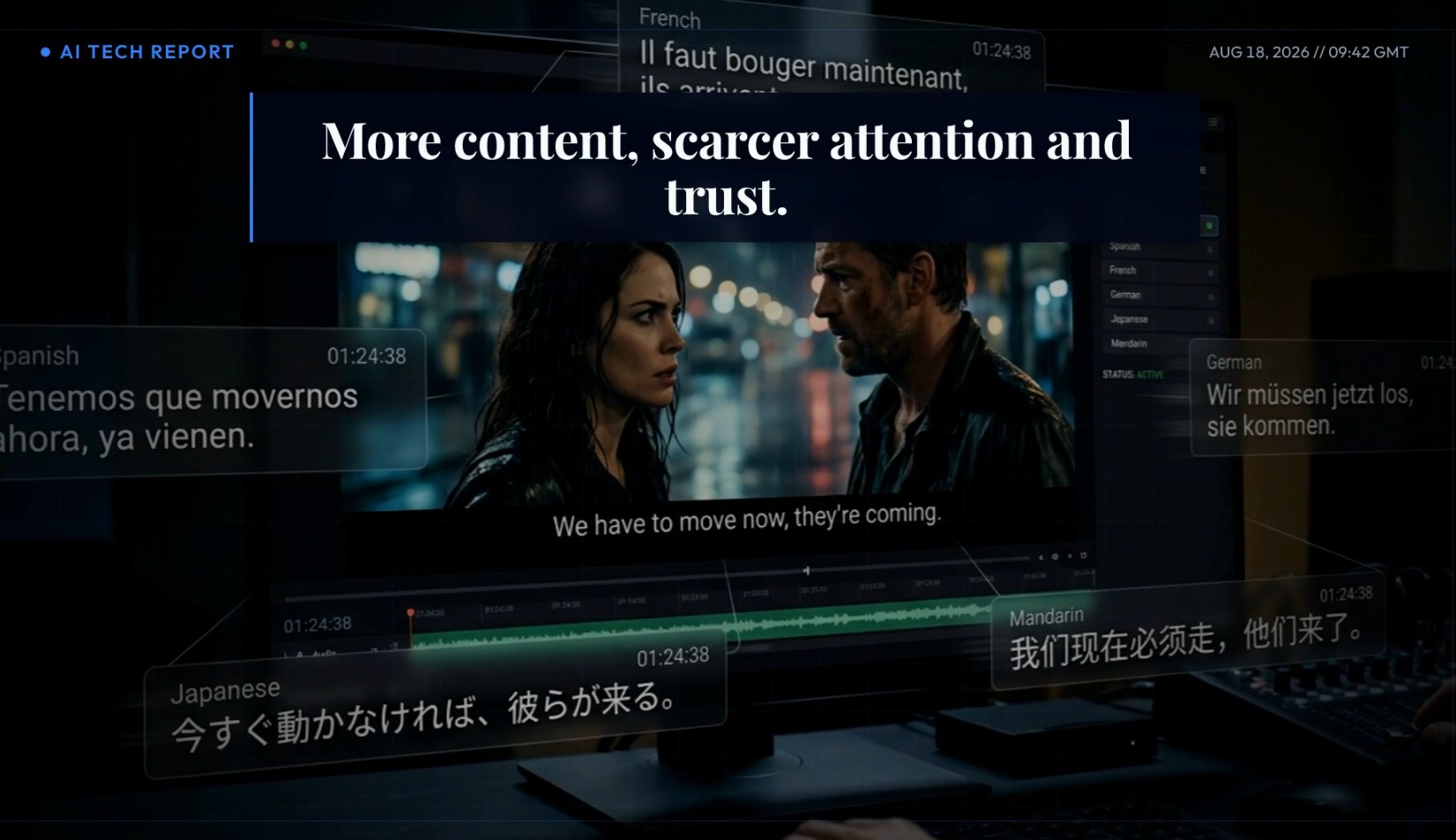
One person can now complete some of the work that once required an entire team. An article can quickly be transformed into a video. An interview can generate multilingual subtitles and voice-overs. A video can be adapted for different countries and cultural audiences. Even a still image can be converted into dynamic content.
This means that, in the future, the truly scarce resource may no longer be the ability to produce content, but human attention.
As the volume of content grows rapidly, the central competition in media will shift from “Who can produce content?” to “Who can make audiences stop?”, “Who can earn their trust?”, and “Who can build lasting relationships?”
Understanding the Audience Is Becoming a New Core Media Capability
Within the traditional media system, gathering information, editing, verification, production, and publication were core capabilities. These skills remain important in the AI era, but media organizations must also develop another essential capability: understanding their audiences.
Who is watching? Why are they watching? How long do they watch? Why do they share? What makes people stop scrolling? What makes them leave? Why are audiences willing to comment, participate, or create derivative content?
These questions will directly influence content planning, presentation formats, publishing platforms, and distribution timing.
Future competition in media may not be about who produces the most content, but about who understands their audience best and can translate that understanding into a consistent content capability.
From this perspective, a new form of “audience sovereignty” is emerging.
Today’s audiences are no longer passive recipients of content. They are simultaneously consumers, distributors, commentators, participants, and sometimes content creators. After a video goes viral, those who sustain its continued spread are often not the original creators, but the thousands of ordinary users who share, comment, edit, imitate, dub, and translate it.
However, “audience sovereignty” does not mean that audiences have completely independent choices. What users see is still influenced by platform rules, commercial interests, social relationships, and algorithm design. Therefore, rather than saying that distribution power has been completely transferred to audiences, it is more accurate to say that this power is being redistributed among media institutions, platforms, and audiences.
The Logic of Traffic Cannot Replace Professionalism
Studying the rules of internet distribution does not mean that media organizations should deliberately cater to low-quality content.
If traditional media organizations see crudely produced videos attracting enormous traffic and conclude that “the rougher the content, the more easily it spreads,” they are also misunderstanding the rules of distribution.
The question worth studying is not “Why does it look so bad?” but “Why does it make audiences stop scrolling?”
These are fundamentally different questions.
Excellent media must integrate truthfulness, professionalism, news value, and expressive ability with audience psychology, social distribution, platform mechanisms, and AI tools. Media organizations must understand how traffic is generated without treating traffic as the only standard.
In fact, as AI makes content increasingly easy to produce, professionalism will become even more important.
In an environment overwhelmed by misinformation, information overload, and low-quality content, verifying facts, finding credible sources, providing necessary context, explaining complex issues, and accepting responsibility for what is published will become increasingly rare and valuable capabilities.
The most competitive media model of the future should not simply be “traditional media versus new media,” nor “human production versus AI production.” It should combine professional media capabilities, AI-powered production, platform distribution, and audience participation.
The Media Organization of the Future May No Longer Be a “Large Company”
In the past, people generally understood a media organization as a fixed institution with offices, reporters, editors, camera crews, and distribution channels.
Media organizations in the AI era may look entirely different.
They may consist of only a few people, yet use AI to organize information, translate, edit videos, generate subtitles, produce voice-overs, and create visual designs. At the same time, they may connect with audiences across YouTube, TikTok, Facebook, Instagram, WeChat, and other platforms, using multilingual content to reach different countries and cultural groups.
The core assets of such a media organization will no longer be limited to offices, equipment, and staff size. Instead, they will include content databases, brand credibility, AI capabilities, distribution networks, and a sustained understanding of audiences.
This also means that small media organizations have, for the first time, an opportunity to gain the multilingual and cross-platform distribution capabilities that were once available only to large institutions. However, lowering the barriers to production does not automatically establish credibility. Tools can expand scale, but trust must still be built over time.
Conclusion: Only Those Who Earn Trust Can Sustain Distribution
From the viral success of Niu Lai and the recommendation systems of YouTube and TikTok to the rapid development of AI-generated content, a new trajectory of media evolution is emerging:
In the traditional media era, media organizations primarily selected content and searched for audiences. In the internet era, audiences began actively selecting their media. In the AI era, content production, algorithmic recommendations, and audience participation are becoming more deeply integrated, jointly creating distribution.
Therefore, when evaluating content today, we cannot ask only, “Is it good?” We must also ask: Who is willing to watch it? Why are they willing to watch? Why are they willing to share it? Can it stimulate participation? Does it generate approval, controversy, or merely temporary curiosity?
In an era of abundant content and continually declining production costs, human attention is undoubtedly a scarce resource. Yet capturing attention alone is not enough to create genuine media value.
Attention can only open the door to distribution; trust is what sustains a long-term relationship. Algorithms can generate exposure, but only professionalism can establish credibility.
Niu Lai may simply be a case of unexpected viral success, but the question it raises is one that the entire media industry must confront: In an era when everyone can speak and AI can produce content on a massive scale, who ultimately decides what deserves to be seen by the world?
The answer is no longer a particular editor or a single media organization.
Audiences make choices through their behavior. Algorithms record and amplify those choices. Creators and media organizations help shape the environment in which those choices occur. The media organizations with genuine distribution power in the future will be those that understand their audiences, use AI and platforms effectively, and remain committed to truthfulness, professionalism, and public responsibility.
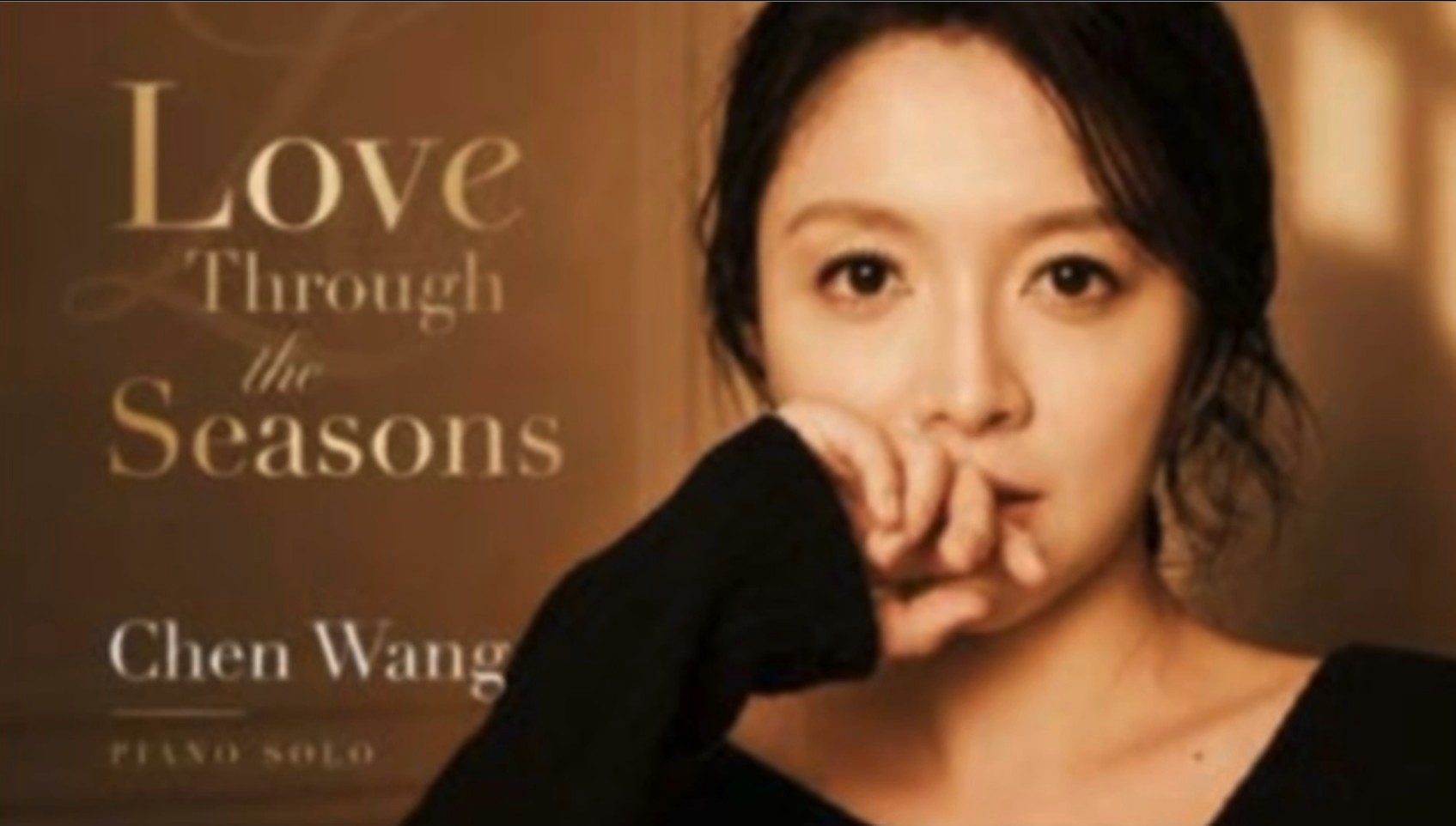
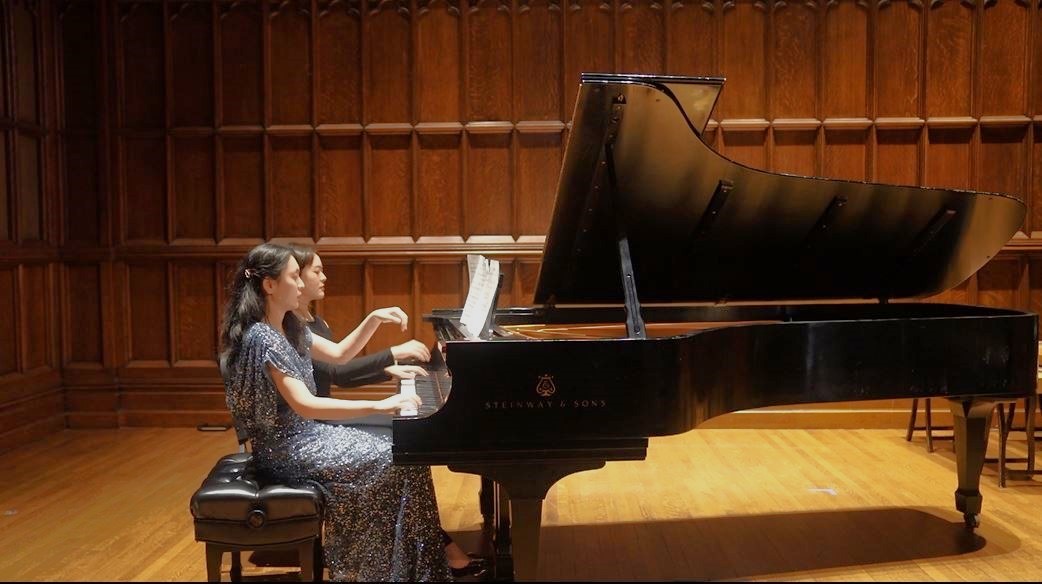
Celebrity Media Commentator: Recently, internationally renowned pianist Wang Chen released the second piano album of her “Journey of Love and Peace,” Love Through the Seasons, through the British record label Sheva Collection. The album has gradually become available on major international digital music platforms, including Spotify, Apple Music, iTunes, Amazon Music, YouTube Music, TikTok, and Instagram Music. It is now reaching audiences through more than twenty digital streaming platforms worldwide and has also been featured on international music media platforms such as BBC Music Magazine.
As Chair and Chief Executive Officer for Culture and the Arts at the United Nations Global Youth Leadership Foundation, as well as Director of Arts Education and Senior Researcher at Columbia University’s Center for Chinese Education, Dr. Wang Chen has long been committed to international musical exchange, arts education, and cross-cultural collaboration. The global release of Love Through the Seasons represents not only a new development in her career as a composer and performer, but also an important expansion of the “Journey of Love and Peace” from live concerts into global digital distribution.
Player loading...
From Concert Performances to a Digital Album: A New Stage in the “Journey of Love and Peace”
Love Through the Seasons continues Wang Chen’s original mission of promoting cultural exchange through music while carrying her vision of communicating love and peace through art.
The year 2025 marked the 80th anniversary of both the end of World War II and the founding of the United Nations. Through the piano, Wang Chen reflected on history and paid tribute to peace. A series of musical activities connected her personal artistic practice with this important historical milestone.
In October 2025, she performed selections from Tchaikovsky’s piano suite The Seasons and the classic Chinese folk composition Colorful Clouds Chasing the Moon at a United Nations commemorative event in Rhode Island. The meeting of Eastern and Western works on the same stage transformed the concert from an artistic presentation into a space where different cultures could listen to and understand one another.
In December of the same year, she presented a special concert at Teachers College, Columbia University, titled “Across Mountains and Seas—A Musical Dialogue Between East and West on the Theme of Peace.” As an important part of the commemorative events for China’s National Memorial Day for the Victims of the Nanjing Massacre, the concert featured the world premiere of the original work Across Mountains and Seas—Eastern and Western Harmonies for Peace.
The work combines multiple artistic forms, including Kunqu opera, traditional Chinese instrumental music, musical theater, and vocal performance. It brought together representatives from academic, cultural, and artistic communities, as well as advocates for peace, to commemorate history through art, reflect on the tragedy of war, and call upon people to cherish the peace that has been achieved at such a great cost.
If the earlier stages of the “Journey of Love and Peace” primarily created emotional connections through live performances, the digital release of Love Through the Seasons allows the project to move beyond the limitations of theaters, cities, and national borders. Listeners no longer need to attend a concert in person. They can now experience these works in different countries and at different times through mobile devices and digital platforms.
▶
Click to Play
Digital Platforms Open New Channels for Classical Music
As short-form videos, streaming services, and mobile devices become the primary means of cultural consumption, the international distribution of classical music is also undergoing significant change.
In the past, distributing a piano album in different countries often depended on physical record releases, local performing arts organizations, or promotion through traditional media. Today, digital music platforms have significantly lowered the barriers to international distribution. Platforms such as Spotify, Apple Music, and YouTube Music allow a piano composition to reach listeners around the world within a relatively short period.
The availability of Love Through the Seasons on more than twenty international digital platforms means that the “Journey of Love and Peace” is beginning to establish a more stable, open, and sustainable channel for global distribution. This method is particularly effective in helping classical music reach younger audiences and enabling Chinese musicians to participate in a broader international cultural environment.
However, appearing on international platforms is only the beginning of the distribution process and does not automatically create international influence. Genuine cross-cultural exchange also requires high-quality works, sustained content distribution, music education programs, and long-term cooperation with arts institutions in different countries. In recent years, Wang Chen has combined musical performances, educational exchanges, original compositions, and the theme of peace in an effort to establish a lasting model of cultural exchange that extends beyond individual performances.
Responding to History Through Music and Giving the Theme of Peace a Contemporary Expression
Peace is an expansive subject, but the particular value of art lies in its ability to transform abstract historical memory into sounds and emotions that individuals can personally experience.
Tchaikovsky’s The Seasons portrays everyday life and human emotions through the passage of time. Colorful Clouds Chasing the Moon carries the poetry and imagination of Eastern music, while Across Mountains and Seas—Eastern and Western Harmonies for Peace attempts to combine traditional Chinese art, contemporary stage expression, and the ideal of peace. By placing these different works within a shared artistic narrative, “love and peace” become more than slogans. They become cultural expressions that can be heard and experienced.
The title Love Through the Seasons also carries symbolic meaning. The recurring cycle of the four seasons represents both the passage of time and the continuation of life. The wounds left by war must be remembered, while peace must be protected by one generation after another. Against this background, Wang Chen’s musical reflection on history does more than commemorate the past. It also reminds today’s listeners that peace should never be taken for granted.
Music cannot directly resolve the conflicts of the real world, but it can help people understand one another, preserve shared memories, and create an emotional foundation for communication between different cultures. This is the practical significance of the “Journey of Love and Peace.”
Creating a More Multifaceted International Voice for Chinese Musicians
In recent years, the “Journey of Love and Peace” world concert series has received support from United Nations-affiliated organizations, international organizations in multiple countries, international cultural institutions, renowned universities, and nonprofit organizations. It has continued to present concerts, charitable performances, and cross-cultural exchange activities.
Related activities and reports have reached more than sixty countries and regions worldwide, advancing the integrated development of music, education, and cross-cultural exchange. The global release of Love Through the Seasons further expands the project’s forms of communication. It now includes both live concerts and digital albums; performances of classical compositions as well as original music and interdisciplinary artistic collaborations; professional artistic expression as well as music education and public cultural exchange.
This multilayered path of development creates new possibilities for young Chinese musicians to participate in international cultural exchange. International expression should not consist simply of “bringing Chinese works overseas,” nor should it remain at the level of displaying cultural symbols. Instead, different cultures should develop genuine understanding and resonance through equal dialogue, joint creation, and sustained cooperation.
From this perspective, Wang Chen’s “Journey of Love and Peace” tells more than the personal artistic story of a pianist. It also demonstrates how a young Chinese musician can participate in public cultural discussions on the international stage and promote exchange and mutual learning among civilizations.
Bringing the Melodies of Love and Peace to a Wider World
According to the organizers, Wang Chen and her “Journey of Love and Peace” will continue to visit the United Nations and international platforms throughout Asia, Europe, Africa, Australia, and other regions. Through musical performances, educational exchanges, and cultural cooperation, the project will continue to promote mutual learning between Chinese and international civilizations and strengthen connections among people.
The global release of Love Through the Seasons opens a new chapter in this journey. Through digital music platforms, classical music can cross national, geographical, and cultural boundaries to reach more listeners. Reflections on life, time, love, and peace can also continue through the changing seasons.
The seasons return in an endless cycle, while life continues to move forward. As music crosses time and geographical boundaries, the “Journey of Love and Peace” will continue to use the piano as a medium for building understanding and resonance among different cultures, carrying the voices of love, peace, and hope into a wider world.
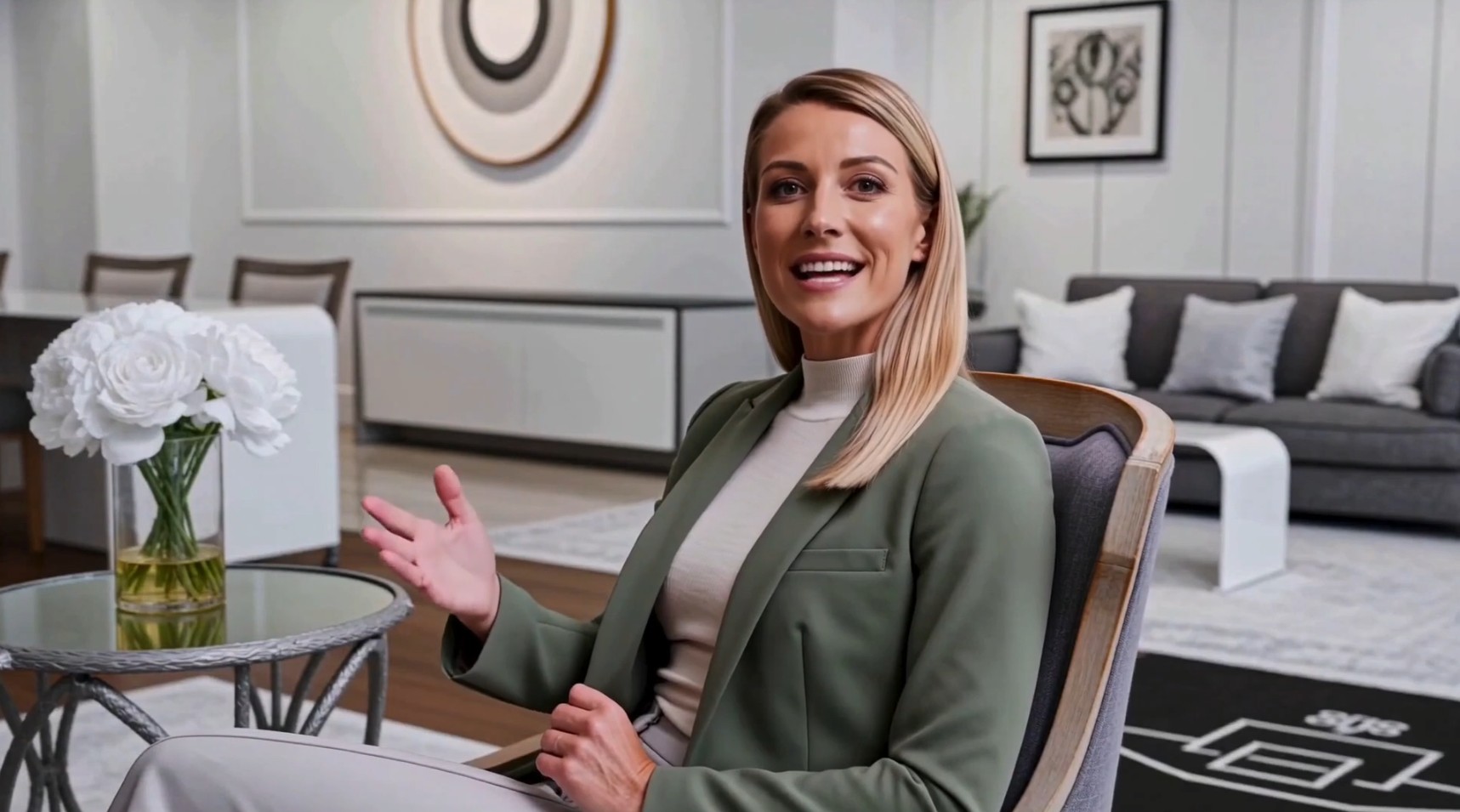
It is also worth noting that one year ago, Wang Chen successfully presented a solo piano recital at Carnegie Hall in New York. Following the performance, Celebrity Media host Shiyi Shi conducted a relaxed and spontaneous interview with Wang Chen at the hotel where she was staying. The entire conversation was conducted in English and covered music, art, cultural exchange, and personal experiences. The interview not only revealed Wang Chen’s sincere and approachable personality beyond the stage, but also gave international audiences a deeper understanding of her artistic commitment to connecting cultures and communicating love and peace through music.
You may copy the six-language video report at https://video.jiuan.org/2026/Aug/Wanga.html, take it home, and share it on any social media platform.
Celebrity Media Editorial Department: In 2026, the selection of the next United Nations Secretary-General has entered a critical stage.
Seven candidates are undergoing closed-door assessments by the United Nations Security Council. According to diplomatic sources cited by multiple media outlets, two female candidates emerged as the early frontrunners after the first informal straw poll. This has renewed the possibility that the United Nations may appoint its first female Secretary-General and brought a question debated for decades back before the international community:
Is the United Nations ready for its first female Secretary-General?
The answer depends not only on the candidates’ abilities, but also on whether the Security Council can rise above the interests of major powers, political inertia, and gender bias to make a choice that will stand the test of history.
▶
The United Nations was founded in 1945. For more than eight decades, its Secretaries-General have come from Europe, Asia, Africa, and Latin America—but every one of them has been a man.
From the Cold War to the post-Cold War era, from peacekeeping to the advancement of sustainable development, and from the Millennium Development Goals to the 2030 Agenda for Sustainable Development, the United Nations has undergone one major transformation after another. Yet today, when women make up nearly half of the world’s population, no woman has ever held the organization’s highest administrative office.
Is this merely a historical accident, or the result of long-standing inertia in international politics?
The world today faces unprecedented complexity: regional conflicts drag on, geopolitical competition continues to intensify, artificial intelligence is rapidly reshaping how society operates, and climate change, public health, poverty, and the global development divide are increasingly intertwined.
The United Nations Secretary-General is not the leader of a “world government,” cannot decide international affairs alone, and cannot make choices on behalf of sovereign states. Nevertheless, the Secretary-General is not only the UN’s chief administrative officer, but also an important embodiment of the spirit of the UN Charter, a mediator in international crises, a champion of multilateral cooperation, and a vital voice for vulnerable and overlooked communities around the world.
The world therefore needs more than someone capable of managing the UN system. It needs a leader who can exercise independent judgment amid the competing interests of major powers, promote dialogue among parties to conflict, and rebuild consensus when trust within the international community has eroded.
Are women inherently better suited than men to serve as United Nations Secretary-General?
The answer, of course, is no.
Gender should not be the sole criterion in selecting a Secretary-General. The decision should also reflect competence, character, global vision, credibility, independence, and the political wisdom to navigate complex international relations. Female leaders differ in their political positions, governing experience, and leadership abilities, and they should not be judged alike simply because they share the same gender.
Yet when several female candidates already possess the experience and ability required of a Secretary-General, the international community must seriously consider whether the United Nations should continue an eight-decade history in which no woman has ever been selected for the role.
True equality does not mean supporting a candidate unconditionally because she is a woman. It means ensuring that when she is equally—or even better—qualified, she is no longer denied the opportunity because she is a woman.
The appointment of the first female Secretary-General would undoubtedly carry profound symbolic significance, but symbolism alone is not enough.
If a woman is merely the safest compromise among major powers but cannot maintain her independence, advance reform, or speak openly during major crises, then a breakthrough in gender representation will not necessarily translate into a breakthrough in UN leadership.
What the international community needs is not merely a change in the gender of the person occupying the UN’s highest office, but a genuine renewal of leadership, institutional reform, and the spirit of multilateralism.
The Secretary-General must ultimately be recommended by the Security Council. A candidate must secure at least nine votes in the Council without being vetoed by any of its permanent members, and must then be appointed by the United Nations General Assembly.
This means that the final outcome will still be determined by the complex politics of major powers, rather than solely by the candidates’ résumés, public expectations, or international reputations.
History also shows that the person ultimately selected as United Nations Secretary-General is often not the most prominent candidate or the one receiving the greatest public attention, but rather someone broadly acceptable to the members of the Security Council—especially its five permanent members.
Consequently, the coming rounds of informal straw polls and any shifts in the positions of the permanent members will directly shape the final outcome of this selection process.
This once again exposes long-standing problems in the way the United Nations selects its Secretary-General.
In recent years, candidates have begun participating in public dialogues, allowing the international community to learn about their backgrounds, ideas, and policy positions. This is a welcome step forward. Yet the Security Council negotiations and decisive votes that determine the outcome still take place behind closed doors.
If the United Nations expects countries to practice good governance, public accountability, and institutional transparency, then the process by which it selects its own highest administrative official should also be subject to fuller international scrutiny.
The outcome matters, but whether the selection process is fair, open, and credible is equally important to the credibility of the United Nations itself.
Celebrity Media believes that whoever is ultimately selected, the next Secretary-General must confront the real challenges facing the United Nations: the Security Council is frequently deadlocked over major conflicts; UN agencies are under financial strain; multilateralism is being weakened by unilateral action and rivalry among major powers; the development priorities of Global South countries remain inadequately addressed; and the ethical and governance challenges posed by emerging technologies are expanding rapidly.
The next Secretary-General must place greater emphasis on peace, development, human rights, technology ethics, and equitable participation by countries of the Global South, while working to restore international trust in the United Nations amid an increasingly divided global environment.
If the United Nations selects the first female Secretary-General in its history in 2026, it will mark not only a historic breakthrough in UN leadership but also an important moment in the global pursuit of gender equality.
Whether that historic significance can be transformed into genuine progress, however, will depend on her future leadership, independent judgment, and actions.
If this selection process still fails to produce the first female Secretary-General, the international community will be justified in asking whether other candidates were truly more qualified—or whether invisible barriers rooted in closed-door negotiations, major-power interests, and political inertia have yet to disappear.
The vote can tell the world only who was ultimately selected. Whether that choice was the right one will be judged by time, action, and history.
The United Nations must also make the selection process more open and transparent, reduce behind-the-scenes political bargaining, and allow the international community to examine the candidates’ abilities, ideas, and independence more fully.
A fairer, more inclusive, and more united United Nations was not only an ideal at the organization’s founding in 1945; it should also be a shared goal for the international community in the twenty-first century.
The United Nations has reached a new crossroads.
The 2026 vote will determine who becomes the next Secretary-General, while her or his actions will determine how the international community ultimately judges that choice.
The answer may be revealed soon, but history’s judgment is only beginning.
Celebrity Media has reason to say this: The United Nations should not choose a woman merely to make history—but neither should it preserve history by once again passing over the most qualified woman.
كلمة نائبة الأمين العام للأمم المتحدة أمينة ج. محمد خلال اجتماع تقييم تنفيذ ميثاق المستقبل
Remarks by UN Deputy Secretary-General Amina J. Mohammed at the Stocktaking of the Pact for the Future
Allocution de la Vice-Secrétaire générale des Nations Unies, Amina J. Mohammed, lors du bilan du Pacte pour l’avenir
Выступление заместителя Генерального секретаря ООН Амины Дж. Мохаммед на мероприятии по подведению итогов реализации Пакта во имя будущего
Discurso de la Vicesecretaria General de las Naciones Unidas, Amina J. Mohammed, durante la evaluación del Pacto para el Futuro
▶
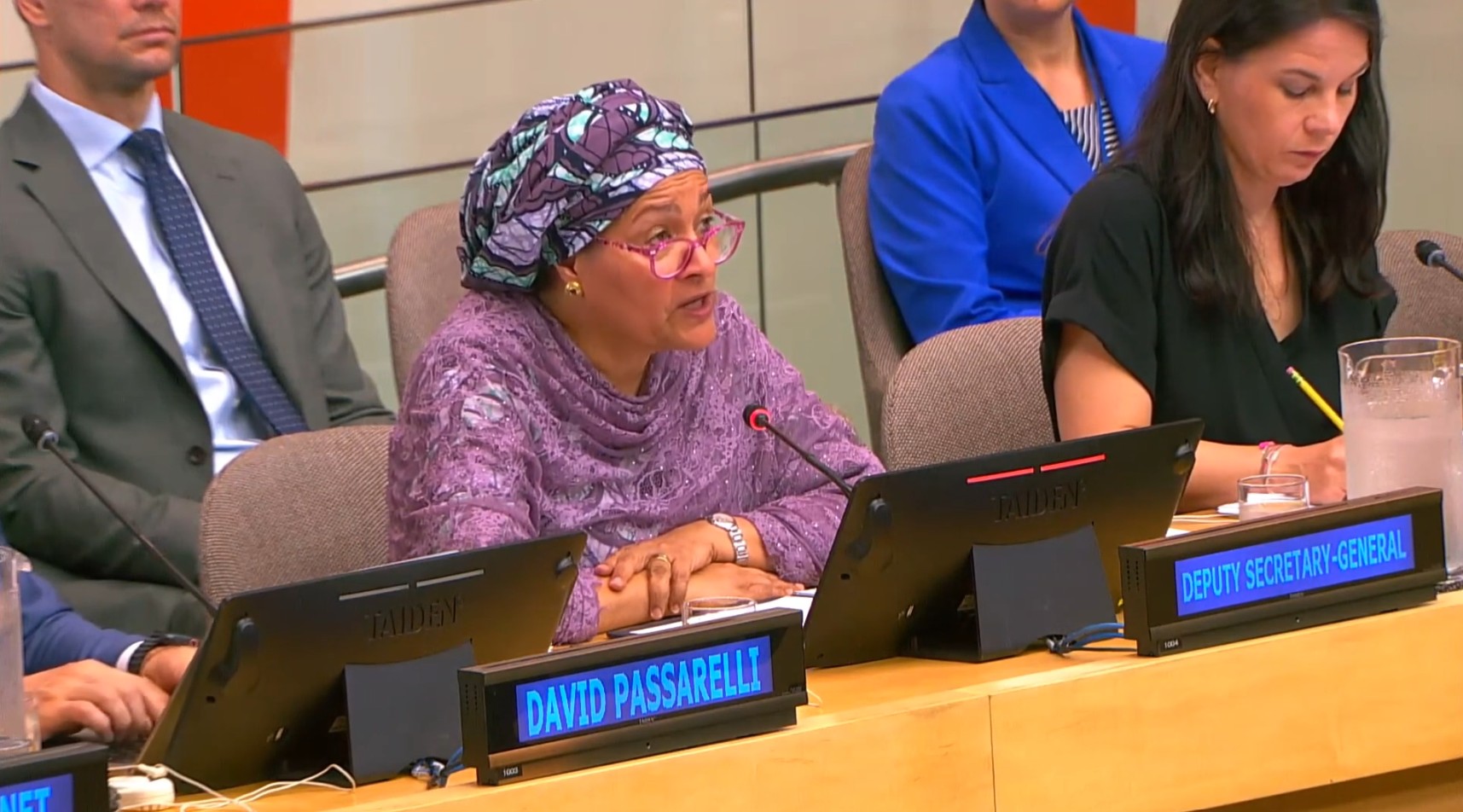
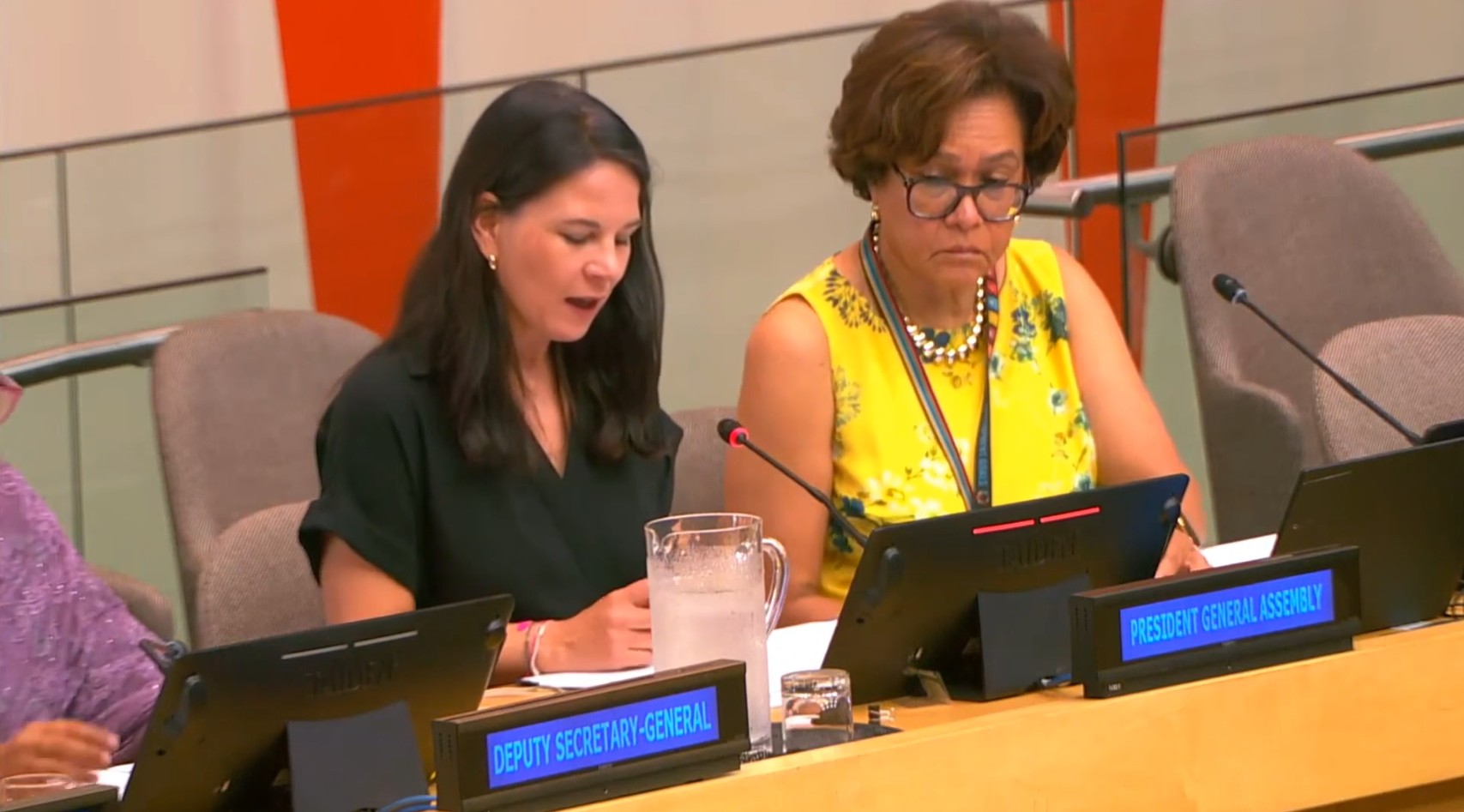
This morning’s debate today, and I now give the floor to the Deputy Secretary-General of the United Nations, Her Excellency Amina Mohammed. Thank you.
Thank you, Madam President, dear Annalena, Excellencies, ladies and gentlemen, and our colleagues from civil society.
My thanks to you, Madam President, for convening this really important meeting. It builds on the one earlier this morning, where we had interaction with our key stakeholders.
Nearly two years ago, in this building, Member States adopted the Pact for the Future. Today, I’d like to share where I think we stand on the commitments made, how far along the road the Pact has traveled, and what it would take to go the distance.
First, let’s consider the road conditions. Countries are navigating one of the most complex geopolitical landscapes in recent history. You’re facing debt pressures, conflict, climate impacts, and declining resources for sustainable development, with each new shock or crisis striking before you have recovered from the last.
In six years, we have faced a pandemic, a war in Europe, and now the crisis in the Strait of Hormuz that is choking energy, food, and fertilizer supplies. In that landscape, the SDGs remain our benchmark, and the Pact for the Future is our political compass. The UN80 Initiative is how we equip the United Nations to deliver better on both.
So, how are we doing? Let me share where the Pact’s commitments stand.
Starting with financing—the means of implementation—multilateral development banks are finding ways to lend more from the capital they already have. That amounts to at least $700 billion in additional lending capacity. The Borrowers Platform is up and running. ECOSOC is hosting a new dialogue on credit ratings. The reform of the IMF surcharges is well underway.
As for how we measure progress itself, the high-level expert group appointed by the Secretary-General delivered its proposal for going beyond GDP within a single year, capturing the economic, social, and environmental dimensions of development together. The intergovernmental process has begun to act on that.
On our institutions, the reviews of ECOSOC and the High-Level Political Forum are keeping these bodies fit for purpose. I thank the co-facilitators, the Permanent Representatives of Barbados and Malta, for their stewardship.
On country-level impact, under the leadership of Resident Coordinators, UN country teams are using the Pact as a practical framework to align national priorities with SDG acceleration efforts in several countries. Cooperation frameworks now reflect Pact commitments on financing, social protection, digital transformation, and institutional reform.
On future generations, country teams are supporting governments in embedding long-term thinking in policymaking, providing assistance with strategic foresight, and assessing national laws to better protect the interests of new and future generations.
On digital transformation, the UN has just concluded its very first Global Dialogue on Artificial Intelligence. Meanwhile, the Global Digital Compact is guiding national efforts to expand digital public infrastructure, close digital divides, and ensure that new technologies work for everyone.
Finally, the machinery for delivering the Pact for the Future in countries is in place and working. This is where the UN80 Initiative comes in. Its purpose is simple: a United Nations better able to support you in turning commitments into results on the ground—results that are visible, credible, and responsive to your national priorities, including those that you set out in your voluntary national reviews.
In practice, that means much stronger Resident Coordinator leadership. Country teams draw on the full policy, technical, and operational depth of the system, providing the expertise that countries need, surge capacity, better use of data, foresight and expertise, and fewer overlapping mandates, processes, and presences that place a burden on your governments.
All of this is about better implementation and better support for you and your national priorities.
Excellencies, governments cannot deliver this agenda alone. The good news is that they are increasingly choosing not to. Across regions, more countries are opening their voluntary national reviews to civil society, businesses, local authorities, academia, and young people, bringing their expertise and experience into the accounting.
The picture that emerges is fuller and much more honest. That is how national ownership takes root, how accountability deepens, and how the 2030 Agenda becomes a whole-of-society effort.
In closing, let me say this: the Pact will move at the speed at which you move it. Your leadership, your policies and investments, and your willingness to share what works will determine whether the commitments made here become the tangible progress that was promised to people two years ago.
So, in today’s roundtables, I would ask you not to hold back. Tell us what is working so others can use it. Tell us where you’re stuck so that we can help clear the way. Tell us what support you need—and be specific. The more specific you are, the better able we are to act.
I very much look forward to hearing your views on the road ahead to 2030 and beyond. I thank you.
I thank the Deputy Secretary-General for setting the scene so precisely—where we are with implementation, but also what we are working on within the UN system and through the UN80 reform.





 From Concert Performances to a Digital Album: A New Stage in the “Journey of Love and Peace”
 Creating a More Multifaceted International Voice for Chinese Musicians
 Bringing the Melodies of Love and Peace to a Wider World